

Plastic recycling and material selection in the automotive interior sector
As environmental compliance in the automotive industry accelerates, many design and materials engineers are wondering, "Why are interior parts so difficult to recycle?" While there are requirements to meet recycled plastic usage targets and EU regulations, aesthetics, tactile feel, and durability cannot be sacrificed.
The core of this challenge lies in the structure of the interior surface and the presence of adhesives. In this article, we will explain the differences between vacuum forming and injection molding, and then discuss a solution called "adhesive-free construction" that achieves both recyclability and product performance without using adhesives.
Table of Contents [hide]
- 1.Plastics for Automobiles and Recycling
- 2.Status of Recycling Considerations by Component
- 2.1.Bumper
- 2.2.Interior trim
- 3.Interior upholstery and adhesive
- 3.1.Interior Upholstery Composition
- 3.2.Vacuum forming and adhesives
- 3.3.Injection-molded skin and inset (no adhesive used)
- 4.Materials suitable for injection-molded skins
- 5.Deployment of the Tefabloc™ QE Series
Automotive plastics and recycling
In the automotive industry, the way plastic materials are used is undergoing a major transformation in order to achieve carbon neutrality. In addition to weight reduction, recyclability and the use of recycled materials are becoming important evaluation criteria.
Japan's Recycled Plastic Use Targets
In Japan, efforts are underway to expand the use of recycled plastics in the automotive sector, with a target of 2030. The use of single-material components and recycled materials is considered crucial.
Status of consideration in the EU
In the EU, the ELV Directive is being considered to mandate the use of recycled plastics and strengthen regulations on composite structures, including adhesives.
Status of recycling considerations by component
bumper
Bumpers are a component for which a recycling loop has been established relatively early on.
We have a proven track record in collecting, recycling, and reusing PP-based materials, and in recent years, we have been considering further increasing the proportion of recycled materials.
Interior trim
On the other hand, interior trim materials have been considered difficult to recycle for the following reasons:
• Multilayer structure consisting of a skin, substrate, and adhesive.
• High demand for sensory quality, such as design and tactile feel.
• Cost and technical constraints of the separation process
In this field, there is a need for proposals for materials and construction methods that rethink the structure itself.
Interior upholstery and adhesive
Interior upholstery composition
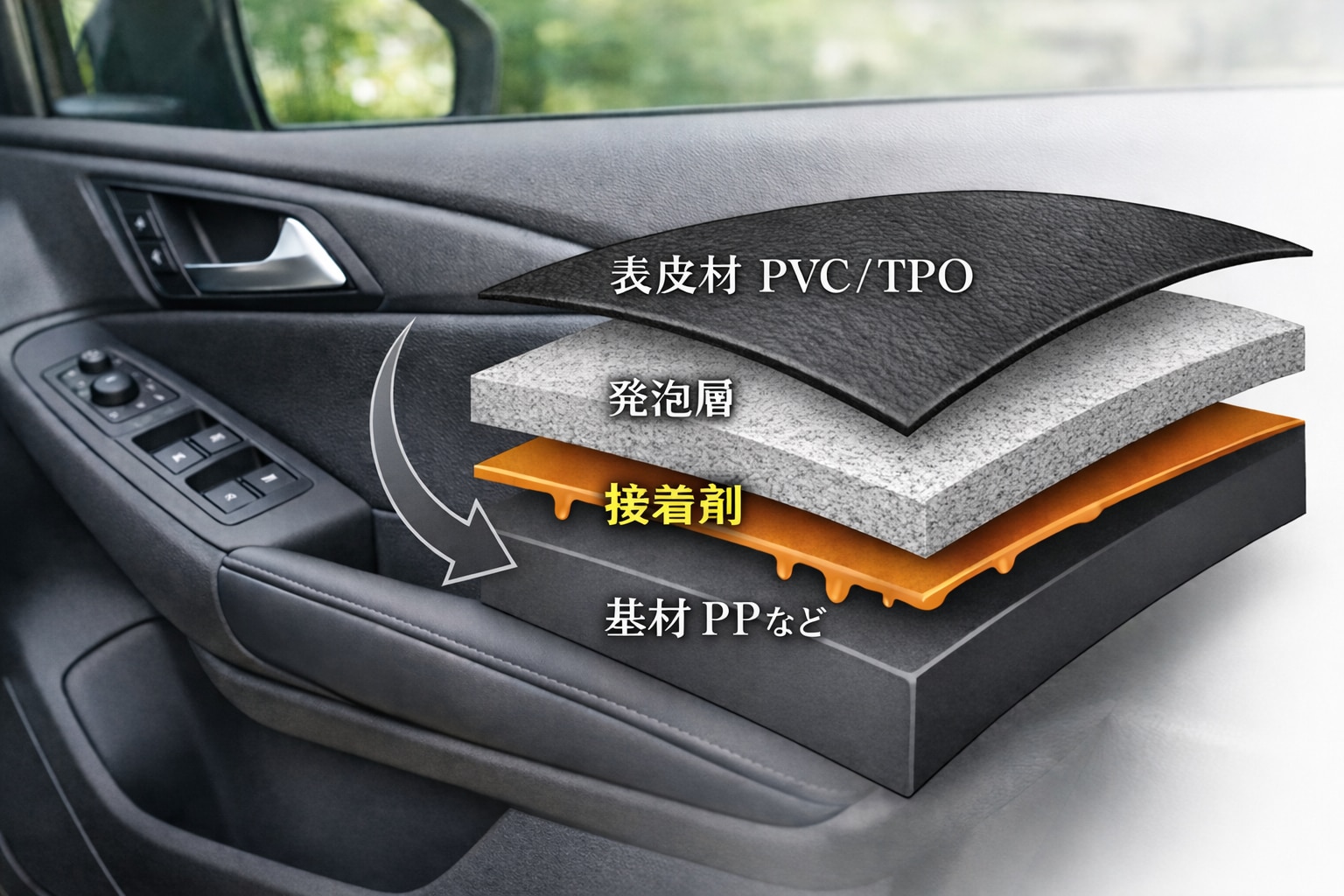
Conventional interior upholstery typically consists of the following components:
• Skin material (PVC, TPO, etc.)
• Foam layer
• Base material (PP etc.)
• Bonding with adhesive
This multilayer structure has made material separation difficult.
Vacuum forming and adhesives
Vacuum forming is a manufacturing method in which a pre-formed sheet-like surface is placed over a base material during the molding process.
Adhesives are essential in this process for the following reasons:
• In vacuum forming, the skin and base material are formed in separate processes and at different times.
• The vacuum pressure used during molding cannot ensure permanent joint strength.
• Chemical adhesive strength is required to withstand the operating environment (temperature changes, vibration, aging).
Therefore, an adhesive such as urethane or hot melt adhesive is interposed between the surface and the base material.
For the first time, it ensures the durability and reliability required for a product.
On the other hand, this structure,
• Combination of dissimilar materials: surface material + base material + adhesive
• Difficulty in separating materials during recycling
These are some of the challenges that arise.
Injection-molded skin and inset (no adhesive used)
A major difference between injection molding and vacuum forming is that injection molding allows the skin itself to be directly molded as a three-dimensional shape.
This construction method allows for structural design without the use of adhesives.
The main reasons why adhesive is not needed are as follows:
• Injection molding allows for the integrated design of the surface shape, thickness, ribs, and claw structure.
• The interlocking (mechanical fixing) structure with the base material can be incorporated during the molding process.
• By selecting materials with high compatibility with the PP substrate, good compatibility between materials is achieved.
This eliminates the need to rely on adhesives.
• Sufficient fixation strength
• Durability to withstand long-term use
This can be secured.
As a result,
• Improved ease of dismantling and recyclability through the use of adhesive-free materials.
• Cost reduction through process reduction
• Reduce environmental impact
These are some of the benefits that arise.
Comparison items | vacuum forming | Injection molding |
Use of adhesive | In some cases, the use of adhesive may be required. | One-piece molding without the use of adhesives is possible. |
Method of fixing components | Fixation by adhesive | Mechanical fixing is possible through insert molding, etc. |
Product material composition | It tends to be composed of multiple components. | Product design using a single material is possible. |
Recyclability | Composite materials tend to decrease in quality. | It is easier to improve by using a single material. |
Materials suitable for injection-molded skins
Required material properties
• High design quality (texture transferability, uniform appearance)
• Genuine leather-like texture
• Abrasion resistance
• Scratch resistance
• Chemical resistance and oil resistance
• Injection moldability
• Compatibility with PP substrates and recyclability
Only a limited number of materials satisfy all these requirements simultaneously, making material selection a crucial point.
Deployment of the Tefabloc™ QE Series
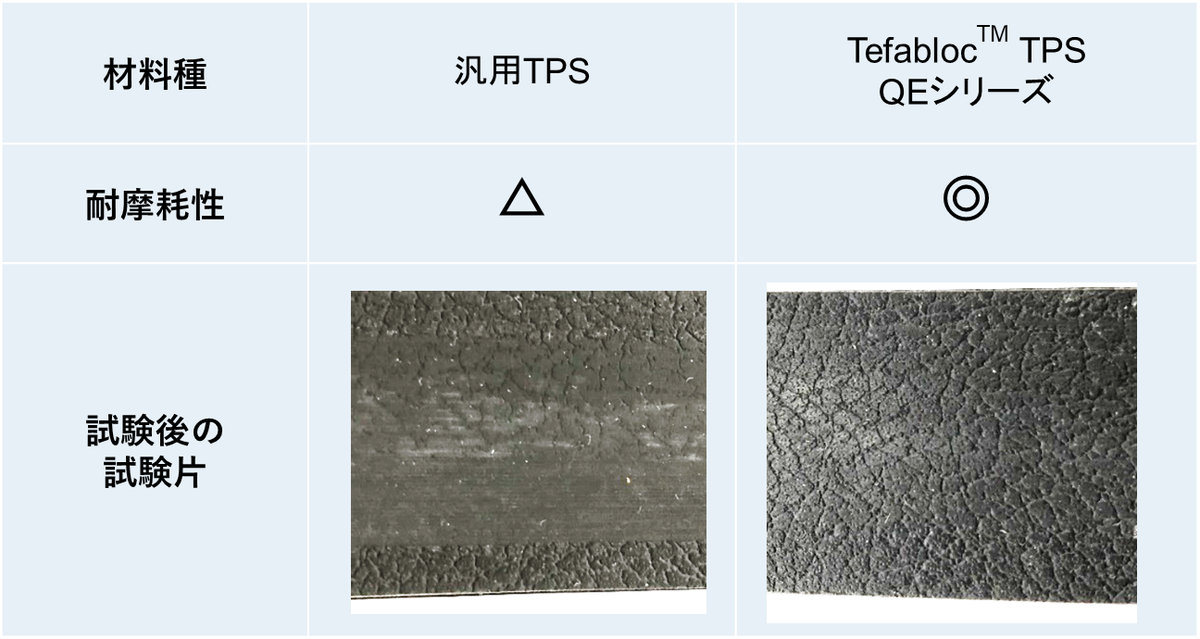
The Tefabloc™ QE series is a thermoplastic elastomer material specifically designed for injection-molded interior upholstery, meeting the above-mentioned characteristics. In addition to enabling easy disassembly without adhesives, its unique compounding technology provides sufficient abrasion and chemical resistance even without a topcoat, thus reducing the need for coating processes.
While the applications of the Tefabloc™ QE series are expanding, we are striving to broaden our product lineup to meet new needs. Through the proposal and development of optimal materials for injection molding, we contribute to promoting the recycling of plastics in automobiles.