Long-term reliability achieved with the Tefabloc™ QE series.
Elastomers offer excellent tactile properties and processability, making them suitable for a wide range of products. However, long-term use requires durability against abrasion, scratches, and adhesive substances. This article explains the Tefabloc™ QE series, which achieves high durability that maintains both tactile feel and appearance over extended periods.
Table of Contents [hide]
- 1.Durability required for elastomers
- 2.Durability of the Tefabloc™ TPS QE series
- 2.1.Abrasion resistance
- 2.2.Scratch resistance
- 2.3.Penetration and alteration due to adhering substances
- 3.About the Tefabloc™ TPS QE Series
- 3.1.Proof of high durability = Track record in the automotive industry
- 3.2.Applicationexamples
- 3.3.Grade Lineup
Durability required for elastomers
Thermoplastic elastomers are innovative materials that combine the elasticity of rubber with the processability of plastic. They offer excellent moldability and recyclability, and are used in a wide range of fields, including pharmaceutical packaging, automotive parts, electronic devices, and consumer goods.
One area where elastomer materials play a vital role is in applications that come into direct contact with human hands or as surface materials constantly exposed to the environment. In applications such as automotive interior parts, tool handles, smartphone cases, and sports equipment grips, simply being "soft" or "easy to grip" is insufficient. Durability that maintains quality over the long term is required because these components are constantly exposed to "contact and change" from the environment.
Every day, our hands make contact with surfaces hundreds or even thousands of times. This isn't just due to physical force; it's also influenced by various substances like salt in sweat, sebum, antiperspirants, sunscreen, and hand cream. Furthermore, friction from clothing gradually damages the surface, causing roughness and loss of shine, resulting in a "worn-out" or "deteriorated" appearance.
Even if there are no problems with the contents of the product itself, damage to the product's appearance can negatively impact the consumer's experience and ultimately damage the product's and, by extension, the manufacturer's brand image.
In order for products to be used for extended periods, the elastomer material used as the surface material must have "abrasion resistance" to withstand daily contact, "scratch resistance" to protect the surface from scratches, and "durability" against "time," "heat," "light," and "chemicals."
How to meet these complex durability requirements is the cutting edge challenge in elastomer material selection. For many years, we have been continuously developing materials to meet these requirements, and as an evolution of conventional TPS, we have developed the Tefabloc™ TPS QE series, a grade with superior abrasion resistance compared to other conventional elastomers, and have been mainly targeting its use in automotive interiors.
Next, I would like to explain this further using specific data.
Durability of the Tefabloc™ TPS QE Series
Wear resistance
Microscopic friction is constantly occurring in areas that are repeatedly touched by human hands. For example, a car's grip is gripped tens of thousands of times a year, and a tool is squeezed hundreds of times every day. This cumulative friction gradually damages the material surface, eventually manifesting as roughness and loss of shine.
The table below shows the results of surface friction tests performed on elastomers commonly used as surface materials.
This study compares the abrasion resistance of general-purpose TPS and the Tefabloc™ TPS QE series. After the abrasion test, the Tefabloc™ TPS QE series showed superior abrasion resistance, with reduced surface damage in the test specimens.
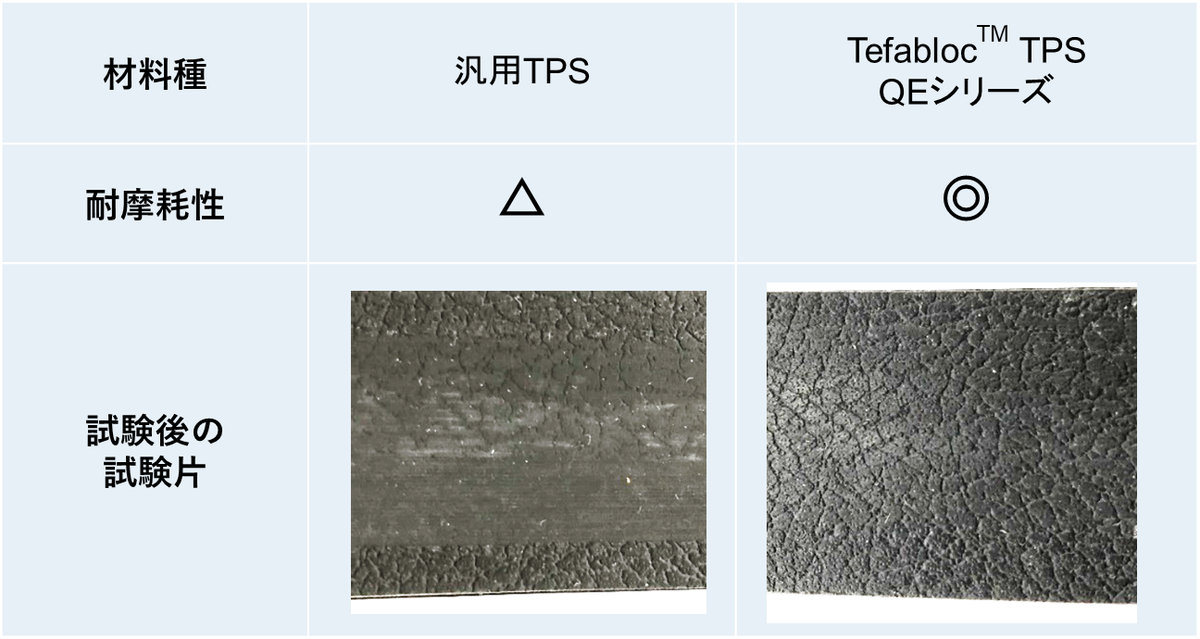
While general-purpose TPS shows clear wear, with the surface texture being worn away and becoming flat, the Tefabloc™ QE series exhibits minimal change in appearance. Furthermore, it showed less weight loss and less color transfer to the cotton cloth used in the friction test (detailed data can be downloaded from the "Technical Documents" section).
This test simulates the deterioration of a product's appearance and color transfer to other materials (clothing) due to friction with clothing, and evaluates the possibility of color transfer to clothing due to friction.
Scratch resistance
In everyday use, scratches are unavoidable not only from friction but also from contact with sharp objects. Repeated unintended contact with keys, fingernails, hard plastic parts, etc., causes scratches on the surface, and as these scratches accumulate, they are visually perceived as "aged" or "deteriorated quality." In particular, for automotive interiors and consumer products, this scratch resistance directly impacts product lifespan and brand image.
We applied a tungsten blade to the sample surface with a constant load and evaluated the appearance of the scratches that formed on the surface.
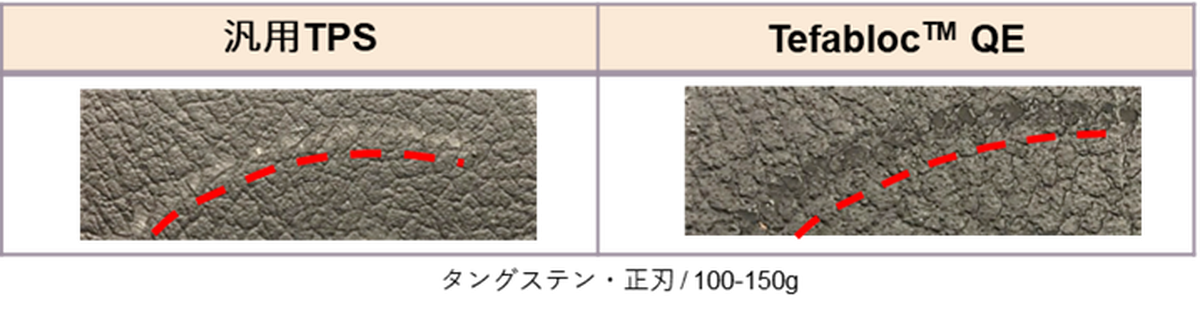
As you can see from the photos, general-purpose TPS surfaces are prone to noticeable damage and show whitish scratches, whereas the Tefabloc™ QE series scratches do not deepen and visual deterioration is minimized. This is the result of precisely designed balance between surface hardness and internal elasticity.
Penetration and alteration due to adhering substances
Touching a product means contact with various substances. The salt in sweat, the oil components in sunscreen, contact between products, and the migration of plasticizers and oils in resin products can cause the elastomer to deteriorate, swell, or change color. The QE series offers robust resistance to these challenges.
As an example of results demonstrating this, there was a case where a PVC smartphone case expanded due to contact with high temperatures, resulting in a cosmetic defect, and we conducted an experiment to reproduce this.
This is the result of evaluating the surface changes of the elastomer after contacting the elastomer and small pieces of polyvinyl chloride resin at 80°C for a certain period of time, using a laser microscope.
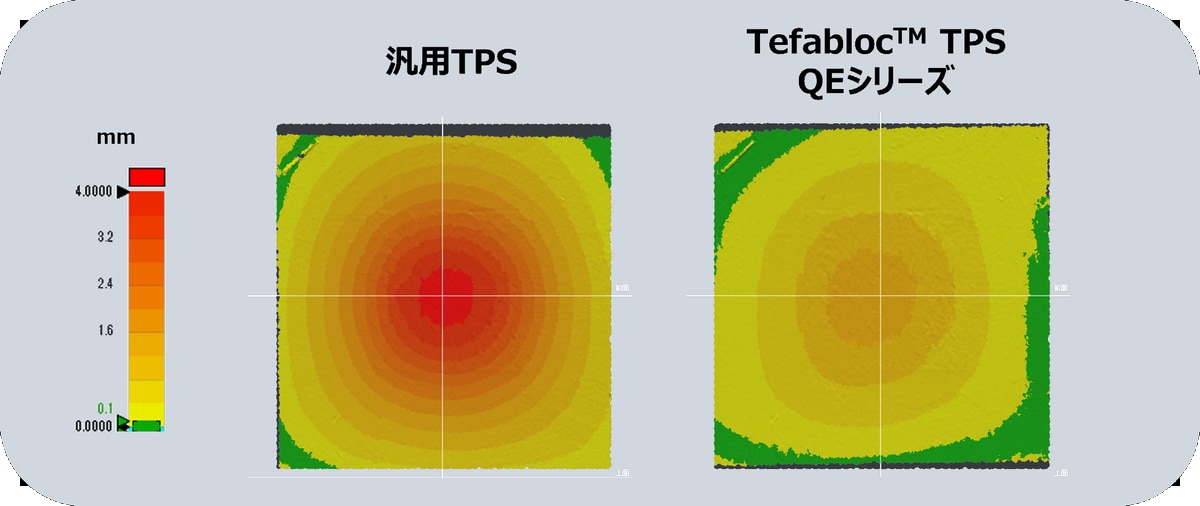
In the general-purpose TPS grade on the left, the center is shown in red. This indicates that the part in contact with the polyvinyl chloride resin is swollen and raised (higher) than the outer edge.
On the other hand, it can be seen that the QE series on the right shows almost no volume expansion.
The reason for the market complaint is that soft polyvinyl chloride resins typically contain a large amount of plasticizer. In high-temperature environments, this plasticizer can leach out and migrate to the elastomer. The QE series has resistance to such adhesions from contacting materials.
For detailed test conditions and results, please refer to the technical document below.
About the Tefabloc™ TPS QE Series
Proof of high durability = proven track record in the automotive industry
The requirements for automotive interior components are among the most stringent in the industry. With a service life of over 10 years from initial registration, exceeding 100,000 km of driving distance, temperature fluctuations ranging from 80-110°C in summer to -35°C in winter, contact with a wide variety of chemicals including sweat, sunscreen, antiperspirants, hand gels, and beverages, and a strict quality standard where a claim rate exceeding 1% results in the termination of the supply contract, the Tefabloc™ QE series has been adopted by domestic and international automotive manufacturers. Its long-term durability has been highly evaluated even in high-contact areas such as grips, consoles, doors, and dashboards. This track record is proof of its reliability. We encourage you to consider incorporating the QE series, which has cleared the stringent quality standards of the automotive industry, into your products.
Application example
The QE series allows for two-color molding with olefin resins such as PP.
- Grips and handles for everyday items and electrical appliances where flexibility and tactile feel are important.
Buttons, displays, and other parts that require a good feel and durability.
・Design components and decorative products where tactile sensation and aesthetic appeal are required.
Grade lineup
Tefabloc™ QE offers a wide range of tactile variations, from "moist" to "smooth," across a hardness range of approximately A40 to A90. It's not simply "durable," but also offers the potential to freely realize the "texture image" desired by designers. Furthermore, we have developed it to meet various customer needs, such as increased fluidity and improved heat resistance. For detailed technical information and grade selection, please refer to the technical document below.