
What Are Thermoplastic Elastomers (TPEs)? A Comprehensive Guide.
Thermoplastic elastomers (TPEs) are innovative materials that combine the elasticity of rubber with the processability of plastic. They offer excellent moldability and recyclability, and are used in a wide range of fields, including pharmaceutical packaging, automotive parts, electronic devices, and consumer goods. This article also introduces Mitsubishi Chemical's diverse lineup of TPEs.
Table of Contents [hide]
- 1.What is thermoplasticity? How does it differ from thermosetting thermoplasticity?
- 2.What is an elastomer?
- 3.Types of TPE and how to choose the right one
- 4.Mitsubishi Chemical's TPE lineup
- 4.1.Non-crosslinked olefin elastomers (TPO)
- 4.2.Dynamically Crosslinked Olefin Elastomers (TPV)
- 4.3.Styrene elastomer (TPS)
- 4.4.Polyester elastomer (TPC)
- 4.5.Urethane elastomer (TPU)
- 5.熱可塑性エラストマーの特徴一覧
- 6.TPEの射出成形で注意したい不具合
- 7.お困りごとがあれば
What is thermoplasticity? How does it differ from thermosetting?
Thermosetting resins, once hardened (crosslinked), cannot be melted or softened again even when heated, making recycling difficult. On the other hand, thermoplastic resins do not change their chemical structure even when repeatedly heated and cooled, and can be processed repeatedly using methods such as injection molding and extrusion molding.
• Thermosetting resins: undergo a cross-linking reaction at high temperatures and harden permanently.
• Thermoplastic resin: Plasticizes when heated, solidifies after molding, and can be remolded.
What is elastomer?
Elastomers are a combination of "Elastic" and "Polymer," possessing the property of restoring to their original shape even when subjected to external force. Thermoplastic elastomers (TPEs) have a structure in which hard and soft segments are block copolymerized or phase-separated, making them a material that combines the elasticity of rubber with the processability of plastic. Due to the following advantages, they are widely used in a variety of applications such as O-rings, seals, grip components, and cable coatings, as a substitute for vulcanized rubber and silicone rubber.
• Rubber-like flexibility and elasticity
• Easy mass production using plastic molding machines
• Process reduction and lower costs due to the elimination of the vulcanization (crosslinking) process.
• Easy to recycle and reprocess
Types of TPE and how to choose the right one.
They are broadly classified into six main categories based on the chemical structure of their hard and soft segments.
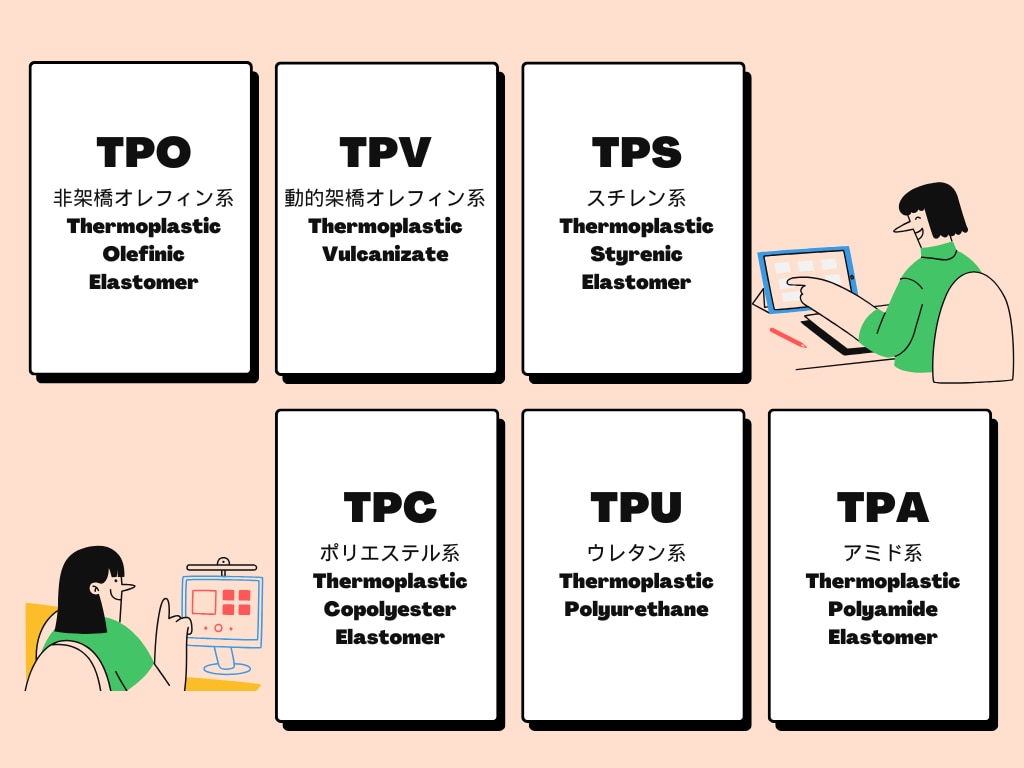
With so many options, it's difficult to choose the right TPE.
Mitsubishi Chemical offers a lineup of almost all TPEs except TPA, allowing us to propose the most suitable material for your application and operating environment. If you are looking for TPE materials, please contact us first.
Mitsubishi Chemical's TPE lineup
Mitsubishi Chemical offers a wide range of TPE products that can be selected according to the performance and processing conditions required by our customers.
Non-crosslinked olefin elastomer (TPO)
Because it is polyolefin-based, it has excellent chemical and weather resistance and is used as a sealant for automotive interior and exterior parts and building materials. Since it is non-crosslinked, it also has excellent hygiene and is suitable for medical films and containers.
Excellent chemical resistance and weather resistance
Lightweight and excellent impact resistance
Medical-grade compatible (Zalas™TPO)
Dynamically crosslinked olefin elastomers (TPV)
This material features a cross-linked structure of olefin-based rubber within an olefin-based resin matrix, enabling thermoplastic processing while maintaining its cross-linked structure. It possesses high heat and oil resistance and exhibits excellent compression set. It is ideal for automotive applications (moldings, interior upholstery, engine compartment components) and industrial material applications, particularly tool grips.
Low compression set due to dynamic bridging
Excellent heat resistance and oil resistance
Styrene elastomer (TPS)
Made from styrene-based rubber (SBC), it features high hygiene and a smooth surface. With a wide hardness range, it is suitable for household goods where a soft touch is required, as well as automotive interiors (moldings/injection molding/grips), and medical gaskets and rubber stoppers.
flexibility
Low Compression Set
Medical-grade compatible (Zelas™TPS)
Polyester elastomer (TPC)
This polyester-based TPE (Tyretic Polyethylene) consists of a hard segment made of polyester (PBT) and a soft segment made of polyether, and is characterized by its high heat resistance, oil resistance, and abrasion resistance. It is also excellent for two-color molding when combined with engineering plastics (such as ABS/PC/PMMA).
heat resistance
Oil resistance
Wear resistance
Design Flexibility Through Two-Color Molding
Urethane elastomer (TPU)
This structure features polyurethane bonds obtained by chemically reacting polyols and isocyanates in the hard segment, and polyethers or polyester polyols in the soft segment, resulting in biocompatibility and mechanical strength.
- Excellent mechanical strength and wear resistance
- Excellent biocompatibility and antibacterial properties
Mitsubishi Chemical has strengthened its portfolio of medical-grade TPUs by acquiring the TPU business of AdvanSource Biomaterials, a US company. This has enabled them to secure product certifications and sales channels for high-value medical device markets such as cardiac catheters, accelerating their global expansion. Please note that these products are for medical applications only and cannot be offered for industrial use.
List of characteristics of thermoplastic elastomers
Thermoplastic elastomers (TPEs) exhibit significant differences in moldability, mechanical properties, environmental resistance, and bonding properties with other materials, depending on the chemical structure and constraint configuration of the material.
The table below compares the material structure and general relative properties of representative TPE material groups: olefin-based TPV, styrene-based TPS, polyester-based TPC, and urethane-based TPU. Each evaluation indicates the trend for the material group as a whole, and actual performance will vary depending on the grade, hardness, composition/additives, molding conditions, and usage environment.
item | Olefin-based | Styrene-based | Polyester | Urethane-based |
Material types | TPV | TPS | TPC | TPU |
Product name | Trexprene™ | Tefabloc™ | Tefabloc™ | Chrono Students™ ChronoThane™ Limited to medical use |
Restraint form | Crystal phase/crosslinking point | Crystal phase/frozen phase | crystalline phase | Crystalline phase and hydrogen bonding |
hard segment | PP | PP | PBT | Urethane bonding |
Soft segment | Ethylene-propylene rubber | Hydrogenated Block Copolymer | polyether | polyether polyester |
Extrusion moldability | ◎ Very high | ◎ Very high | △ Limited | △ Limited |
Injection moldability | ◎ Very high | ◎ Very high | ◎ Very high | △ Limited |
mechanical strength | △ Limited | △~○ Higher depending on the conditions | ◎ Very high | ◎ Very high |
Low-temperature characteristics | ◎ Very high | ◎ Very high | ◎ Very high | ○ High |
Resistance to compression set | ◎ Very high | ○ High | △ Limited | ○ High |
Heat resistance | ◎ Very high | ○ High | ◎ Very high | ○ High |
Heat aging resistance | ◎ Very high | ◎ Very high | ○ High | △ Limited |
Weather resistance | ◎ Very high | ◎ Very high | △ Limited | × Low / Not recommended for general use |
water resistance | ◎ Very high | ◎ Very high | × Low / Not recommended for general use | × Low / Not recommended for general use |
Oil resistance | ○ High | △ Limited | ◎ Very high | ◎ Very high |
Thermal fusion properties to polar resins | ×~△ Limited~Low | △~○ Higher depending on the conditions | ◎ Very high | ◎ Very high |
Flame retardant | × Low / Not recommended for general use | × Low / Not recommended for general use | ○ High | ○ High |
Glossiness (sheen) | × Low / Not recommended for general use | × Low / Not recommended for general use | ○ High | ○ High |
Wear resistance | △ Limited | ○ High | ◎ Very high | ◎ Very high |
Lightweight | ◎ Very high | ◎ Very high | △ Limited | △ Limited |
As can be seen from the table, each material group has its own distinct strengths and points to note.
Olefin-based TPVs offer excellent lightness, water resistance, weather resistance, and heat resistance. However, applications requiring thermal bonding with polar resins or high mechanical strength necessitate additional consideration of bonding design and material selection.
Styrene-based TPS (Total Polystyrene) exhibits excellent extrusion and injection moldability, as well as good low-temperature properties and weather resistance, making it suitable for flexible components and applications where processability is relatively important. However, oil resistance and heat resistance vary depending on the grade, so it is important to check these properties according to actual usage conditions.
Polyester-based TPCs are suitable for applications where mechanical strength, abrasion resistance, heat resistance, oil resistance, and heat fusion to polar resins are important. On the other hand, long-term stability against water and hydrolysis requires evaluation taking into account the operating temperature, humidity, contact fluid, and sterilization method.
Urethane-based TPUs offer high mechanical strength, abrasion resistance, oil resistance, and bonding properties with polar resins, making them a suitable choice for tubes, catheters, and moving parts where flexibility and abrasion resistance are required. However, water resistance, weather resistance, and long-term hydrolysis stability vary significantly depending on the molecular design, including whether it is polyether-based or polyester-based.
TPEの射出成形で注意したい不具合
TPEは、ゴムのような柔軟性とプラスチックの成形加工性を兼ね備えています。一方で、実際の射出成形では、材料の流動特性や固化挙動、製品形状、金型構造などによって、外観や取り出し性に関する不具合が生じる場合があります。材料の特徴を活かすには、用途に適したグレード選定に加え、成形条件や金型設計も確認することが大切です。
TPEの射出成形では、次のような不具合に注意が必要です。
Defect | どのような現象? | 確認したいポイント |
|---|---|---|
Flow marks | 成形品の表面に、縞状やレコード盤状の流れ跡が現れる。 | 材料の流動性、樹脂温度、射出速度、金型温度など。 |
離型不良 | 成形品が金型に貼り付く、取り出しにくい、突き出し時に変形する。 | 冷却時間、樹脂温度・金型温度、金型表面、抜き勾配など。 |
Weldline | 分岐した樹脂の流れが合流する部分に線状の跡が現れ、強度に影響する場合もある。 | 合流部の温度、ガスの排出、射出速度、ゲート設計など。 |
Flush | 金型の合わせ面などから樹脂が漏れ、薄い膜状の余剰部分ができる。 | 射出圧力・保圧、材料の流動性、型締め力、金型の隙間など。 |
Silver Streaks | 成形品の表面に銀白色の筋状模様が現れる。 | 材料の吸湿・結露、揮発成分、樹脂の過熱や滞留など。 |
改善には材料・成形条件・金型の確認を
成形不具合は、一つの原因だけで発生するとは限りません。例えば、フローマークは材料の流動性不足だけでなく、流動先端の不安定化によって生じることもあり、原因によって適切な調整方法が異なります。また、流動性を高める方向の調整が、バリの発生につながる場合もあるため、複数の不具合のバランスを見ながら検討することが重要です
まずは、不具合の見た目や発生位置を確認し、材料・成形条件・金型の各面から原因を整理しましょう。乾燥の必要性や推奨成形条件はTPEの種類・グレードによって異なるため、使用する材料の推奨条件を確認してください。
不具合の原因と対策を詳しく知る
「表面の流れ跡を改善したい」「金型から取り出しにくい」「バリや銀白色の筋が発生する」といった課題については、関連記事で詳しく解説しています。
フローマーク・離型不良・ウェルドライン・バリ・シルバーの5つの不具合について、発生要因と、成形条件・金型・材料選定からの改善ポイントをご紹介しています。試作時の課題整理や、成形条件を見直す際にお役立てください。
If you have any problems
Please feel free to contact Mitsubishi Chemical. We will leverage our extensive knowledge and experience to provide you with the best possible proposals and support.