Enabled Compatibilization and Fine Dispersion: NEXT-Generation Recycling! Modic™.
While the use of recycled materials is progressing, performance degradation due to incompatibility between resins remains an unavoidable challenge. This is where dispersion and homogenization technology, which effectively "blends" different resins together, becomes crucial. Modic™ plays this role, providing an effective solution for maintaining and improving performance even with recycled materials. This article clearly explains the challenges of recycled materials and how Modic™ can contribute to addressing them.
Table of Contents [hide]
Expectations and challenges of recycled materials
In order to realize a circular economy, interest in material recycling and recycled resin blends is rapidly increasing in the automotive, home appliance, and food packaging industries. This is an important initiative aimed at shifting from the conventional disposable production and consumption system to a sustainable resource circulation system.
The biggest challenge in resin mixing recycling is the incompatibility between different types of resins. For example, when polyolefins (PP, PE, etc.) are mixed with resin materials of different polarities, such as polyamides (PA) or barrier resins (EVOH), they do not mix well due to weak molecular-level interactions. This incompatibility leads to a significant decline in product quality, including reduced mechanical strength, poor appearance, and deterioration of thermal stability of recycled resins.
Modic™'s superior distribution capabilities
Modic™ is a functional resin in which polar groups are introduced into non-polar polyolefins (PE, PP, etc.) or polyester copolymers through a graft reaction. Due to its unique molecular structure, it is possible to bond materials that would normally not adhere due to their differing chemical compositions, such as "non-polar/polar resins" or "resin/metal," by using Modic™ as an intermediary. Taking advantage of the property of having opposing chemical properties within Modic™'s polymer structure, Modic™ is used as a dispersant in resin mixing and recycling.
Adding Modic™ to mixed recycled materials at a few percent yields the following benefits:
-Reduction of interfacial tension: Significantly reduces interfacial energy between dispersed resins.
-Miniaturization and homogenization of domain size: Controlling the phase separation structure to achieve a more homogeneous mixed state.
• Compatibility enhancement: Strengthening interactions at the molecular level.
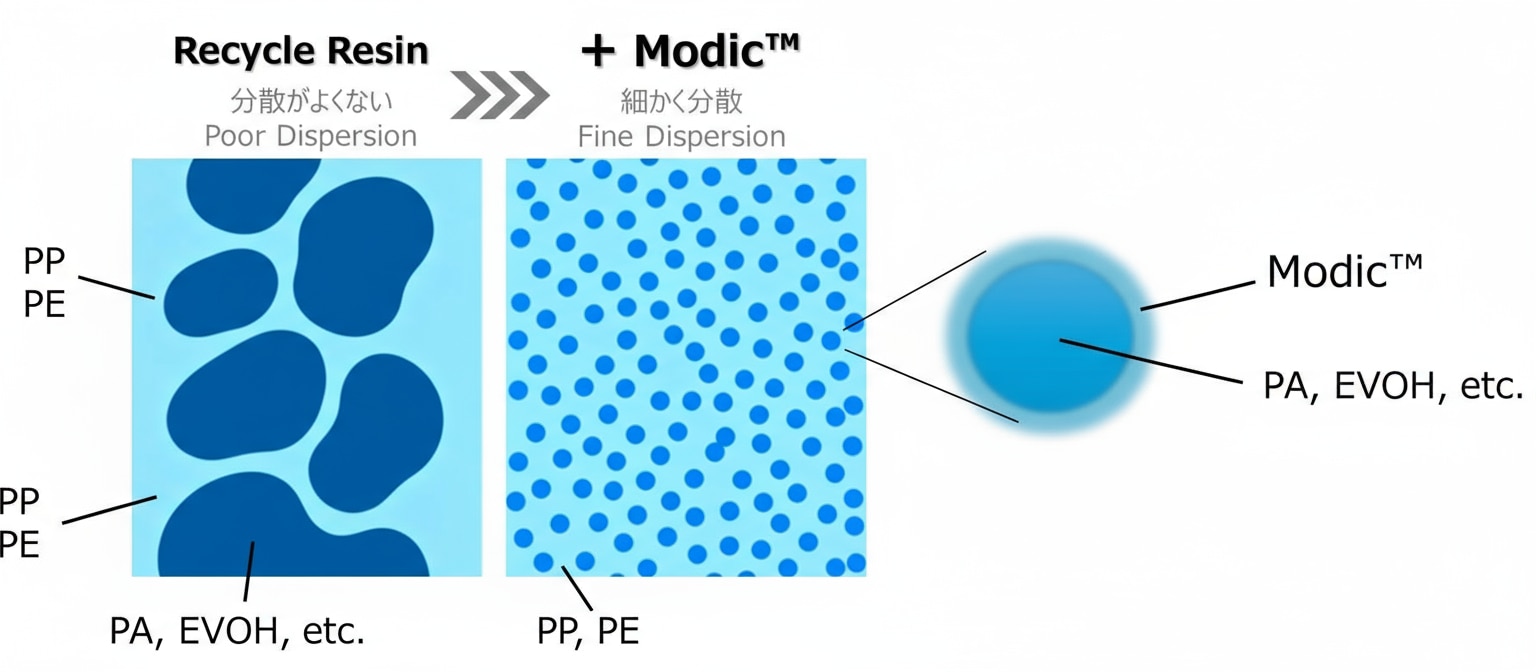
These effects result in a stable dispersion when Modic™ is placed at the interface of resin materials with different polarities, as shown in the image below.
Let's look at the results of observing the morphology of a film obtained by extruding a model composition of PA and PP, with a few percent of Modic™ added, using an electron microscope.
Comparing the photos below, you can see that in the two-component PP/PA resin system, PA is sparsely distributed in streaks within the PP matrix, whereas in the three-component PP/PA/Modic™ system, PA particles are finely and uniformly dispersed within the PP matrix.
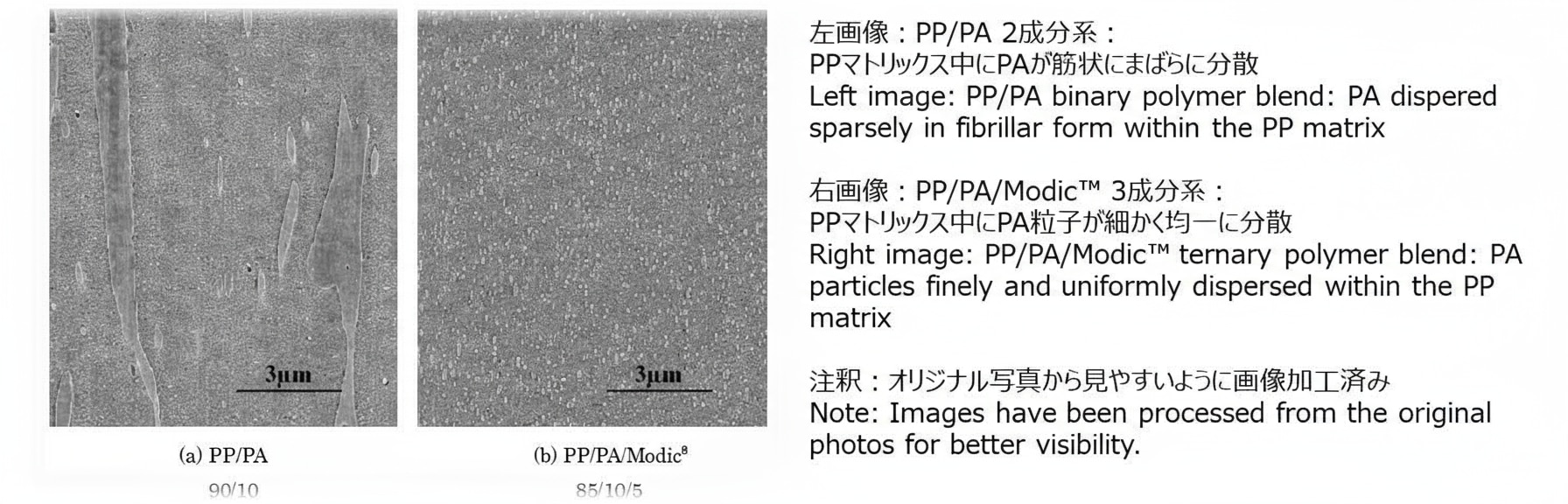
• Left: Two-component system (PP/PA): PA is sparsely dispersed in a streaky pattern within the PP matrix.
• Right: Three-component system (PP/PA/Modic™): PA particles are finely and uniformly dispersed in a PP matrix.
When large, striated domains like those shown on the left are present, the physical properties of the molded product are generally significantly impaired. However, by adding Modic™, a fine and uniform dispersion structure is obtained as the amount of Modic™ increases, resulting in a substantial improvement in tensile strength and impact strength. This allows recycled materials to approach the impact resistance and tensile strength of virgin materials.
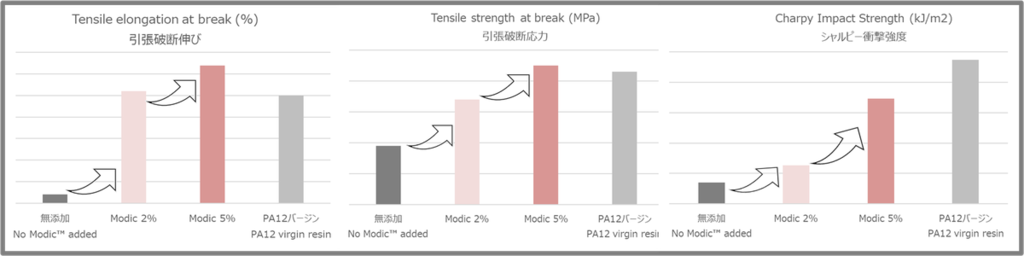
I hope you now understand how Modic™ is effective in improving the physical properties of recycled resin-blended materials.
More detailed formulation conditions and evaluation data can be downloaded from the link below.
Application Examples
Multilayered products made from different materials are used in a variety of applications.
Modic™ is expected to act as a dispersant when recycling these products.
• Films for fresh food (PE/PA, PE/EVOH)
• Cosmetic tubes (LDPE/EVOH)
• Chemical barrier bottles (HDPE/EVOH)
• Rice barrier containers, jelly cups (PP/EVOH)
Automotive coolant hose (PP/PA12)
A diverse lineup
Depending on the type of recycled resin and molding method you wish to use, it is necessary to select the optimal base resin and grade. For more details, please contact us using the information below.