

What are adhesive resins? An explanation of Mitsubishi Chemical's adhesive resins.
Traditionally, bonding polyolefin resins such as polyethylene (PE) and polypropylene (PP) to polar resins, metals, and glass has been difficult. However, adhesive resins that impart adhesive properties to the polyolefin material itself can integrate molding and bonding. Because strong bonding between dissimilar materials can be achieved during the resin molding process, production efficiency and environmental impact can be reduced compared to coating-type adhesives.
This article provides a thorough explanation of Mitsubishi Chemical's "Modic™" and "Linklon™" adhesives, which are used in a wide range of fields including food packaging, automotive components, battery packaging, and cosmetic containers, from their bonding mechanisms to examples of their applications.
Table of Contents [hide]
- 1.Do you have any of these challenges or requests regarding bonding dissimilar materials?
- 2.What is adhesive resin?
- 3.Mitsubishi Chemical's lineup of adhesive resins
- 4.Adhesionmethod
- 5.How to use adhesive resins
- 5.1.For bonding with polar resins (Modic™)
- 5.2.As a metal bonding agent (Modic™)
- 5.3.As a glass adhesive (Linklon™)
- 6.If you are considering bonding dissimilar materials
Do you have any of these challenges or requests regarding bonding dissimilar materials?
Polyolefin resins (PE, PP, etc.) do not adhere well to polar resins (PA, EVOH, etc.), metals, and glass, which can lead to delamination during bonding and multilayer molding.
Using adhesives complicates the production process, increasing costs and environmental impact.
- The adhesive is hard and lacks flexibility to conform to the substrate.
Adhesive resins are
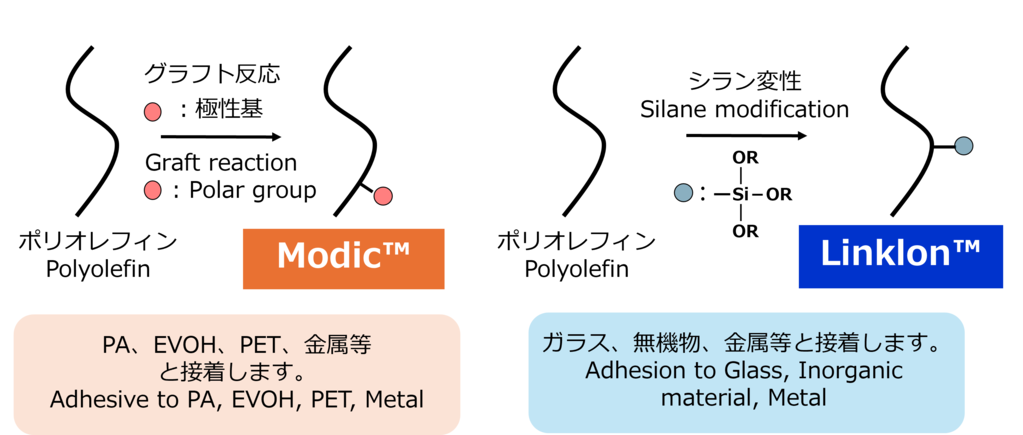
Mitsubishi Chemical's adhesive resins primarily involve grafting polar functional groups, such as acids or silane-modified groups, onto non-polar resins like polyolefins, thereby enabling chemical interactions with dissimilar materials.
• Maintains the mechanical properties and heat resistance of polyolefins.
• Strong adhesion to a wide variety of substrates, including polar resins, metals, and glass.
• Can be bonded by multi-layer co-extrusion, extrusion lamination, and heat pressurization, eliminating the need for adhesive coating.
Mitsubishi Chemical's lineup of adhesive resins
Modic™
Modic™ is a series of adhesive resins primarily based on PE and PP, incorporating polar functional groups. We offer a variety of materials to meet diverse needs, including grades that exhibit adhesion to polar resins such as PA and EVOH, as well as metals, through chemical interactions, and grades that exhibit adhesion to PS and PET, which lack (or have low amounts of) specific reactive groups, through viscous bonding. Furthermore, Modic™ TPC is a modified polyester elastomer that Mitsubishi Chemical has successfully industrialized for the first time in the world, utilizing its elastomer design and resin modification technologies. Because it is molecularly compatible with polyester resins, PC, and PS, it adheres more strongly than olefin-based materials and chemically bonds to polar resins. It also features high heat resistance.
Linklon™
Linklon™ is a series of adhesive resins that primarily utilize silane modification on PE and PP to impart functionalities such as adhesion and reactivity. It reacts with silanol groups on glass surfaces, achieving extremely high glass adhesion unattainable with other materials. It provides stable glass adhesion even in outdoor and humid environments.
Adhesion method
Modic™ bonding method
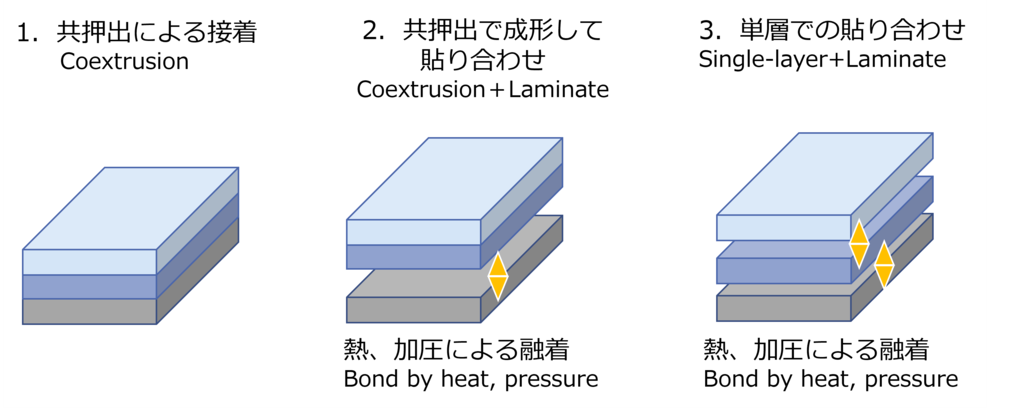
In addition to bonding by co-extrusion, bonding is also possible through heat and pressure.
The application of adhesive can be eliminated, and bonding can be achieved without the use of solvents.
*The layer structure and bonding method shown are just examples.
*Specific conditions may be required for adhesion.
Linklon™ bonding method
After being molded as a single layer, it is bonded to glass or other materials by heating and pressurizing.
Additionally, insert molding is possible, where glass is set into a mold and resin is integrated into it through injection molding.
The application of adhesive can be eliminated, and bonding can be achieved without the use of solvents.
*The layer structure and bonding method shown are just examples.
*Specific conditions may be required for adhesion.
How to use adhesive resins
For bonding with polar resins (Modic™)
It can be used in multilayer films and hose products where barrier properties and strength development are required. Adhesion is achieved by using Modic™ in the // portion as an adhesive layer.
• Films for fresh food (PE//PA, PE//EVOH, PBT//PE)
• Cosmetic tubes (LDPE/EVOH)
• Chemical barrier bottle (HDPE/EVOH)
• Rice barrier container, jelly cup (PP/EVOH)
• Water supply and hot water pipes, heating pipes (PE/EVOH, PB/EVOH)
Automotive coolant hose (PP/PA12)
As a metal bonding agent (Modic™)
It can be used for purposes such as improving adhesion around batteries and preventing rust around piping. Adhesion is achieved by using Modic™ in the // area as an adhesive layer.
• Tab lead film (metal tab // PP)
• Battery pouch (Al/PP)
• Hot water heating piping (Al/PE)
- Buried piping (iron/PE)
• Retort food pouches, cosmetic aluminum tubes (AL//PP, Al//PE)
*Special processing methods may be required.
*Preheating of metal may be required.
*Adhesion will vary depending on the type of metal and surface treatment. ○: AL, zinc plating, etc. △: SUS
As a glass adhesive (Linklon™)
It is possible to manufacture components that integrate glass and resin without applying adhesives or other coatings.
• Solar cell encapsulant (glass/Linklon™)
• Industrial products, etc., that combine glass and olefin-based resins (glass/Linklon™)
• A sheet made by combining glass and olefin resin (glass/Linklon™)
If you are considering bonding dissimilar materials
Adhesive resins not only enable the integral molding and bonding of dissimilar materials, which was previously difficult, but also contribute to simplifying the adhesive coating process. If you have any problems with bonding dissimilar materials, please contact us.