
Robot Hand Material Selection Guide
As the market for soft robot hands expands, the importance of material selection is increasing.
This article will explain the reasons behind the shift from conventional silicone rubber and urethane to thermoplastic elastomers, and their practical benefits.
What materials are used in robot hands?
In recent years, there has been a growing need for soft robot hands that use flexible materials to adapt to the diverse shapes of workpieces (objects to be grasped). Soft robot hands have primarily used silicone rubber (thermosetting) and thermosetting polyurethane.
These materials have been selected based on required properties such as high elasticity and wear resistance. While the common method involves pouring the material into a mold and heat-curing it, the mandatory curing process complicates the production cycle. Furthermore, reprocessing and recycling are difficult. Therefore, the potential application of thermoplastic elastomers is being explored in recent years.
The table below summarizes the characteristics of each material used in robot hands.
Each material has its own advantages and disadvantages, and there is no material that satisfies all needs. Therefore, the choice of material must be appropriately determined based on the intended use, the design of the hand itself, and the manufacturing process.
[Figure 1; Comparison of Features]
特性 | Thermoplastic elastomer (TPE) | シリコーンゴム (熱硬化型) | ポリウレタン (熱硬化型・UV硬化型) |
密度(軽量性の目安) | ◎ 非常に低い (約0.89 g/cm³) | ○ 低い (約0.95 g/cm³) | △ やや高い (約1.10 g/cm³) |
低硬度化の可能性 | ◎ A硬度10未満にも対応可能 | ○ A硬度40超が一般的 | ○ A硬度65超が一般的 |
主な加工方法 | Injection molding | 液状射出成形/注型成形 | 注型成形、3Dプリンティング |
Recyclability | ◎ リサイクル可能 | × 一般にリサイクル困難 | × 一般にリサイクル困難 |
異種材料との接着・接合 | ◎ 接着・接合が可能 | × 一般に困難 | × 一般に困難 |
触感 | ◎ 良好 | ○ 表面処理により改善可能 | ◎ 良好 |
Heat resistance | △ 使用温度の目安:120°C未満 | ◎ 使用温度の目安:150°C超 | ◎ 使用温度の目安:150°C未満 |
Chemical resistance | ○~◎ 良好~非常に良好 | ◎ 非常に良好 | ○ 良好 |
Weather resistance | △~○ 限定的~良好 | ◎ 非常に良好 | △ 限定的 |
(Note) This table is a relative comparison based on general material properties. Actual performance may vary depending on the usage environment, manufacturing conditions, and evaluation method.
Why thermoplastic elastomers now?
- Main building molding process
Thermoplastic elastomers are manufactured in a single process of "heating and melting → injection molding → cooling and solidification," eliminating the need for secondary curing. This significantly shortens the production cycle. - High productivity and cost efficiency
Achieves continuous molding and high yield with injection molding machines. Optimizes cycle time and total cost during mass production by extending mold life and reducing post-processing. - Characteristic control through a diverse lineup.
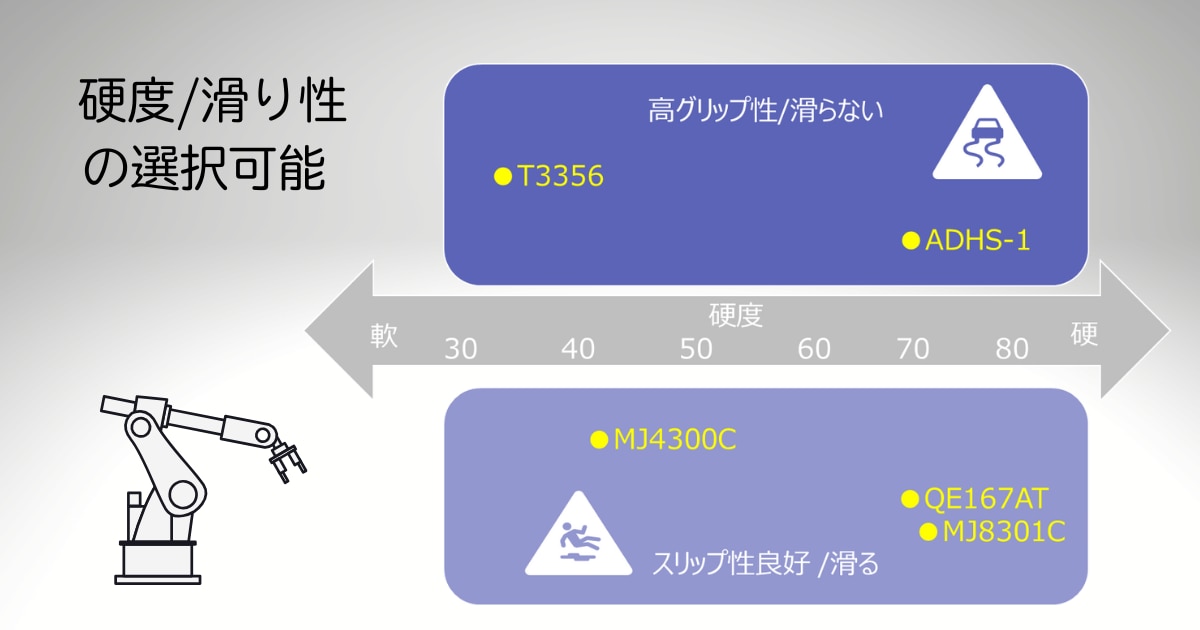
Tefabloc™ TPS offers a range of products including the SJ series (general industrial use), MJ series (food contact grade), and special series (high flexibility), allowing for flexible adjustment of hardness and friction characteristics within a range of A hardness from approximately 10 to 80 and static friction coefficient from 0.5 to 4.5. Materials can be customized to achieve optimal gripping performance for each application.
[Figure 2: Hardness - Coefficient of Friction]
Robot hand for food processing plants
The market for robotic hands used in food processing plants is expected to reach US$2.8 billion by 2025. This is because two challenges—labor shortages and stricter hygiene regulations—are accelerating automation investment across the food industry.
Soft robotic hands automate the picking and sorting of food ingredients, achieving both increased line utilization through high-speed processing and reduced contamination risk through decreased human contact. Furthermore, their ability to flexibly grasp products with varying shapes and hardnesses, such as fruits and baked goods, is leading to their increasing adoption in a wide range of manufacturing processes. To meet these needs, materials that allow for precise control of hardness and frictional properties while ensuring hygiene, durability against various foods, and resistance to disinfectants essential in food factories are indispensable.
1. Positive List System Compliance
Tefabloc™ TPS includes food-contact grades thatcomply with the revised Food Sanitation Act Positive List, which will come into effect on June 1, 2025, and can be used in applications that come into direct contact with food.
2. Excellent resistance to hypochlorite
Urethane resins are susceptible to hydrolysis, requiring careful selection that takes material degradation into consideration. However, Tefabloc™ TPS shows virtually no change in physical properties even after being immersed for 30 days in a 1% sodium hypochlorite solution, which is commonly used in food processing plants. This significantly reduces the frequency of replacement in food processing facilities that require strict disinfection cycles.
For information on the various physical property changes in sodium hypochlorite aqueous solution, please refer to the document below.
Features of Tefabloc™
- Adhesion to different materials
Certain grades of Tefabloc™ can bond strongly to other plastics and metals without the need for adhesives. Tefabloc™'s unique material composition formulations enable the creation of complex shapes and integrated robotic hands through two-color molding of base resins (PC, PBT, ABS, etc.) and multi-material insert molding.
2. Excellent oil and chemical resistance
Tefabloc™ can also be developed in grades that are resistant to various industrial oils and greases. It suppresses deterioration of gripping performance even in environments exposed to food oils and machine lubricants.
3. Development of custom materials tailored to customer needs and applications.
Leveraging Mitsubishi Chemical's compounding technology, we can design formulations tailored to individual requirements, including hardness, friction, chemical resistance, sliding properties, and hygiene and low gas generation, which are essential for pharmaceuticals and semiconductors.
If you have any questions, require technical consultation, or would like to request a sample evaluation, please feel free to contact us using the inquiry form below. We will propose the most suitable material solution for your application.