
Biomass plastics evolve with Modic™
Biomass composites are attracting attention as environmentally friendly materials, but uniformly dispersing resins and naturally derived fillers remains a major challenge. This is where Modic™, a compatibilization technology, plays a crucial role. This article explains the difficulties of biomass filler dispersion and the potential of Modic™ to help solve them.
Table of Contents [hide]
- 1.Current status and challenges of the biomass plastics market
- 2.Improve performance with dispersion stabilization!
- 2.1.Case Study #1: Improvement in PE/Wood Powder Composite
- 2.2.Case Study #2: Examples with Various Biomass Fillers
- 3.What to do if you have problems with composite materials of fillers and resins
Current status and challenges of the biomass plastics market
The social demand for reducing environmental impact is increasing. In an era where sustainability management is crucial to corporate value, the use of biomass raw materials has become not merely a trend, but a core element of business strategy. In particular, biomass composites, which are made by mixing natural waste materials such as wood flour, cellulose, seashells, and eggshells with plastic, are being increasingly used in many industries, including automotive parts, home appliance casings, building materials, and daily necessities, as a key to reducing fossil fuel use and realizing a circular economy (CE). However, biomass composites also face significant challenges.
This is due to uneven dispersion, which is a common problem with composite materials.
Why does "poor variance" occur?
Many resins are hydrophobic (they repel water), meaning they don't mix well with water. On the other hand, biomass fillers are hydrophilic (they mix well with water), which is the opposite property.
Therefore, simply mixing them together results in the resins and biomass fillers attracting similar materials, making it difficult to uniformly disperse the biomass fillers within the resin. This tendency increases as the amount of filler added increases, causing the fillers to aggregate more easily. In an attempt to achieve a high biomass ratio, the strength and impact strength will decrease significantly.
"We want to incorporate biomass materials into our products, but we are hesitant to commercialize them due to remaining performance challenges."
This dilemma is the biggest obstacle to adopting biomass composite materials.
One way to fundamentally solve these problems is through the superior dispersion and compatibility of Mitsubishi Chemical's Modic™ as a dispersant.
Improve performance with dispersion stabilization!
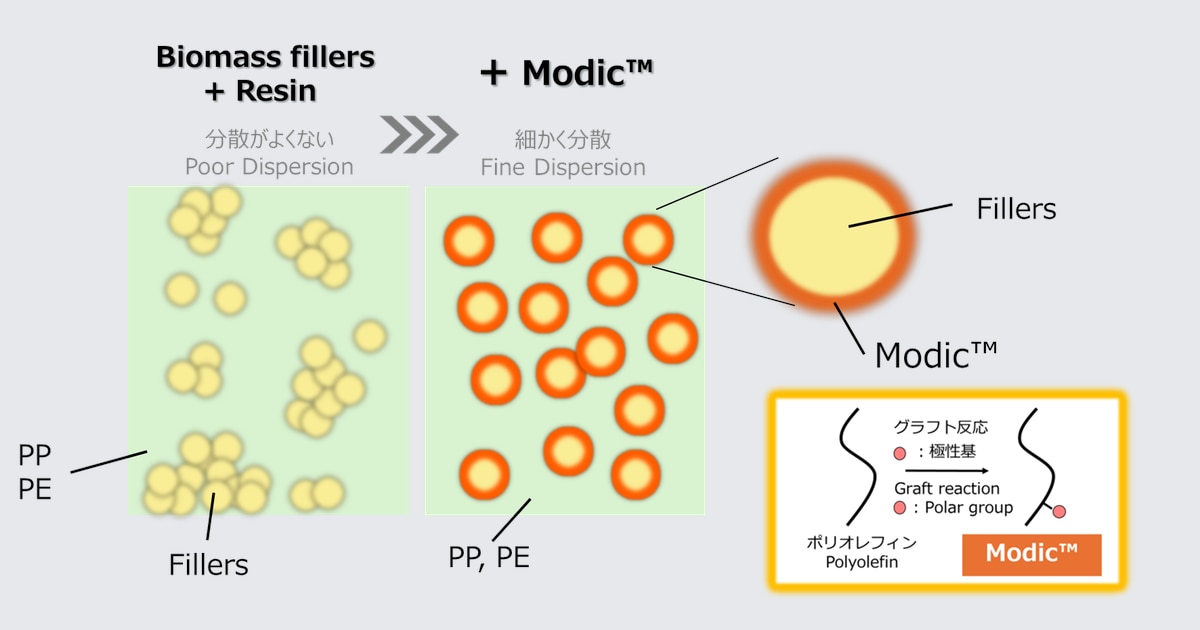
Modic™ acts as an "intermediary" between resins and biomass fillers.
Modic™ contains both a part that has affinity for the resin (polyolefin) and a polar part that has affinity for the biomass filler within a single molecular structure. This polar group forms chemical interactions with the hydroxyl and carbonyl groups of the biomass components. This effect allows the filler to be stably dispersed within the resin.
Furthermore, because Modic™ possesses both properties, it improves the adhesion between the filler and the resin (acting as an intermediary), thus leading to improved material strength.
Case Study #1: Improvement in PE/Wood Powder Composite
Let's take a look at the actual modification effects when Modic™ is incorporated.
The table below shows the results of testing Modic™ at 0 wt% and 2 wt% concentrations against a base resin of 30% PE (polyethylene) and 70 wt% wood flour.
Adding just 2% Modic™ improved flexural modulus, flexural strength, and impact strength, as shown in the table below. Water absorption also decreased from approximately 18% to 7%.
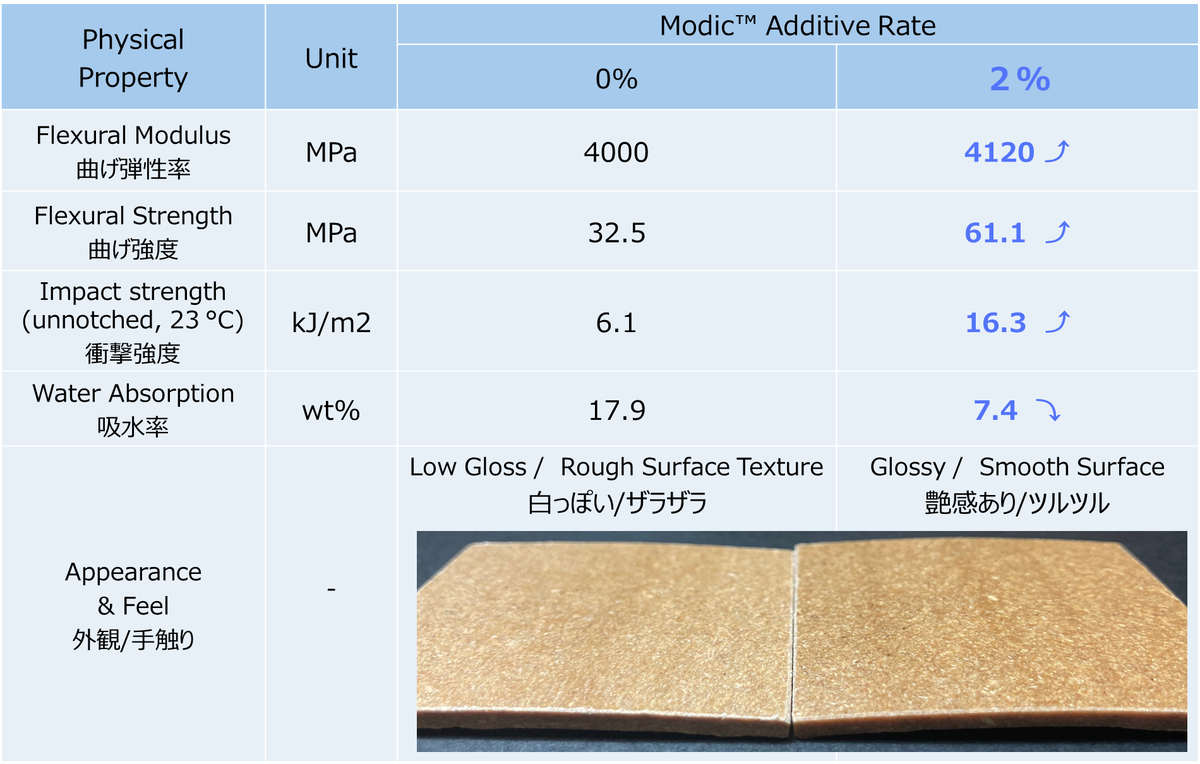
These results demonstrate Modic™'s remarkable potential to dramatically improve physical properties while minimizing cost increases.
By reducing the water absorption rate, swelling due to water absorption of the compounded materials is suppressed, and it is expected that shape changes over time will be minimized. This is an extremely important characteristic in the development of products intended for long-term use, such as automotive interior parts, building materials, and home appliance casings.
Case Study #2: Examples with Various Biomass Fillers
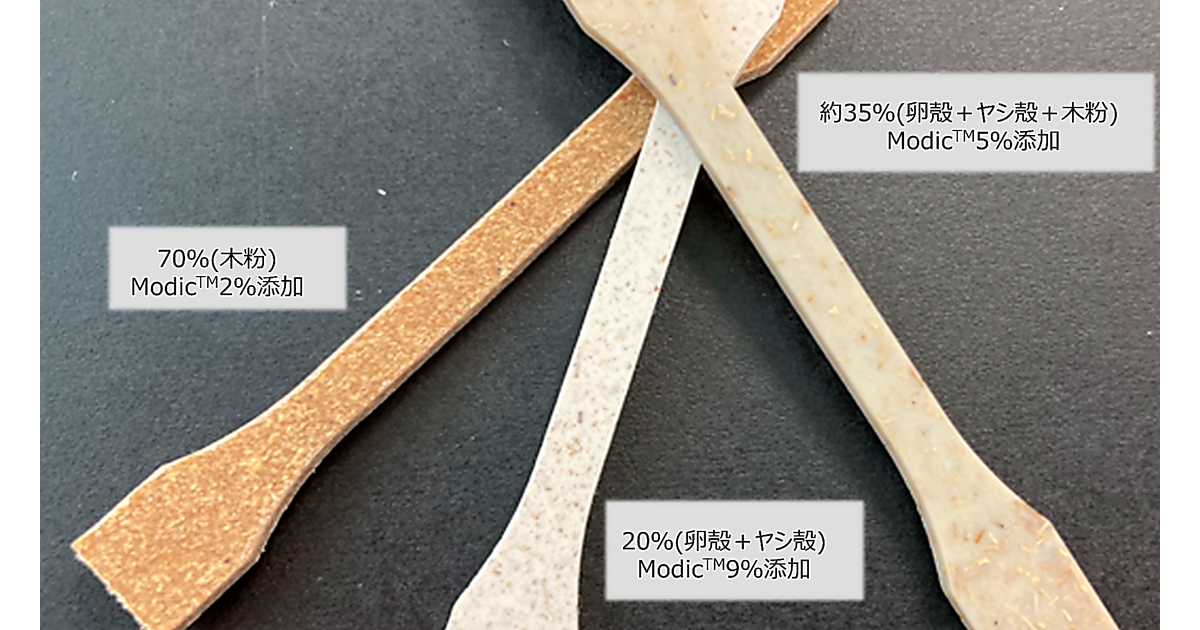
Modic™'s dispersion effect has been confirmed with materials such as wood powder/cellulose, seashells/eggshells/coconut shells, and glass fibers. As shown in the photo below, the texture of the resin can be altered depending on the type of biomass filler used, expanding the options for product design and concept.
This photograph shows an example of the appearance of a molded spoon containing biomass-derived by-products. It demonstrates that the use of naturally derived fillers such as wood flour, eggshells, and coconut shells results in variations in color, particle size, and surface texture depending on the composition.
The molded product on the left is an example of a product containing 70% wood flour and 2% Modic™. It features a woody brown color and a natural grainy texture derived from the wood flour. The molded product in the lower center is an example of a product containing 20% eggshell and coconut shell and 9% Modic™, showing fine particles within a light color tone. The molded product on the right is an example of a product containing approximately 35% eggshell, coconut shell, and wood flour in total and 5% Modic™, achieving a light-colored, natural appearance and texture by combining multiple biomass fillers.
Furthermore, Modic™ is effective in improving the dispersion of polar resins and is also effective as a dispersant and compatibilizer in the mixed recycling of dissimilar resins.
When you have trouble with composite materials of fillers and resins
Are you considering using biomass resin, but facing any of these challenges?
• We want to achieve a high biomass content while maintaining the same level of strength and impact strength as our current products, but we are having trouble doing so.
• Insufficient dispersion control of composite materials and recycled materials results in large variations in physical properties.
• I'm interested in performance enhancement using Modic™, but I'm unsure which grade is best suited to my chosen resin and filler.
The Modic™ development team aims to provide scientifically-backed, implementable solutions to these challenges. We will propose the optimal Modic™ grade for your specific application (automotive parts, home appliance casings, everyday goods, building materials, etc.).
Technical documentation on Modic™'s distributed capabilities can be found here.
For specific sample requests or technical inquiries, please contact us here.
For more detailed information about Modic™, please click here.