
Mitsubishi Chemical Corporation
Polymer Compounds Business Group
Polyester-based thermoplastic elastomer
ABOUT
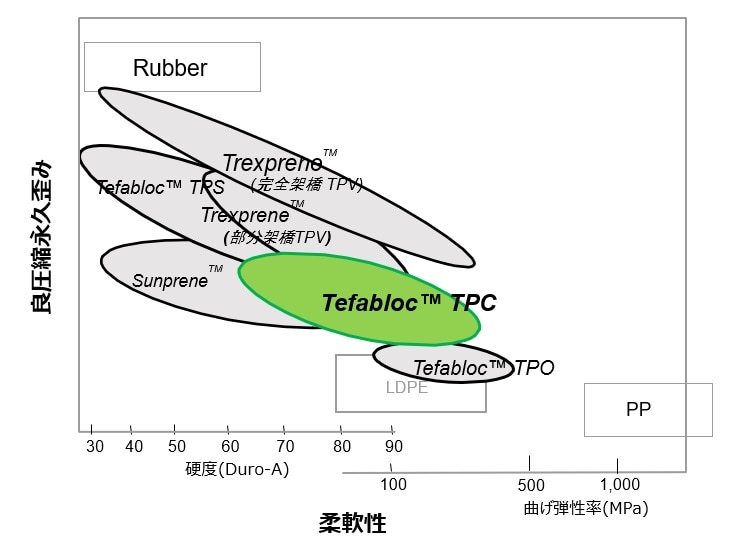
Tefabloc™ TPC is a combination of hard and soft segments.
This is a polyester-based thermoplastic elastomer composed of polyether copolymers.
It offers excellent abrasion resistance, heat resistance, and oil resistance. Furthermore, it is compatible with hard resins such as ABS/PC/PMMA, allowing for two-color molding or heat fusion via insert molding.
It is widely used in pen grips made from PCs and other materials, waterproof gaskets for electronic components, and automotive parts that require high mechanical strength.
*As of April 2017, the product name "Primaloy" has been changed to "Tefabloc™".
*TPC refers to a mixture containing polyester elastomer components.
*The product name used on the packaging, delivery specifications, SDS, etc., for this product will be "Tefabloc™".
FEAUTURE
Features of Tefabloc™ TPC
Heat-sealable rigid resin
classification | Specific example | Recommended fusion temperature (°C) | remarks |
Amorphous resin | Polycarbonate resin (PC) | 200~240 | Flame-retardant grades tend to have reduced strength. |
Styrene-based resins (ABS, AES, AS, GPPS, HIPS) | 200~240 |
| |
Acrylic resin (PMMA) | 200~240 |
| |
Polyphenylene ether resin (PPE, PPE/PS) | 230~250 | PPE/PA type is not suitable. | |
Crystalline resin | Aromatic polyester resins (PBT, PET, PET-G) | 230~250 | Preheating recommended (GF-enhanced items are essential). |
Cellulose resin (cellulose propionate, cellulose acetate) | 200~240 | The moisture content of the adherend is a factor. | |
Biodegradable plastics (PLA, PBSL) | 200~240 | The moisture content of the adherend is a factor. | |
Polyamide resins (PA6, PA66, PA12, PA-MXD) | 230~250 | Preheating recommended (GF-enhanced items are essential). | |
Polymer alloy | PC/ABS, PC/PBT | 200~250 |
|
thermosetting resin | Phenolic resin, polyimide resin | 200~240 |
|
Unsaturated polyester resin | 200~240 |
|
Tefabloc™ TPC Fusible Resin Grade List
This document lists polyester elastomers (A series) that can be bonded to rigid resins such as PC, ABS, PMMA, PA, and POM.
We have confirmed that the grades marked with a checkmark are suitable for fusion bonding.
Grade Name | ||||||||||||||||
resin | Cylinder temperature | A1400N | A1400C | A1500N | A1600N | A1602N | A1606C | A1610N | A1700N | A1704N | A1706C | A1710N | A1800N | A1900N | EPO-18 Development Product | EPO-20 |
|---|---|---|---|---|---|---|---|---|---|---|---|---|---|---|---|---|
PC | 220 | ✔ | ✔ | ✔ | ✔ | ✔ | ✔ | ✔ | ✔ | ✔ | ✔ | ✔ | ✔ | ✔ | ✔ | ✔ |
240 | ✔ | ✔ | ✔ | ✔ | ✔ | ✔ | ✔ | ✔ | ✔ | ✔ | ✔ | ✔ | ✔ | ✔ | ✔ | |
ABS | 220 | ✔ | ✔ | ✔ | ✔ | ✔ | ✔ | ✔ | ✔ | ✔ | ✔ | ✔ | ✔ | ✔ | ✔ | ✔ |
240 | ✔ | ✔ | ✔ | ✔ | ✔ | ✔ | ✔ | ✔ | ✔ | ✔ | ✔ | ✔ | ✔ | ✔ | ✔ | |
PMMA | 220 | ✔ | ✔ | ✔ | ✔ | ✔ | ✔ | ✔ | ✔ | ✔ | ✔ | ✔ | ✔ | ✔ | ✔ | ✔ |
240 | ✔ | ✔ | ✔ | ✔ | ✔ | ✔ | ✔ | ✔ | ✔ | ✔ | ✔ | ✔ | ✔ | ✔ | ✔ | |
PA | 220 |
|
|
|
|
|
|
|
|
|
|
|
| |||
240 |
|
|
|
|
|
| ✔ |
|
|
| ✔ |
| ||||
PA-GF | 220 |
|
|
|
|
|
|
|
|
|
|
|
| |||
240 |
|
|
|
|
|
| ✔ |
|
|
| ✔ |
| ||||
Copolyester | 240 | ✔ | ✔ | ✔ | ✔ | ✔ | ✔ | ✔ | ✔ | ✔ | ✔ | ✔ | ✔ | ✔ | ✔ | ✔ |
PBT | 220 |
|
|
|
|
|
|
|
|
|
|
|
| ✔ | ✔ | ✔ |
240 |
|
|
|
|
|
|
|
|
|
|
|
| ✔ | ✔ | ✔ | |
280 |
|
|
|
|
|
|
|
|
|
|
|
| ✔ |
|
| |
PBT-GF | 220 |
|
|
|
|
|
|
|
|
|
|
|
|
| ✔ | ✔ |
240 |
|
|
|
|
|
|
|
|
|
|
|
| ✔ | ✔ | ✔ | |
POM | 220 |
|
|
|
|
|
|
|
|
|
|
|
|
| ✔ | ✔ |
240 |
|
|
|
|
|
|
|
|
|
|
|
|
| ✔ | ✔ | |
Product lineup and physical properties table
- A Series (Low Hardness, Good Thermal Adhesion)
- B Series (Good heat resistance, good oil resistance)
- PTB Series
Tefabloc™ TPC A Series
Tefabloc™ TPC A Series
A standard grade of flexible injection molding material that can be heat-fused with rigid resins.
item | Test method | unit | A1400N | A1500N | A1600N | A1700N | A1800N | A1900N |
Density | ISO 1183 reference | g/ cm³ | 0.95 | 0.98 | 1.00 | 1.02 | 1.07 | 1.12 |
MFR | ISO 1133 reference | g/10min | 4 | 6 | 5 | 8 | 29 | 25 |
Duro hardness A (after 15 seconds) | ISO 7619-1 Reference | - | 45 | 61 | 67 | 76 | 85 | 93 |
Tensile stress at break | ISO 37 Reference | MPa | 5 | 6 | 8 | 8 | 12 | 13 |
Elongation during cutting | % | 750 | 810 | 930 | 810 | 980 | 1000 | |
Fusion strength PC | Base material: PC, ABS | N/25mm | 93 | 141 | 185 | 275 | 412 | 507 |
Fusion strength PC | N/25mm | 68 | 142 | 179 | 263 | 407 | 514 | |
Fusion strength ABS | N/25mm | 69 | 125 | 143 | 192 | 234 | 175 | |
Fusion strength ABS | N/25mm | 63 | 124 | 142 | 189 | 231 | 176 |
*The above figures are representative values and not guaranteed values.
*The product name on the packaging, delivery slip, SDS, etc., of this product will be "Tefabloc™".
Issued:Sep.2025
A functional grade characterized by good release properties and high transparency.
Test items | Test method | unit | A1602N | A1704N | A1400C | A1606C | A1706C |
Features | Good release type | Good release type | high transparency | high transparency | high transparency | ||
Density | ISO 1183 reference | g/ cm³ | 1.00 | 1.08 | 0.94 | 1.00 | 1.02 |
MFR (230 ℃,21.2N) | ISO 1133 reference | g/10min | 3 | 11 | 1 | 4 | 13 |
Duro hardnessA (after 15 seconds) | ISO 7619-1 reference | - | 69 | 81 | 47 | 68 | 78 |
Tensile stress at break | ISO 37 reference | MPa | 9 | 8 | 4 | 7 | 9 |
Elongation during cutting | % | 840 | 480 | 630 | 880 | 880 | |
Fusion strengthPC | Base material:PC,ABS | N/25mm | 166 | 141 | 38 | 185 | 285 |
Fusion strengthPC | 197 | 143 | 40 | 205 | 279 | ||
Fusion strengthABS | 193 | 146 | 36 | 153 | 250 | ||
Fusion strengthABS | 152 | 144 | 45 | 161 | 244 | ||
HAZE | ISO 14782 reference | % | - | - | 76 | 35 | 45 |
*The above figures are representative values and not guaranteed values.
*The product name on the packaging, delivery slip, SDS, etc., of this product will be "Tefabloc™".
Issued:Sep.2025
PA/PBT Functional Grade
Test items | Test method | unit | A1610 | A1611N |
Features | PA fusion | PBT fusion | ||
Density | ISO 1183 reference | g/ cm³ | 1.00 | 1.00 |
MFR | ISO 1133 reference | g/10min | 7 | 16 |
Duro hardness A (after 15 seconds) | ISO 7619-1 Reference | - | 67 | 68 |
Tensile stress at break | ISO 37 Reference | MPa | 9 | 4 |
Elongation during cutting | % | 850 | 580 | |
Fusion strength PBT | Base material: PBT | N/25mm | - | 80 |
Fusion strength PBT | N/25mm | - | 75 | |
Fusion strength PA | Base material: PC, ABS | N/25mm | 60 | - |
Fusion strength PC | N/25mm | 180 | - | |
Fusion strength PC | N/25mm | 170 | - | |
Fusion strength ABS | N/25mm | 100 | - | |
Fusion strength ABS | N/25mm | 90 | - | |
*The above figures are representative values and not guaranteed values.
*The product name on the packaging, delivery slip, SDS, etc., of this product will be "Tefabloc™".
Issued:Sep.2025
B Series (Good heat resistance, good oil resistance)
Tefabloc™ TPC B Series
Excellent heat resistance, wear resistance, oil resistance, and mechanical strength.Injection molding grade
item | Measurement method | unit | B1600N | B1700N | B1900NR | B1910N | B1920N | B1921N | B1932N | |
MFR | ISO1133 reference | g/10min. | 2 | 4 | 23 | 26 | 23 | 20 | 45 | |
density | ISO1183 Reference | g/ cm³ | 0.97 | 0.98 | 1.12 | 1.14 | 1.16 | 1.19 | 1.23 | |
Duro A hardness (after 15 seconds) | ISO7619 Reference | - | 63 | 69 | - | - | - | - | - | |
Duro D hardness (after 15 seconds) | ISO868 reference | - | - | - | 39 | 45 | 49 | 53 | 60 | |
Tensile test | Tensile stress at break | ISO37 reference | MPa | 6 | 9 | - | - | - | - | - |
Elongation during cutting | % | 590 | 730 | - | - | - | - | - | ||
Bending test | Flexural modulus | ISO178 reference | MPa | - | - | 96 | 145 | 183 | 170 | 355 |
Wear resistance | Abrasion resistance test | MCC Test Method 500g * 5000 times | % | - | - | 0.064 | 0.051 | 0.027 | 0.010 | 0 |
*The above figures are representative values and not guaranteed values.
*The values in the table above are subject to change without notice.
*Please evaluate and judge the quality suitability, safety, and legality of the product for your intended use.
*The product name used on the packaging, delivery specifications, SDS, etc., for this product will be "Tefabloc™".
*TPC refers to a mixture containing polyester elastomer components.
*Reproduction of this data and information without prior written consent is prohibited.
Issued:Sep.2025
PTB Series
item | Measurement method | unit | PTB201 | PTB202 | PTB203 | PTB204 | |
MFR | ISO1133 reference | g/10min. | 14 | 23 | 21 | 18 | |
density | ISO1183 Reference | g/ cm³ | 1.01 | 1.02 | 1.04 | 1.05 | |
Duro A hardness (after 15 seconds) | ISO7619 Reference | - | 43 | 48 | 67 | 73 | |
Tensile test | Tensile stress at break | ISO37 reference | MPa | 3 | 6 | 8 | 8 |
Elongation during cutting | % | 280 | 400 | 550 | 750 | ||
Compression permanent set | ISO 815 reference | 70℃, 22hrs | % | 37 | 41 | 54 | 59 |
Oil swelling resistance test | MCC method | IRM903, | D Vol.% | 0 | 8 | 19 | 28 |
Static friction coefficient | Friction and wear testing machine | Load against SUS: 50g | - | 1.04 | 1.05 | 1 | 1.52 |
coefficient of kinetic friction | Friction and wear testing machine | Load against SUS: 50g | - | 1 | 1 | 1 | 1 |
Rebound elasticity | JIS K6253 reference | Lübke system | % | 78 | 76 | 76 | 81 |
*The above figures are representative values and not guaranteed values.
*The values in the table above are subject to change without notice.
*Please evaluate and judge the quality suitability, safety, and legality of the product for your intended use.
*The product name used on the packaging, delivery specifications, SDS, etc., for this product will be "Tefabloc™".
*TPC refers to a mixture containing polyester elastomer components.
*Reproduction of this data and information without prior written consent is prohibited.
Issued:Sep.2025
Recommended molding conditions
Related articles
What are polyester elastomers?
Examples of robotic hand applications
Fusion with Tritan
For the export of chemical products, we will check the regulations of each country and then respond regarding whether or not we can provide them.
Please be sure to include information such as the exporting country.
Please note that for some products, we may not be able to offer or provide a different grade.
CASE
Application example

Various types of grips

Pen grip

rubber seal
CONTACT
Before you start worrying about selecting and developing resin materials
Please contact Mitsubishi Chemical.
Polymer Compounds Business Group Products
Useful resources are available here.
Please feel free to ask any questions.
Please contact us.

The above information is based on the latest available information as of the date of creation and may be revised in the future based on new information.
Furthermore, this information is provided as general technical information and reference material, and we do not guarantee the accuracy or completeness of the content.
Product performance and characteristics may vary depending on usage conditions, processing conditions, etc. The final decision regarding applicability and design is the customer's responsibility.
We will check the regulations of each country regarding the export of chemical products and then respond whether or not we can provide them. Please be sure to include information such as the exporting country.
Depending on the product, we may suggest a different grade or may not be able to provide the product at all.

Mitsubishi Chemical Corporation
Polymer Compounds Business Group

Copyright © Mitsubishi Chemical Corporation, Polymer Compounds Business Group