The role required for steel pipe coating and the features of Modic™
As the demand for longer infrastructure lifespans increases, the selection of steel pipe coatings that balance corrosion protection and ease of installation is becoming increasingly important. This article introduces the role of coatings required for underground steel pipes such as water supply, sewage, and gas pipes, and the innovative features of Modic™.
Table of Contents [hide]
- 1.The role required of steel pipe covering.
- 1.1.Water supply pipes
- 1.2.Sewer pipe
- 2.Sewer pipe rehabilitation technologies and their types
- 2.1.Gas pipes
- 2.2.Other underground pipes
- 3.Applicable materials and characteristics
- 4.Features of Modic™
- 4.1.Feature 1: High adhesion and holding power with steel pipes
- 4.2.Feature 2: Adaptability to various processing and construction methods
- 4.3.Feature 3: Environmental Considerations and Sustainability
- 5.Summary
The role required of steel pipe coatings
For steel pipes used underground or underwater for extended periods, coating technology is essential to prevent corrosion and galvanic corrosion and extend their service life. In recent years, the importance of renewal and rehabilitation technologies for aging pipelines has also increased, and the performance of coating materials has become a factor that affects the reliability of social infrastructure.
Water supply pipes
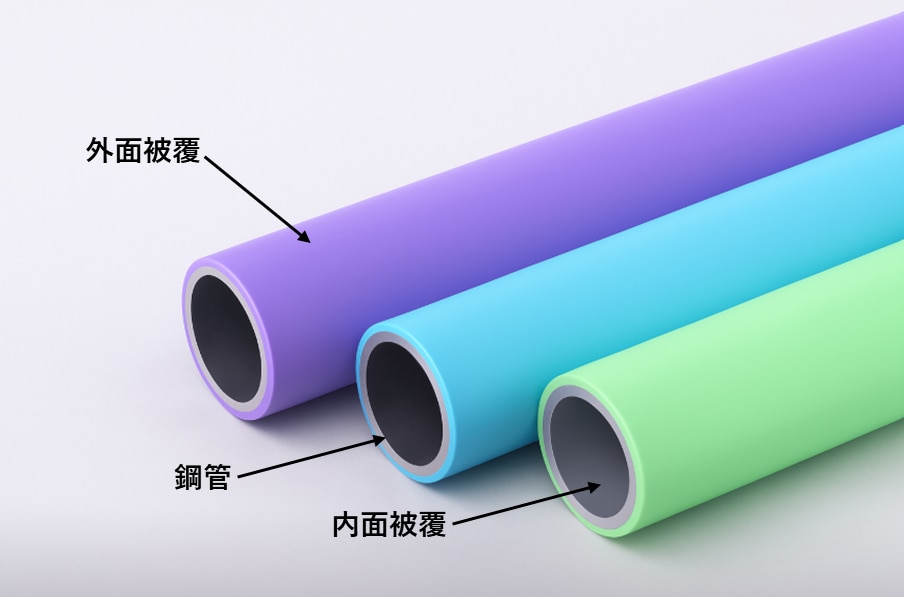
Water supply pipes require the highest standards of safety and hygiene. The inner surface must be coated with a material that has minimal impact on water quality, while the outer surface must be coated with a material that offers excellent corrosion resistance. For internal corrosion protection, thermoplastic resins such as polyethylene (PE) and modified PE (modified polyethylene) are often used to maintain clean water quality. These materials have low affinity for water and are chemically stable, thus preventing water pollution and maintaining a smooth inner surface over the long term. For external corrosion protection, PE coating is currently the mainstream. It is highly flexible, has excellent water and chemical resistance, and is easy to install.
On the other hand, polyamide (PA) coatings have also been used. PA has attracted attention as a material that is resistant to external impacts and abrasion due to its high strength and abrasion resistance, but its evaluation is divided in long-term use environments due to concerns about hydrolysis due to water absorption. Depending on the application and installation conditions, PA coatings are still suitable in some cases, and it is important to choose according to the purpose.
sewer pipe
Sewer pipes are exposed to corrosive gases such as hydrogen sulfide and acidic environments, making internal corrosion protection particularly important. FRP (fiber-reinforced plastic) and curable resins (epoxy, vinyl ester resin, etc.) are commonly used on the inside to ensure acid and chemical resistance. On the other hand, thermoplastic coatings such as PE and modified PE are used for external corrosion protection to counter soil corrosion and maintain long-term corrosion protection performance.
Sewer pipe rehabilitation technologies and their types
In recent years, the number of sewer pipe damage and collapses due to aging has been increasing nationwide, leading to the adoption of "pipe rehabilitation technology," which repairs existing pipes without excavation. Rehabilitated pipes restore function by forming new pipes or resin layers inside existing pipes, and various construction methods are selected depending on the construction environment and purpose.
Typical types of rehabilitation tubes:
- Reverse lining method: A resin-impregnated liner is inserted in reverse and cured with a thermosetting resin.
Materials = unsaturated polyester resin, vinyl ester resin, etc.
- Slip lining method: Rehabilitation is performed by inserting a new PVC or PE pipe into the existing pipe and filling the gap.
Materials = PE, PVC, PP, etc.
・Spray lining method: A corrosion-resistant layer is formed by spraying epoxy resin or polyurea resin into the existing pipe.
gas pipe
Gas pipes must withstand both internal pressure and galvanic corrosion. For external corrosion protection, PE (polyethylene) and polyvinyl chloride (PVC), which have excellent insulation and impact resistance, are the mainstream materials. In recent years, in particular, three-layer PE-coated steel pipes, which offer excellent durability and ease of installation, have become the standard specification. PA (polyethylene) is known as a tough and abrasion-resistant material, but there are concerns about hydrolysis due to moisture absorption, requiring careful selection depending on the usage environment. Although limited, applications that take advantage of PA's properties are also being considered under specific conditions.
Other underground pipes
Power cable protection conduits, communication conduits, and agricultural water pipes require long-term corrosion resistance, weather resistance, and impact resistance. Depending on the usage environment, materials such as PE, modified PE, or FRP are used, contributing to a reduction in life cycle costs.
Applicable materials and features
The materials used for coating steel pipes vary depending on the operating environment, design life, and construction method. Among them, PE-based materials are widely used due to their lightweight, flexibility, and excellent chemical resistance. Here, we introduce representative materials along with the features of Modic™, a modified PE developed by our company.
PA (Polyamide)
PA is an engineering plastic with high mechanical strength, abrasion resistance, and heat resistance. While it exhibits excellent resistance to underground environments and external impacts, there are concerns about hydrolysis due to water absorption, and ensuring long-term dimensional stability remains a challenge. Therefore, its applications are limited, but it can still be a viable option in special environments where high strength and scratch resistance are required.
PE (Polyethylene)
PE (polyethylene) is a lightweight, flexible material that combines excellent corrosion resistance and electrical insulation properties, making it widely used in water pipes, gas pipes, and power protection pipes. In particular, three-layer PE-coated steel pipes (3PE pipes), which have a three-layer structure (epoxy base + adhesive layer + PE outer layer), have become the standard for current underground corrosion protection specifications. However, ordinary PE has poor adhesion to metal surfaces, and peeling of the coating layer can be a problem, making reliable formation of the adhesive layer and proper pretreatment conditions important.
Modified PE (Modified Polyethylene) "Modic™"
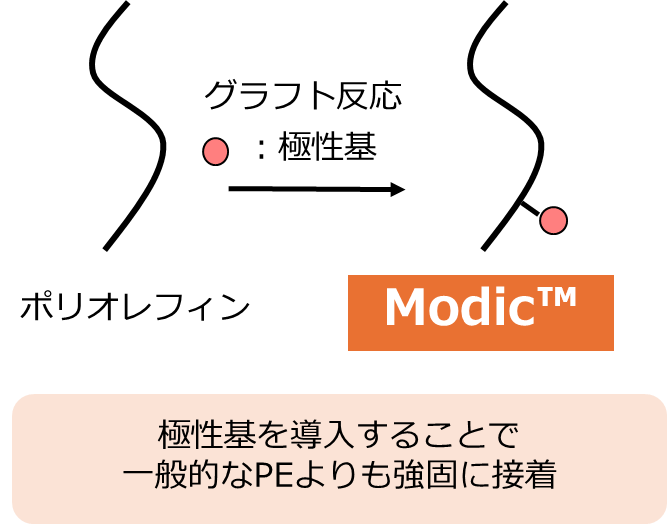
Our company's "Modic™" is a new generation coating material that dramatically improves adhesion and retention to steel pipe surfaces by applying a special modification treatment to a base material that is normally PE. It maintains the chemical resistance and flexibility inherent in PE while achieving both long-term corrosion protection and processability.
Features of Modic™
Feature 1: High adhesion and holding power with steel pipes
Modic™ significantly reduces the occurrence of interfacial delamination, a common weakness of conventional PE (polyethylene) coatings, by strengthening the chemical bond with the oxide film and undercoat layer on the steel surface. It exhibits excellent water-resistant adhesion even in high-humidity environments, and its coating has high conformability to impact and bending stresses, resulting in a structure that is less prone to cracking and lifting. This enables reduced maintenance frequency and lower life cycle costs, even in harsh underground environments.
Feature 2: Adaptability to various processing and construction methods
Modic™ offers optimal products tailored to your application, including extruded grades for external coatings and powder grades for internal linings, such as powder coating and fluid immersion coatings.
Feature 3: Environmental considerations and sustainability
Modic™ features a lead-free and halogen-free design, reducing safety during application and environmental impact during disposal. Its easy recycling and reuse of powder during extrusion and powder coating processes makes it a sustainable corrosion protection material from the perspective of CO₂ emission reduction and resource circulation.
summary
Modic™ is a modified PE material that combines excellent functionality and environmental performance, including high adhesion and retention to steel pipes, long-term corrosion protection durability, and adaptability to various construction methods. It can be applied to the external and internal corrosion protection of a wide range of underground pipelines, such as water supply pipes, gas pipes, power lines, telecommunications lines, and agricultural and water infrastructure, contributing to the social challenges of extending the lifespan of infrastructure and reducing maintenance costs.