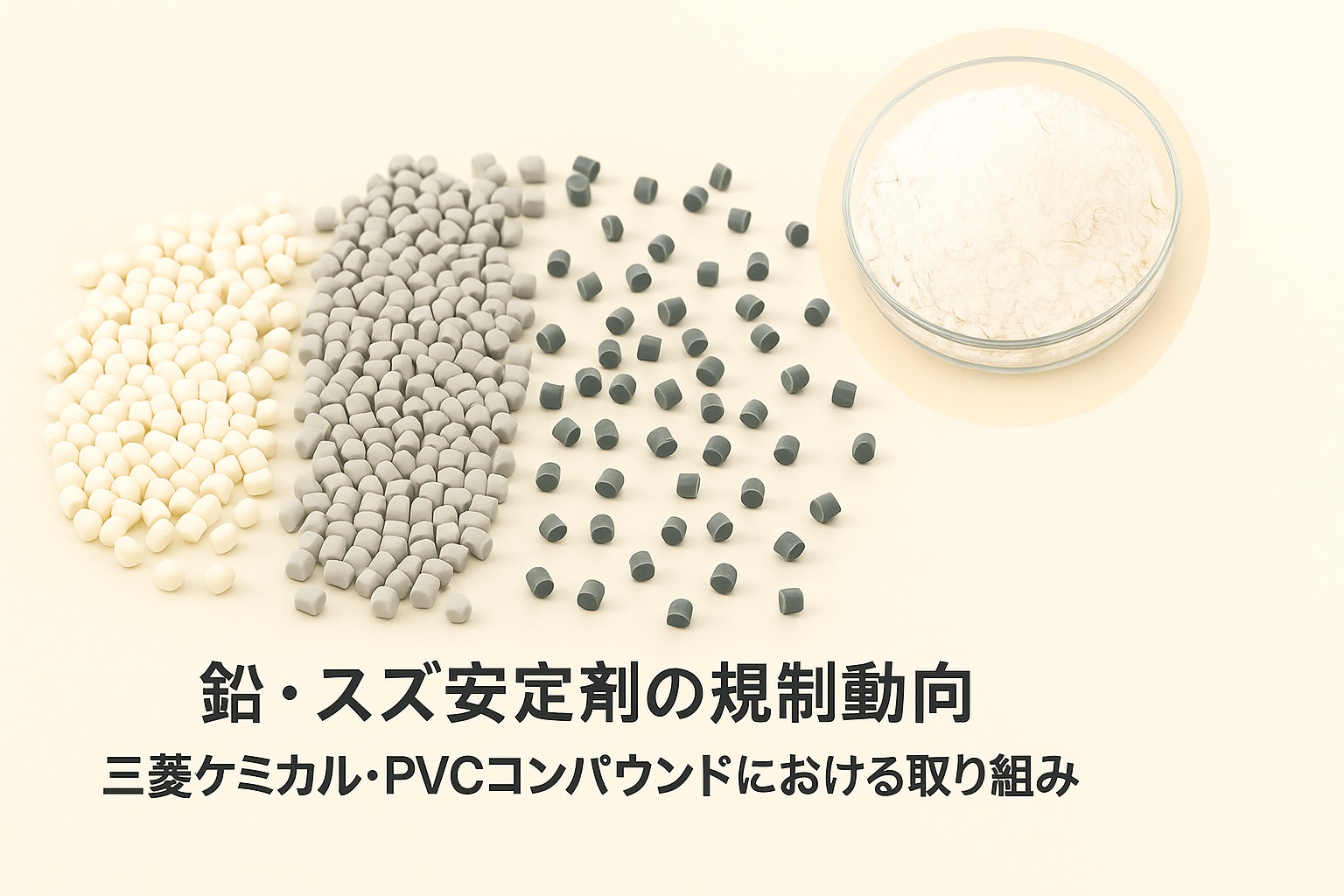
Environmental regulations on stabilizers used in PVC compounds and Mitsubishi Chemical's efforts
Stabilizers are essential for PVC products. The key to this lies in the trends of lead-based and tin-based formulations, which are being re-evaluated in response to environmental regulations. In this article, we will clearly explain how to comply with environmental regulations (RoHS Directive and REACH Regulation) and the points to consider when selecting and designing stabilizers, using Mitsubishi Chemical's rigid PVC compound "Vinika™" as an example.
What is a stabilizer used in PVC compound?
Polyvinyl chloride (PVC) is a resin with excellent durability, chemical resistance, and electrical insulation properties, and is used in a wide range of fields, including building materials, electrical wires, and packaging materials.
However, it is known that it is easily decomposed by heat and light, leading to the generation of hydrogen chloride (HCl), discoloration, and a decrease in mechanical strength.
Stabilizers are used to suppress this decomposition and ensure stability during processing and use.
Stabilizers are important additives that affect the processability and long-term stability of PVC, and are selected according to the product characteristics and application.
The main types and their characteristics are as follows:
安定剤の種類 | 主な特性 | 代表的な用途・選定上の利点 |
鉛系安定剤 | ・高い熱安定性および電気絶縁性を有する ・加工時の温度変動に対する安定性が高く、PVCの熱分解を抑制しやすい ・長期耐久性が求められる用途に適する | 建材、電線・ケーブル、配管材など。高い耐熱性、電気特性および長期耐久性が求められる用途で使用される。 |
スズ系安定剤 | ・高い透明性および初期着色の抑制効果を有する ・熱安定性が高く、短時間の加工サイクルに適する | 透明フィルム、食品包装、医療用途向け製品など。外観、透明性および衛生性が重視される用途で選定される。 |
その他の金属系・有機系安定剤 | ・成形加工性と耐候性のバランスを設計しやすい ・低揮発性・低移行性を考慮したグレード設計が可能 ・配合の自由度が比較的高く、幅広い用途に対応しやすい | 建材、家電部材、一般成形品など。用途要求や規制対応を踏まえ、性能・加工性・環境配慮のバランスを最適化するために選定される。 |
Regulatory trends for lead stabilizers
In the European Union (EU), concerns about the harmful effects of lead and its compounds have led to stricter regulations on a variety of products, including those used in PVC.
- REACH Regulation (Annex XVII): Limits lead content in PVC products to less than 0.1 wt%.
- RoHS Directive: Prohibits the use of lead in electrical and electronic equipment in amounts exceeding 0.1 wt%.
Therefore, PVC products using lead-based stabilizers are rarely seen in the current European market.
In Japan, the use of lead stabilizers is decreasing year by year.
According to a report by the Vinyl Chloride Industry and Environment Association (VEC), since the 2000s, there has been a trend towards lead-free materials, mainly in building materials and electrical wire insulation, and the adoption of lead-free formulations is becoming commonplace.
On the other hand, lead stabilizers have been widely used for many years due to their excellent processing stability and thermal stability.
Therefore, when switching from lead-based formulations to other formulations, a major challenge is the increased likelihood of issues such as "burning" and "discoloration" during injection molding.
To prevent such problems, it is necessary to manage the thermal history of the materials, optimize the sliding balance, and fine-tune the processing conditions.
Regulatory Trends and Challenges Regarding Tin Stabilizers
Tin-based stabilizers (organotin compounds) have been widely used as stabilizers in transparent applications,
Some organotin compounds (such as dibutyltin and monobutyltin) are of concern due to their ecotoxicity, and the following regulations are in place in Europe:
- REACH Regulation (Annex XVII): Restricts certain organotin compounds to less than 0.1 wt%.
- Some member states have independently imposed restrictions on its use in food contact materials and toys.
In response to these developments, the use of tin-based stabilizers is decreasing in Europe.
Furthermore, tin stabilizers have the drawback of easily releasing tinnic acid during molding, which can cause the mold to rust.
Mitsubishi Chemical's initiatives
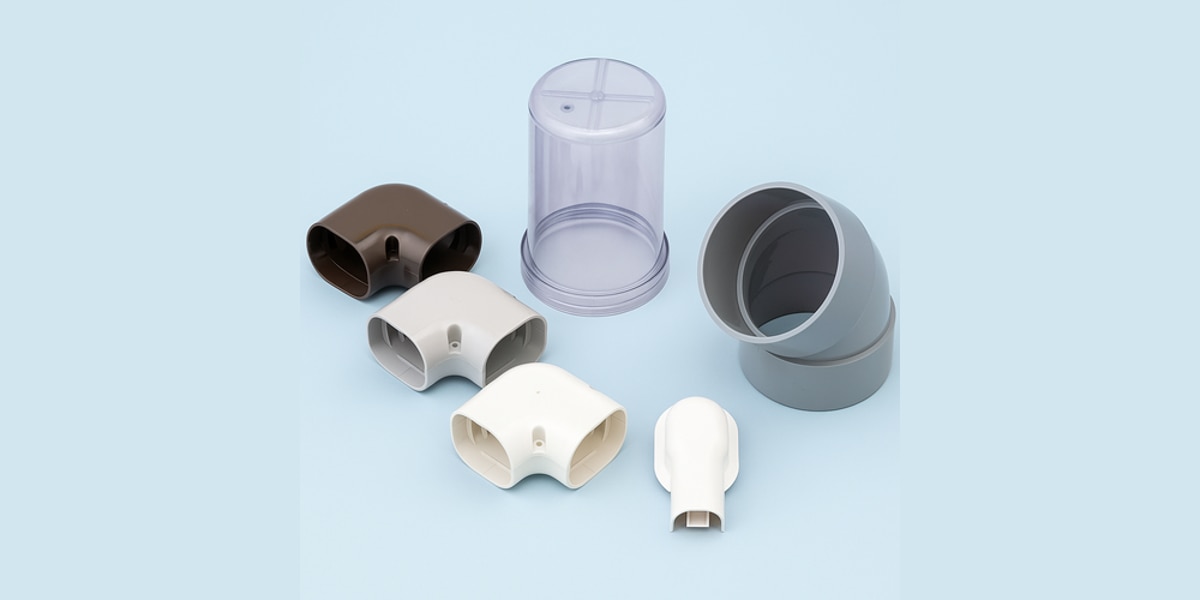
Mitsubishi Chemical is developing Vinika™, a rigid PVC compound that offers an excellent balance of mechanical properties, durability, processability, and appearance quality.
We have established a unique technology that aims to suppress burning and gelling during molding while maintaining stability and moldability equivalent to lead-based stabilizers. One of our features is that we can design and propose the optimal formulation according to the color, shape, and size of the molded product.
By optimizing the interaction of lubricants and additives, we achieve stable quality in both injection molding and extrusion molding, minimizing on-site processing problems.
These products comply with various regulations, including the RoHS Directive and REACH Regulation, and have already been adopted by our customers.
Furthermore, Mitsubishi Chemical has also developed a PVC compound with a completely lead-free and tin-free formulation.
Our unique stabilization technology and additive design achieve a high level of both transparency, weather resistance, and processing stability.
We have established a stabilizer formulation for transparent applications that does not use tin stabilizers.
These technologies meet quality requirements in the building materials sector and also contribute to improving production efficiency at processing sites.
For those interested in this article
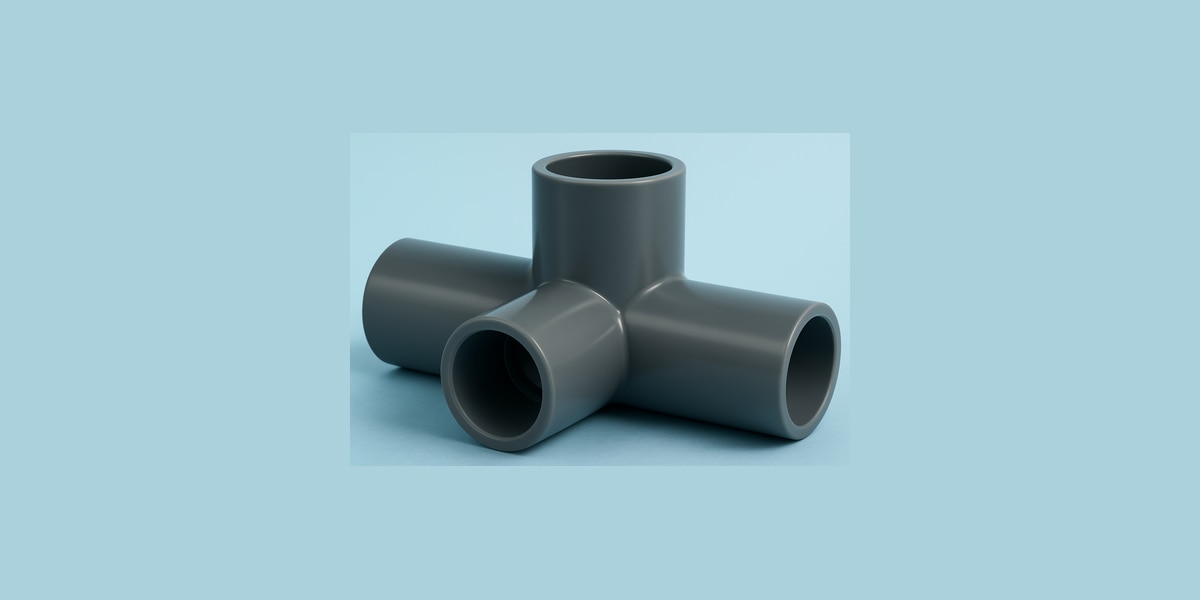
The rigid PVC compound Vinika™ introduced in this article is used primarily in the building materials sector as a material with excellent processability, appearance, and stability.
Customers who are actually molding PVC compounds,
Or, if you use PVC in your company's products or merchandise,
If you are interested in formulations that do not use lead-based or tin-based stabilizers, or in measures to prevent burning during molding, please feel free to contact Mitsubishi Chemical.
We will propose the optimal compound formulation according to your product specifications and processing conditions.