
What is PVC (polyvinyl chloride)? Introducing Mitsubishi Chemical's PVC compound.
PVC (polyvinyl chloride) is a resin that combines excellent durability, flame retardancy, and processability, and is widely used in everything from building materials to automobiles and everyday products. This article introduces the characteristics of PVC compounds offered by Mitsubishi Chemical and its product lineup that meets diverse needs.
Table of Contents [hide]
- 1.What is PVC?
- 2.Mitsubishi Chemical's PVC Compound Lineup
- 3.Characteristics and applications of PVC alloy elastomers (Sunprene™ series)
- 3.1.Rubber Elastic Alloy (Sunprene™ F Series)
- 3.2.Low-temperature flexible alloys (Sunprene™ QS series)
- 3.3.Wear-resistant alloys (Sunprene™ FE series)
- 4.Other special grades
- 5.If you are considering PVC materials
What is PVC?
PVC (polyvinyl chloride) is a type of thermoplastic produced by the addition polymerization of vinyl chloride monomers, which are formed by the reaction of ethylene and chlorine. It has excellent chemical resistance, flame retardancy, durability, weather resistance, and water resistance, and is relatively inexpensive, so it is used in a wide range of applications such as building materials, automotive parts, wire insulation, and everyday goods.
rigid PVC
Rigid PVC is a material that prioritizes hardness and durability without the addition of plasticizers. Because it contains no plasticizers, it is characterized by its hardness and strength, and excellent shape retention. It is offered by Mitsubishi Chemical as the rigid PVC compound Vinika™.
soft pvc
Flexible PVC is a material whose flexibility has been enhanced by adding plasticizers to PVC. The addition of plasticizers provides flexibility, bendability, and stretchability. Flexible PVC is offered by Mitsubishi Chemical as Vinika™ and Sunprene™, and there is a wide range of options in terms of hardness range and functionality.
Mitsubishi Chemical's PVC compound lineup
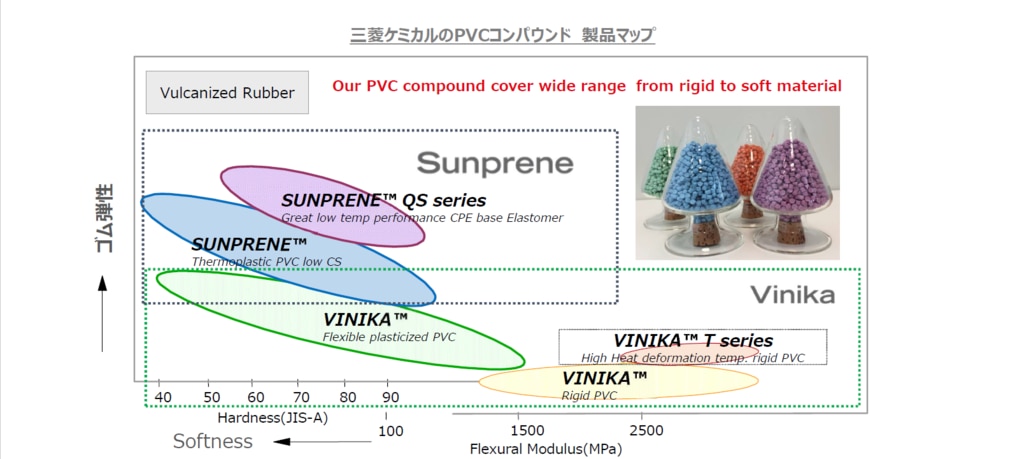
Vinika™
Vinika™ is Mitsubishi Chemical's standard brand of polyvinyl chloride resin compounds. Available in both hard and soft forms, it boasts a comprehensive lineup to accommodate a wide range of hardnesses and color tones.
Sunprene™
Sunprene™ is a series of flexible PVC compounds that offer the same moldability as regular PVC compounds while adding functionality. It features excellent abrasion resistance, low compression set, aesthetic control (high gloss or matte), and a low gel count.
Marvyflo™
Marvyflo™ is a high-flow PVC powder product for slush molding, primarily used as an automotive interior surface material. It is ideal for manufacturing soft-touch parts such as instrument panels (dashboards), door panels, and glove boxes. Grades are classified by plasticizer migration after heat aging and low-temperature properties (Tg), allowing for optimal selection for various applications.
Characteristics and applications of PVC alloy elastomers (Sunprene™ series)
Because PVC has high polarity and excellent compatibility with other resins, it is possible to leverage the advantages of PVC while improving its disadvantages through polymer alloying. Mitsubishi Chemical is developing the "Sunprene™" series of vinyl chloride-based thermoplastic elastomers that apply this technology.
Rubber elastic alloy (Sunprene™ F series)
This type of PVC alloy incorporates a special elastomer, resulting in lower compression set and improved rubber elasticity compared to conventional PVC compounds. Its moldability is comparable to regular PVC, making it ideal for applications requiring long-term sealing performance, such as automotive parts and industrial gaskets.
Low-temperature flexible alloy (Sunprene™ QS series)
This type is made by alloying PVC with a special elastomer, offering excellent low-temperature flexibility and rubber elasticity, making it ideal for use in cold climates. It is used in applications that require flexibility in low-temperature environments, such as electric vehicle power cables and automotive exterior sealing materials.
Wear-resistant alloy (Sunprene™ FE series)
By alloying thermoplastic elastomers, we have significantly improved abrasion resistance and mechanical properties. While maintaining the extrudeability of PVC, this material is expected to be applicable to industrial hoses, FA cables, and other applications requiring high durability. We are also considering a lineup that includes flame retardancy and heat aging resistance.
Other special grades
In addition to the above, Mitsubishi Chemical also develops and provides PVC compounds with special functions.
• ABS-adhering PVC grade for injection molding: Excellent adhesion to ABS during insert molding.
• Improved Tactile Compound: Enhances surface texture and abrasion resistance.
If you are considering PVC materials
Leveraging the compounding design expertise cultivated over more than 40 years in the functional plastics business, Mitsubishi Chemical offers optimal PVC compound solutions tailored to our customers' needs. Please feel free to contact us if you are considering our solutions.