Considering the Blood Compatibility materiaks for Medical Devices (Part 3 of 3)
Part 3 | Perspectives and Industry-Academia Collaboration Needed by Researchers in the AI Era: Good Products are based on Good Science
The story of PMEA and intermediate water is not simply a story of material discovery. Products come first, science follows, and trust with the medical field is built through publication of research papers—this cycle is the essence of medical material development.
In the final episode, we delve into the encounter with the late Professor Teiji Tsuruta, the meaning of the phrase "Personality does not exist before science," the importance of "the ability to formulate questions" in the age of AI, and the structure of industry-academia collaboration, where value is only created when universities, companies, and medical facilities work together.
This three-part series is packed with messages for all engineers involved in medical device development, covering everything from the limitations of coatings to the turning point towards designing the substrate itself to be biocompatible.
Table of Contents [hide]
- 1.Is there a convincing science at play? — What the medical field demanded
- 2.The moment when products, science, and the medical field connect.
- 3.Assignment to a factory—Formative experience as a corporate researcher
- 4.The mentor who supported the research: "Personality does not matter before science."
- 5.The Value of Researchers in the Age of AI
- 6.The value created by industry-academia collaboration: Recognizing differences in roles
- 7.The Limits of Coatings – The Potential of Zelas™AMP
- 8.Message to Medical Device Technicians
- 9.References
- 10.Explanation of Technical Terms
Is there a convincing science at play? — What the medical field demanded.
Kiyan: Last time, you talked about the experimental process that led to the creation of the intermediate water concept.
On the other hand, the practical application of PMEA itself was already well underway.
Professor Tanaka: That's right. Product development was progressing steadily. We had both clinical data and performance evaluation data.
However, doctors are in a position to use it on their own patients.
The mechanism behind "why it achieves that performance" and "is it truly safe?" must be convincing.
We faced a situation where performance alone wasn't enough to get doctors to use our products.
"Synthetic polymers, or artificial materials, cause foreign body reactions in living organisms, so they should be eliminated as much as possible."
That's what's written in medical textbooks.
In order to change the preconceived notions of the doctors who had received that training, a solid theoretical framework was necessary.
Kiyan: Scientific evidence, reproducibility, and mechanism—only when these three elements are present can a treatment reach the medical field.
Professor Tanaka: That's right. With PMEA, we couldn't just end it with "it's a good material," but we needed to show the science behind it.
The moment when products, science, and the medical field connect.
Kiyan: The Biomaterials paper on the blood compatibility of PMEA, and the subsequent paper on intermediate water research, were not merely academic achievements. (References 2, 3, 4)
Professor Tanaka: Changes occurred after the paper was published. Doctors started responding with comments like, "Since the paper is out, let's try using it." In the paper, we organized and showed the relationship between protein adsorption, denaturation, and platelet adhesion. Furthermore, our research on intermediate water added a perspective that explained "why it happens." It was then that I felt for the first time that "product," "science," and "medical practice" had become one.
Kiyan: That perfectly encapsulates what the professor often says: "Good products are backed by good science."
Professor Tanaka: I still think so.
Behind every good product, there must be good science. And good science will lead to good products in the future.
We start from the challenges we face in the field, develop materials, and evaluate them. New questions arise during this process, which we then research. That knowledge, in turn, leads to new technologies. I believe that research and development in medical materials and equipment is about continuously keeping this cycle going.
Assignment to a factory—a formative experience as a corporate researcher
Kiyan: Professor, you moved from a medical device manufacturer to a university. What kind of practical experience during your time at the company became the core of your research?
Professor Tanaka: The biggest thing was being assigned to the factory. I joined the company as a researcher, but I was the first among my同期 (colleagues who joined at the same time) to receive an order to work in the factory. To be honest, I felt like I had fallen into the abyss (laughs). I was on a three-shift system, and all I did was production management. At first, it was just out of a sense of obligation.
Kiyan: Later, I was able to say that it was a "treasure."
Professor Tanaka: I gained a deep understanding of just how incredibly challenging quality assurance for medical devices is—the mindset required in a production environment for products that directly impact human lives. That factory experience served as an initiation for me, instilling in me the feeling that "this research must one day become a product and reach patients." I still tell my students that today.
The mentor who supported the research: "Personality does not matter before science."
Kiyan: I understand that the late Professor Teiji Tsuruta (Professor Emeritus of the University of Tokyo) played a significant role in your long-term research on intermediate waters.
Professor Tanaka: It was extremely important. Professor Tsuruta laid the foundation for polymer biomaterials in Japan. I'm not from Professor Tsuruta's lab, nor was I his student. Nevertheless, he learned about my research through papers and conference presentations, and kept asking me, "What happened with this?" and "What happened after that?" At the time, I was also working on other projects, so I think it was because of the presence of such a mentor that I was able to continue my research on intermediate water.
Kiyan: I heard that another professor asked Professor Tsuruta why he's able to find so many interesting research projects by young researchers?
Professor Tanaka: That question came up during a special lecture by Professor Tsuruta, which was organized by the Japanese Society for Biomaterials. Many in the audience were probably expecting to hear some special know-how. However, after thinking for a while, Professor Tsuruta simply said, "It happens naturally." At that moment, the hall fell silent for a second. The professor who asked the question to Professor Tsuruta was frozen in place (laughs). Looking back now, I think that because Professor Tsuruta always approached his research with a strong sense of inquiry and curiosity, research that raised fundamental questions naturally caught his eye.
Professor Tanaka: Also, among Professor Tsuruta's students, the saying "There is no character before science" was well known. Of course, this does not mean to deny his character. On the contrary, Professor Tsuruta was a very gentle and kind person who valued others. But when it came to scientific discussions, he evaluated research based on whether it addressed an essential question, regardless of age, affiliation, or title. That is why I think he encouraged so many young researchers.
The value of researchers is being questioned especially in the age of AI.
Kiyan: In recent years, AI has come to be widely used in research and development.
Professor Tanaka: AI is very convenient. It can search for papers and organize information. However, AI can only handle "knowledge that already exists in the world." Things that haven't been published in papers, phenomena that no one has ever measured, anomalies that no one has noticed—those things won't come from AI. That was the case with PMEA and intermediate water at first. The forefront of research is areas that no one has yet discovered. There's no other way than to experiment and think for yourself.
Kiyan: I often hear from corporate researchers that opportunities to present at academic conferences and publish papers are limited.
Professor Tanaka: I hope you will share your work as much as you can. If you don't share it, no one will find you. I myself was only able to be discovered by Professor Tsuruta because I continued to publish papers and present at academic conferences. Sharing your work can lead to new collaborative research and encounters.
The value created by industry-academia collaboration: acknowledging differences in roles.
Kiyan: Through this discussion, I strongly felt the importance of industry-academia collaboration.
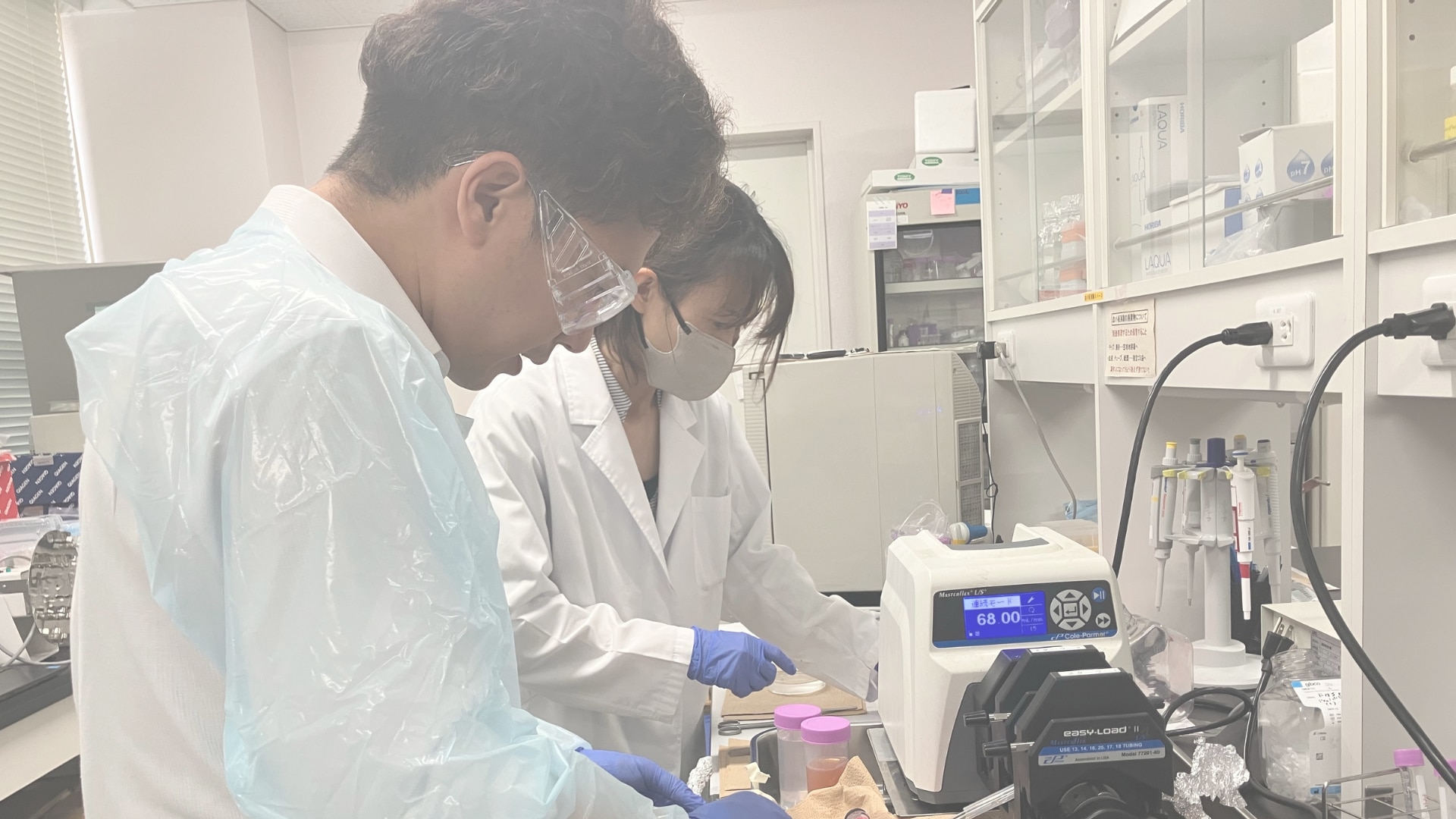
Professor Tanaka: Universities and companies have different roles. Universities pursue the essence of things. Companies implement them in society. It's not a matter of one being superior to the other. In medical device development, new value is only created when material manufacturers, medical device manufacturers, universities, and medical facilities collaborate. Research on PMEA and intermediate water has also grown precisely within such collaboration.
The limits of coatings—the potential of Zelas™AMP
Kiyan: Looking at the current development of materials and coatings for medical devices, what areas do you feel still need improvement?
Professor Tanaka: There are two main issues. One is the limitations of the coating itself. There is a possibility of peeling. It is difficult to uniformly coat the surface of products with complex shapes. The increased number of processes also increases costs and the burden of quality assurance. The other is the continued reliance on heparin in Europe and the United States. Japan has made relatively good progress in switching to synthetic polymers, but globally, heparin coating remains the mainstream.
Kiyan: So, ideally, the design should incorporate biocompatibility into the base material itself, right?
Professor Tanaka: I agree. Coating is a post-processing step and is not cost-effective. Ideally, if the material itself had a structure that formed intermediate water, it would exhibit uniform performance even with complex shapes, and the risk of peeling could be eliminated.
Kiyan: Zelas™ AMP, which our company developed, is based on that design philosophy, and we have been working with Professor Tanaka for many years to verify its effectiveness. Because it can exhibit intermediate water-forming ability simply by compounding it with general-purpose substrates such as PVC and PU,
We are confident that Zelas™ AMP will be a revolutionary material that will break the conventional wisdom that "biocompatibility equals coating."
A message to medical device engineers
Kiyan: Finally, do you have a message for medical device engineers and researchers?
Professor Tanaka:Maintaining a sense of awareness of the problem, conducting experiments, and communicating your findings—these three things are important.
And one more thing: "Making an effort to see what is invisible."
Neither PMEA nor intermediate water had a clear answer from the start.
This was born from continuously questioning the small inconsistencies I felt during my daily experiments.
Developing medical devices is a job that directly impacts patient safety and improves their quality of life.
That's why it's not just about creating high-performance materials, but also about understanding "why that performance is achieved," accumulating that knowledge as science, and delivering it to the medical field.
References
- Ishihara, K., Nomura, H., Mihara, T., Kurita, K., Iwasaki, Y. and Nakabayashi, N. (1998), Why do phospholipid polymers reduce protein adsorption? J. Biomed. Mater. Res., 39: 323-330. https://doi.org/10.1002/(SICI)1097-4636(199802)39:2<323::AID-JBM21>3.0.CO;2-C
- Tanaka M, Motomura T, Kawada M, Anzai T, Kasori Y, Shiroya T, Shimura K, Onishi M, Mochizuki A. Blood compatible aspects of poly(2-methoxyethylacrylate) (PMEA)—relationship between protein adsorption and platelet adhesion on PMEA surface. Biomaterials. 2000;21(14):1471–1481. doi:10.1016/S0142-9612(00)00031-4.pmc.ncbi.nlm.nih+1
- Tanaka M, Motomura T, Kawada M, Anzai T, Kasori Y, Shimura K, Onishi M, Mochizuki A, Okahata Y. A new blood-compatible surface prepared by poly(2-methoxyethylacrylate) (PMEA) coating—protein adsorption on PMEA surface. Jpn J Artif Organs. 2000;29(1):209–216. doi:10.11392/jsao1972.29.209.cir.nii.ac
- Tanaka M, Motomura T, Ishii N, Shimura K, Onishi M, Mochizuki A, Hatakeyama T. Cold crystallization of water in hydrated poly(2-methoxyethyl acrylate) (PMEA). Polym Int. 2000;49(12):1709–1713. doi:10.1002/1097-0126(200012)49:12<1709::AID-PI601>3.0.CO;2-L.
Technical Terminology Explanation
Biocompatibility
The ability of a material to perform its intended function without causing toxicity, inflammation, or immune reactions when it comes into contact with a living organism. Blood compatibility is a concept that specifically focuses on "blood contact."
Surface Free Energy
An index representing the energy state of a material surface. It is estimated from methods such as contact angle measurement. Traditionally, it has been used to explain blood compatibility, but in cases such as PMEA, it may not be sufficient on its own.
Industry-academia collaboration
This is a form of research and development in which universities (basic research and pursuit of fundamental principles) and companies (social implementation and product development) collaborate, each with their own assigned roles. In the medical device field, a four-party collaboration between material manufacturers, medical device manufacturers, universities, and medical institutions is considered the ideal form.
Zelas™ AMP (Mitsubishi Chemical)
An antithrombotic thermoplastic elastomer utilizing the intermediate water concept. By simply compounding it with base resins such as PVC and PU, it can impart intermediate water formation ability, low protein adsorption, and low bacterial adhesion. This enables a base material design approach suitable for complex-shaped medical devices such as blood circuits. For evaluation inquiries, please feel free to contact us using the contact information below.