What is Zelas™ AMP, which enhances blood compatibility through the power of "intermediate water"?
In medical devices that come into contact with blood, such as tubing, catheters, and dialysis circuits, "thrombus formation" and "protein adsorption" are always challenges that need to be overcome. Until now, surface coating has been the mainstream solution for many devices, but many people have likely felt that this method presents challenges in terms of manufacturing process complexity, cost, and durability.
This time, we will thoroughly explain the groundbreaking mechanism and manufacturing benefits for medical device manufacturers of "Zelas™ AMP," a next-generation antithrombotic thermoplastic elastomer developed by Mitsubishi Chemical.
Table of Contents [hide]
- 1.What is Zelas™ AMP?
- 1.1.Why does it work without coating?
- 1.2."Intermediate Water" × Unique Polymer Structure
- 1.3.Applicability to various resin materials
- 2.Functional evaluation of Zelas™AMP
- 2.1.Dramatic reduction in protein adsorption
- 2.2.Inhibition of platelet adhesion
- 2.3.Inhibition of bacterial adhesion
- 3.Transform the manufacturing process of medical device manufacturers!
- 4.Future Outlook and Development Status
- 5.Summary
- 6.References
- 7.Applicationexamples
What is Zelas™ AMP?
Zelas™ AMP is a novel medical compound with surface functionality that utilizes amphipathic polymer technology.
This amphiphilic polymer (the key polymer of Zelas™AMP) is a material specifically developed for molding materials that possesses functions described later, such as antithrombotic properties and resistance to protein adhesion.
We call the resin compound containing this key polymer, which exhibits excellent blood compatibility, Zelas™ AMP.
Why does it work without coating?
By blending Zelas™AMP's key polymers as additives into a base resin, the base resin can be imparted with antithrombotic properties.
Instead of applying an antithrombotic coating to medical device components after molding, as has been done conventionally, the material itself is modified.
It becomes possible to create highly blood-compatible devices simply by "molding" them, just like in a normal process.1)
"Intermediate water" × Unique polymer structure
We hypothesize that the secret to Zelas™ AMP's ability to prevent blood clots and protein adhesion lies in the "intermediate water" formed on the material's surface. Furthermore, this characteristic is also present in the polymer structure, allowing for excellent surface functionality while simultaneously achieving moldability.
- Hydrophilic Segment: This segment retains moisture on its surface, inhibiting the adsorption and denaturation of biological components. This hydrophilic segment is composed of a polymer structure that is believed to contain intermediate water.
- Hydrophobic Segment: Maintains compatibility with the base resin (such as PVC or TPU), facilitating molding and processing.
- Amphiphilic polymer structure: By retaining the properties of both hydrophilic and hydrophobic regions, it can be used as a key polymer that can impart an effect of reducing the adhesion of platelets and proteins to molded products.

This unique polymer structure creates a special layer of intermediate water on the material surface, which is neither "antifreeze water" nor "free water." This hydration layer is thought to act as a barrier, preventing platelets and proteins from directly contacting the material surface. Professor Ken Tanaka of Kyushu University has explained the mechanism by which this special layer of water molecules formed on the material surface prevents the adsorption of platelets and proteins.2)

Applicability to a variety of resin materials
It can be blended with a variety of base resins, including PVC, TPU, TPO, TPS, and PMMA. It can impart antithrombotic properties while maintaining physical properties such as hardness, transparency, and tensile strength.
Note: In some cases, we may not be able to provide the product using certain materials. Also, depending on the base resin, we may refer you to the relevant department within our company.
Functional evaluation of Zelas™AMP
Here is some performance data showing the actual results of adding Zelas™ AMP to existing resins (PVC, TPU).
Dramatic reduction in protein adsorption
Compared to conventional flexible PVC, it has been confirmed that PVC containing Zelas™ AMP reduces the amount of protein (fibrinogen) adsorbed to approximately 1/5. Although flexible PVCs use different plasticizers, it has been confirmed that the effect can be obtained with a wide range of plasticizer types, including DOP, DINCH, and TOTM.
Furthermore, we have confirmed that the amount of adsorption is similarly reduced to approximately 1/2 to 1/6 when added to TPU (thermoplastic polyurethane).
Inhibition of platelet adhesion
In an evaluation conducted in collaboration with Professor Ken Tanaka of Kyushu University, 3) in an experiment in which the material was immersed in human blood for one hour, a large number of platelets adhered to and deformed the material in ordinary soft PVC, while almost no platelet adhesion was observed in the product containing Zelas™ AMP.
Inhibition of bacterial adhesion
In-house bacterial adhesion tests confirmed that the amount of Staphylococcus aureus adsorbed by Zelas™ AMP-containing products was reduced to approximately 1/4 compared to regular flexible PVC. In addition to the low adhesion effect on proteins (fibrinogen) and platelets, we believe that suppressing the adhesion of bacteria that can cause infectious diseases will enable us to propose materials with even lower risks.

We're going to change the manufacturing process for medical device manufacturers!
The possibility of "process simplification"
The biggest advantage of using Zelas™ AMP is that it simplifies the manufacturing process and reduces costs while ensuring blood compatibility and other functionalities.
The diagram below shows a typical manufacturing line process. To improve the adhesion between the base resin and the coating, a lengthy process is required, including priming, coating, functional coating application, drying, and quality inspection.
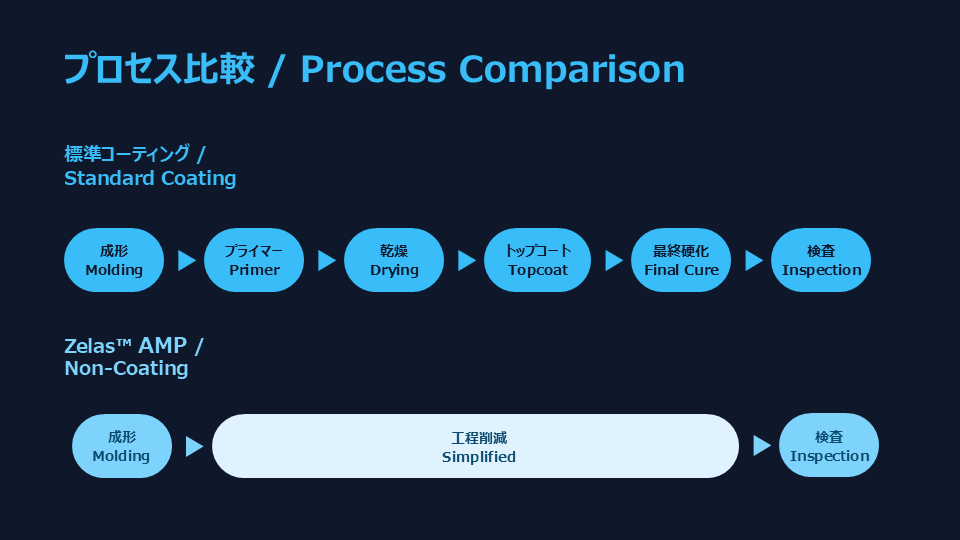
Furthermore, we would like to encourage medical devices that want to improve blood compatibility but cannot afford the process costs associated with coating to consider this solution.
Benefits of hiring
• Process Reduction: Processes such as coating, drying, and curing are eliminated.
• Stabilizing quality: This can reduce the risk of uneven coating or peeling, potentially contributing to extending the product life.
• Zelas™AMP is a synthetic polymer and is considered to have a low risk of containing bio-derived components.
Future prospects and development status
With the aim of fully launching Zelas™AMP polyvinyl chloride resin into the market in fiscal year 2027, we are actively developing the key polymers of Zelas™AMP for mass production.
Furthermore, in October 2025, Mitsubishi Chemical announced joint research with Kyushu University and Osaka University. Through collaboration with academia, we are advancing the verification of safety and effectiveness in practical medical settings.
We can currently provide development samples to manufacturers who are developing catheters, vascular access devices, dialysis/transfusion circuits, etc.
▶ Press release article (Link: https://www.mcgc.com/news_release/02443.html)
summary
"We want to improve the antithrombotic performance of our products without changing our existing manufacturing lines."
"We want to reduce costs by cutting down the coating process."
If you are a developer facing these kinds of challenges, please consider Zelas™ AMP.
We also offer technical consultations, including detailed physical property data and advice on formulations for your products. Please contact us using the information below.
Additionally, for customers interested in Zelas™AMP coatings, we can provide information about our coating services.
References
1) Technical Information Association (ed.), "Protein Adsorption and Interfaces: Development of Hydrophilic, Antithrombotic, Cell-Affinity, and Antimicrobial Materials Approaching from a Mechanistic Perspective," published September 30, 2024, 437 pages, ISBN: 978-4-86798-040-8
*See Chapter 2, Section 11, "Medical Compounds with Low Protein Adsorption and Blood Compatibility."

CASE
Application example