

Cell Culture Tube Selection Guide – Key Points for Choosing Materials to Support the Future of Regenerative Medicine
In the research and manufacturing processes of regenerative medicine, the quality of the tubes that come into direct contact with cells and culture media is crucial to the safety and effectiveness of the product. This article summarizes the latest trends in regenerative medicine and the challenges of tube materials, and then introduces Mitsubishi Chemical's TPE material for cell culture, "Zelas™ MP6301C," and Sanplatec's iP-TEC® tube products.
Table of Contents [hide]
Challenges surrounding regenerative medicine
What is regenerative medicine?
Challenges in the widespread adoption of regenerative medicine
While regenerative medicine is expected to enter a period of significant growth in the future, various challenges are also emerging in its industrialization.
Quality regulatory standards are not yet established.
Currently, there are no regulatory bodies that have established quality standards for resin products used in regenerative medicine. The Forum for Regenerative Medicine Innovation (FIRM) has developed and published the "FIRM Guide for Equipment Users," which provides guidance on points to consider when selecting plastic equipment (sterility assurance levels, endotoxin management, extract/elute management, cytotoxicity testing, etc.), but a unified industry standard is still in the development stage.
Research equipment is not designed for medical use.
In regenerative medicine, the "cells themselves" are the final product, so extractables and leachables derived from the materials directly affect the health, proliferation, and quality of the cells. However, many of the resin products currently in use were originally manufactured for research purposes and were not designed with pharmaceutical manufacturing applications such as regenerative medicine in mind. The number of materials that can be reliably supplied as medical materials is limited, and in some cases, obtaining the materials themselves is difficult.
表に再生医療研究で用いられるチューブの主な材質を比較します。
item | TPE(熱可塑性エラストマー/TPS系) | シリコーン(白金触媒硬化型) | PVC(ポリ塩化ビニル) | フッ素樹脂 |
溶出物リスク(E&Lリスク) | Very low | Very low | 高い(DEHP等の可塑剤溶出) | Very low |
ガス透過性 | 低~中 | expensive | 低~中 | Very low |
熱溶着・シール性 | 可能 | 不可 | 可能 | 困難 |
滅菌方法 | γ線滅菌・オートクレーブ滅菌※・EOG滅菌 | オートクレーブ滅菌※・EOG滅菌 | γ線滅菌・EOG滅菌 | オートクレーブ滅菌※・EOG滅菌 |
価格 | 中程度 | expensive | Very low | 非常に高い |
※オートクレーブ滅菌:121℃
In regenerative medicine manufacturing, maintaining a closed system is extremely important, requiring aseptic connection and disconnection of tubes. In this respect, TPE materials have a significant advantage because they can be heat-welded. On the other hand, silicone cannot be heat-welded, so pre-assembled systems or dedicated aseptic connectors are required.
TPE (tube material) for cell culture provided by Mitsubishi Chemical
As can be seen from the material comparison above, TPE is a material that possesses a good balance of the characteristics required for regenerative medicine, such as "low elution, heat welding capability, and diverse sterilization methods." Based on its more than 30 years of experience in developing the medical compound "Zelas™" series, Mitsubishi Chemical offers the TPS-based grade "MP6301C," which has been meticulously formulated down to the smallest detail to optimize it for cell culture applications.
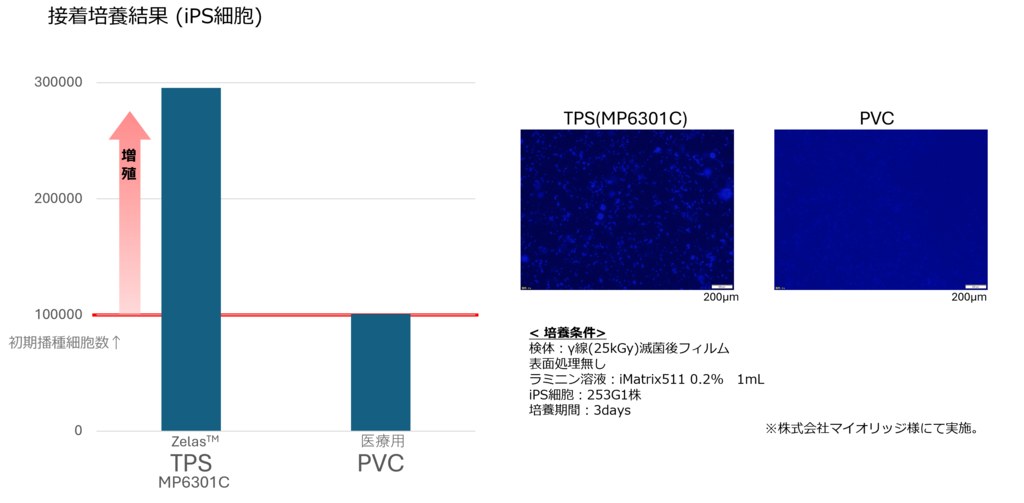
As shown in the figure above, Zelas™ MP6301C has been confirmed to proliferate without problems even in adhesion culture tests using iPS cells, which are considered to be extremely sensitive to chemical substances compared to conventional cell lines. On the other hand, with PVC (polyvinyl chloride), almost no proliferation was observed from the initial seeding number. We hypothesize that this is because plasticizers may have leached out from the PVC and acted as cytotoxic to the iPS cells. This result indicates that the selection of plastic materials used in regenerative medicine research has a decisive impact on cell survival and proliferation.
Other features of the MP6301C:
• Gamma-ray sterilization compatible: Compatible with gamma-ray sterilization, widely used in the manufacturing process of regenerative medicine products, maintaining minimal physical property changes and low elution even after 25 kGy irradiation.
• Autoclave (AC) sterilization compatible: Also compatible with high-pressure steam sterilization (121°C), offering flexible adaptation to various sterilization processes.
• Heat-weldable: Compatible with heat-welding sterile tube joining machines and ultrasonic tube sealers, enabling the maintenance of a closed system through aseptic connection and cutting operations. It allows for the construction of a completely closed system through heat welding, which is difficult with silicone tubing. Furthermore, it can be heat-welded and overmolded with polypropylene and our Zelas™ TPO, TPS, and CP products, increasing the design flexibility of various products in regenerative medicine.
• Custom grade design possible: Based on our extensive knowledge of compounding design, including material fluidity and hardness adjustment, we can design specific grades.
TPE tubes for cell culture provided by Sanplatec
Mitsubishi Chemical's "Zelas™ MP6301C" is supplied as a material (compound), but if you require a finished product molded into a tube shape, please consider the iP-TEC® series from Sanplatec Co., Ltd.
Sanplatec has a long track record of developing live cell transport technologies and culture devices for the realization of regenerative medicine. They incorporate the knowledge gained at the forefront of regenerative medicine, including the development of containers for regenerative medicine products and closed-type automated culture systems, into their product designs.
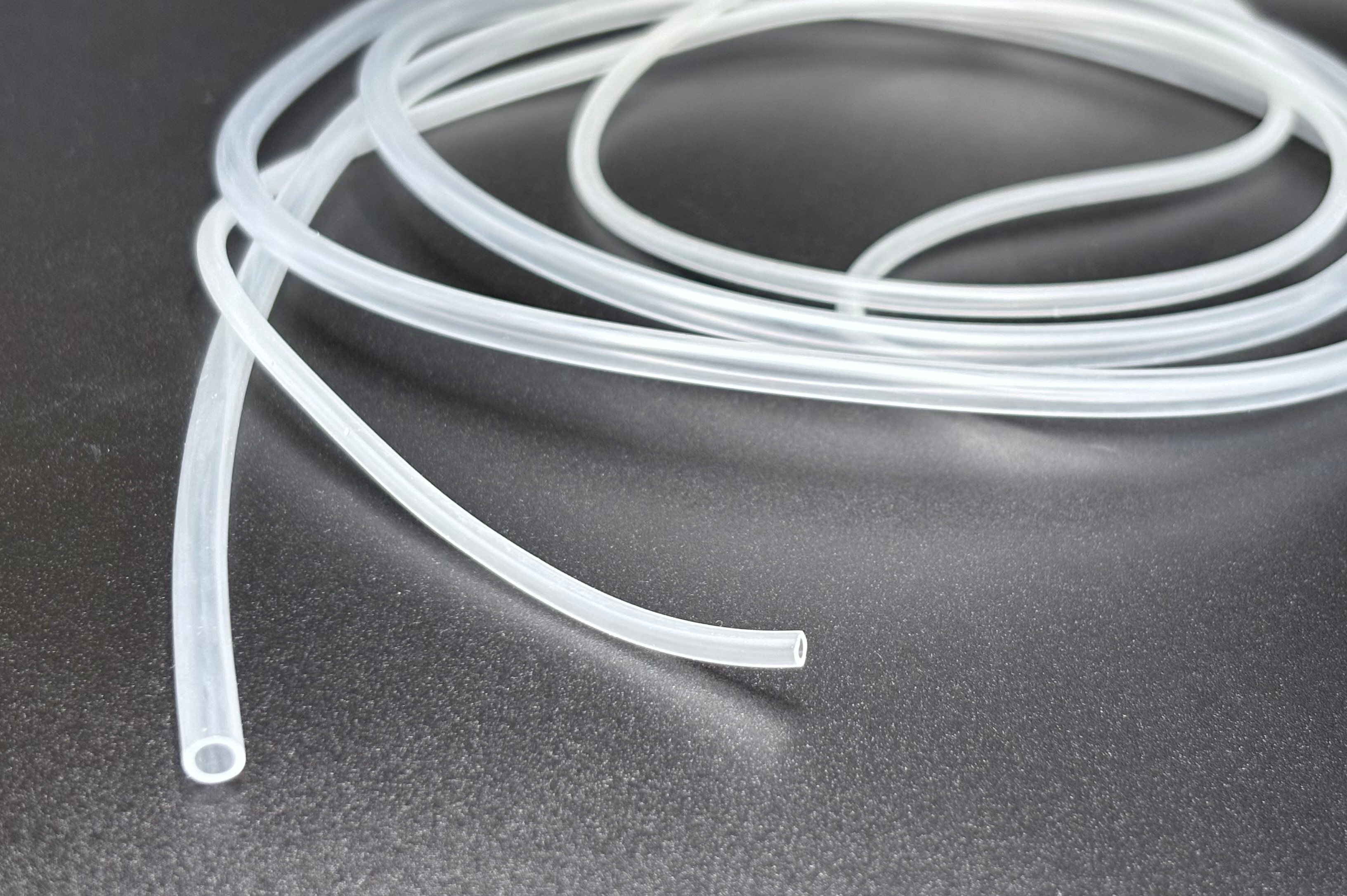
Strengths of iP-TEC® tube products:
• Stable supply unique to domestically manufactured products: By avoiding supply chain risks associated with overseas manufacturers, we ensure a stable supply of products with consistent quality and delivery times.
• Tubing for automated cell culture systems: Optimized tubing design for perfusion culture systems enables automated culture medium exchange in closed systems.
• Flexible customization: We can customize the size and shape to suit your equipment specifications and culture process, and we also support performance testing and the setting of quality standards.
As the industrialization of regenerative medicine accelerates, a safe and reliable manufacturing process can only be achieved when both "material quality" and "perfect quality as a tube product" are in harmony. Please look forward to our integrated solutions brought about by the collaboration between material manufacturers and device manufacturers.
▶ For iP-TEC® product lineup and inquiries, please visit: https://iptec.sanplatec.co.jp/
summary
With the industrialization of regenerative medicine, the selection of materials for cell culture tubes has become a design parameter that directly impacts product quality and patient safety, as well as cost and convenience. TPE is a promising option as a material that can comprehensively address challenges such as cytotoxicity from eluted substances, sterilization compatibility, gas permeability, and the feasibility of sterile connections.
Mitsubishi Chemical's Zelas™ MP6301C is a TPE material that meets the stringent requirements of regenerative medicine, thanks to its compatibility with gamma-ray and autoclave sterilization, the construction of closed systems by heat welding, and its proven cell proliferation properties. Furthermore, Sanplatec's iP-TEC®, a tube product using MP6301C, provides seamless support from research to manufacturing with stable supply through domestic manufacturing and optimized design for automated culture systems.
If you are having trouble selecting materials or developing products for cell culture tubes, please feel free to contact us.
References
- Nikkei Shimbun Digital Edition, "Two iPS Cell Products Approved: First Practical Applications, Commercialization Expected as Early as Summer" (Published March 6, 2026, Last Accessed March 10, 2026) https://www.nikkei.com/article/DGKKZO94831880W6A300C2EAF000/