
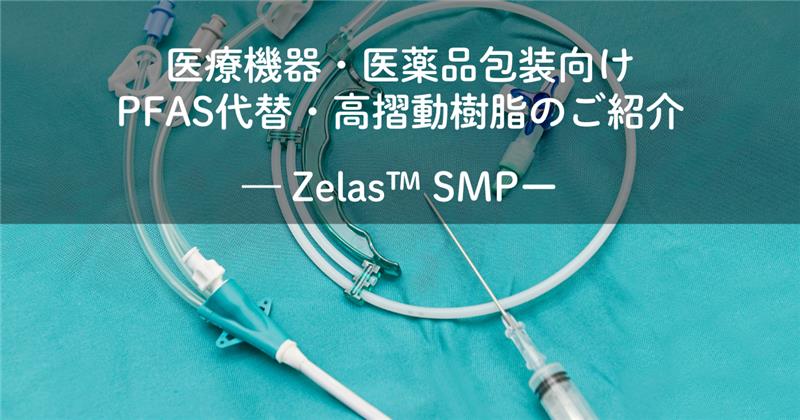
Introducing Zelas™ SMP, a high-friction resin and PFAS alternative for medical device and pharmaceutical packaging.
In the fields of medical devices and pharmaceutical packaging, fluoropolymers such as PTFE and ETFE have been used for many years due to their "high sliding properties," "chemical resistance," and "low adsorption." On the other hand, in January 2023, a comprehensive regulation proposal for PFAS, including fluoropolymers, targeting more than 10,000 types of PFAS substances, was submitted to ECHA. In March 2026, the RAC adopted its opinion, and the concrete development of regulatory considerations is steadily progressing. In this context, there is a need for new materials that can replace fluoropolymers, offering high sliding properties, low elution, and thin-film capabilities. Zelas™ SMP, currently under development by Mitsubishi Chemical, is a high-sliding resin chemically bonded with polypropylene and silicone, and has the potential to be applied to a wide range of medical applications, such as inner and outer layers of catheters and drug stopper laminates. This article will summarize the trends in PFAS regulation and then introduce the features and application concepts of Zelas™ SMP.
Table of Contents [hide]
- 1.Concerns about PFAS regulations
- 1.1.Status of discussions regarding PFAS regulations at ECHA (as of March 2026)
- 1.2.Difficulty in finding alternative materials
- 2.Zelas™ SMP
- 2.1.Features
- 2.2.Highsliding properties
- 2.3.Low bleed-out and elution
- 2.4.Flexibility
- 2.5.Support for multi-layered construction
- 2.6.Thin film compatible
- 2.7.Chemical resistance and low permeability
- 3.Main applications of high-sliding resins
- 3.1.Medical Devices
- 3.2.Zelas™ SMP Application Image
- 3.3.Innermost and outermost layers of high-performance catheters
- 3.4.Innermost and outermost layers of an endoscopic catheter
- 3.5.Zelas™ SMP Application Image
- 4.Other uses
- 4.1.Pharmaceutical Packaging
- 4.2.Zelas™ SMP Application Image
- 4.3.Innermost and outermost layers of the fluid delivery tube
- 5.Others
- 6.Disclaimer
Concerns about PFAS regulations
Status of discussions regarding PFAS regulations at ECHA (as of March 2026)
In January 2023, authorities from five countries—Denmark, Germany, the Netherlands, Norway, and Sweden—submitted a comprehensive proposal for PFAS regulations under the EU REACH Regulation (Annex XV Restriction Report) to ECHA (European Chemicals Agency). This proposal covers more than 10,000 PFAS substances and 14 major industrial sectors (including medical devices, electronics, and textiles), making it the largest regulatory proposal in the history of the REACH Regulation.
During the open consultations held from March to September 2023, numerous comments were received, and based on these, a revised version (Draft Background Document) was published in August 2025. The revised version includes an additional evaluation of eight sectors not included in the original proposal (military, sealing, technical fibers, primary packaging and additives for pharmaceuticals, etc.), and also presents a third option, "continued use under strict control conditions (RO3)," in addition to the previous "total ban (RO1)" and "ban with grace period (RO2)."
On March 3, 2026, ECHA's Risk Assessment Committee (RAC) completed its assessment of the proposed comprehensive restriction of PFAS and adopted its final opinion. This opinion, based on the 2023 proposal and its 2025 revision, comprehensively evaluates the hazards, usage, emissions, risks, and effectiveness of the restriction of PFAS, and ECHA will publish the full text in the near future. On March 11, 2026, ECHA's Socioeconomic Analysis Committee (SEAC) agreed on a draft opinion on the proposed comprehensive restriction of PFAS. The RAC's final opinion and the SEAC's draft opinion are expected to be published soon, and a 60-day public comment period for the SEAC's draft opinion is expected to begin. SEAC aims to adopt a final opinion by the end of 2026, taking into account the information received during the public comment period.
The final RAC and SEAC opinions will be formally submitted to the European Commission by the end of 2026. The European Commission will then formulate a draft PFAS restriction regulation based on these scientific and socioeconomic assessments, and submit it for deliberation and voting by the REACH Commission (representatives of member states).
Main public sources:
CHA — Hot Topics: PFAS https://echa.europa.eu/hot-topics/perfluoroalkyl-chemicals-pfas
FDA — PFAS in Medical Devices https://www.fda.gov/medical-devices/products-and-medical-procedures/pfas-medical-devices[1]
The difficulty of finding alternative materials
One of the main reasons fluoropolymers have been widely used in medical device and pharmaceutical packaging is that they meet the following properties at a high level: [13][1]
• High sliding properties (low coefficient of friction): Lowest static friction coefficient among resin materials
• Chemical resistance: Resistance to a wide range of chemicals, solvents, and disinfectants.
• Heat resistance: Resistance to high-temperature steam sterilization and high-temperature processing.
• Low adsorption and low elution: Low adsorption of drug components and low elution of material components.
• Thin film formability: Suitable for forming and laminating thin films of 10-50 μm thickness.
It is extremely difficult to satisfy all of these properties with non-PFAS materials. PP and PE lack sufficient sliding properties, and silicone alone carries the risk of contamination due to desorption and elution. PEEK has excellent sliding properties but is hard, and ultra-high molecular weight PE presents challenges in thin-film extrusion molding. As a new material to fill these gaps, we introduce Zelas™ SMP, a high-sliding resin that combines the advantages of PP and silicone through chemical bonding. [14][15][13]
Zelas™ SMP
Features
Zelas™ SMP is a high-friction resin currently under development by Mitsubishi Chemical, which chemically bonds polypropylene and silicone. It possesses the unique characteristics of combining the processability and mechanical properties derived from PP with the surface properties derived from silicone. The following summarizes its features relevant to medical device and pharmaceutical packaging applications.
High sliding properties
Zelas™ SMP offers significantly improved sliding properties compared to PP. Designed on an rPP base, Zelas™ SMP reduces static friction by approximately 40% and dynamic friction by approximately 50% compared to typical random PP (rPP). The chemically bonded silicone phase forms a permanently low-friction surface that is independent of bleed-out.
Zelas™ SMP can be designed using homo-PP (hPP) or block-PP (bPP) bases, and while it offers less flexibility than rPP-based designs, it provides even higher sliding properties. It has the potential to provide sliding properties equivalent to or comparable to PTFE liners as a sliding surface for guidewires and catheter devices.
Low bleed-out/elution
Conventional silicone-containing resins and silicone oil-added compounds raise concerns about the silicone component bleeding out (seeping to the surface) over time, potentially causing fine particles and secondary contamination. Zelas™ SMP, however, features extremely low silicone seepage even in high-temperature environments because the silicone portion is chemically bonded to the PP backbone.
The residual levels of cyclic siloxanes (D4, D5, D6) are less than 10 ppm, well below the 1,000 ppm threshold regulated by the EU REACH regulation. This property reduces the risk of silicone leaching from wetted surfaces and subvisible particles in the primary packaging of pharmaceuticals.
Flexibility
Zelas™ SMP can be designed using any PP-based polymer as the base, achieving flexibility comparable to rPP. Compared to PEEK, it is significantly softer, making it suitable for designs that offer superior flexibility and kink resistance in catheter shafts.
Furthermore, compared to ultra-high molecular weight PE, it is easier to extrude into thin films, making it a promising material for use as an inner liner for small-diameter catheters.
Multi-layered construction compatible
Because Zelas™ SMP has a PP backbone, it exhibits excellent heat-sealing and co-extrusion properties with PP, PE, TPE (especially TPO/TPS), and other olefin-based materials. When used in combination with Zelas™ adhesive grades, which are flexible and have good adhesion to polar resins, it is also possible to create multilayer structures with polar resins such as PA and highly polar TPEs (PA elastomer, TPU, etc.).
This method eliminates the need for adhesives or primers, enabling direct co-extrusion of multilayer tubes, which is expected to streamline catheter manufacturing processes while increasing flexibility and design freedom.
Conventional PTFE liners typically require chemical etching for bonding to the blade and outer jacket material, but this pretreatment step may be omitted when using SMP. [7]
Thin film compatible
The surface properties of Zelas™ SMP are essentially independent of thickness; for example, even thin films of about 5 μm maintain high sliding and liquid-repellent properties. This may contribute to achieving a design that maximizes the inner diameter while minimizing the liner thickness when applied as an inner layer of a catheter.
It can also be considered for application to laminating films for drug caps, and could be a potential alternative to PTFE and ETFE film laminations.
Chemical resistance and low permeability
As a PP-based polymer, Zelas™ SMP exhibits chemical resistance comparable to that of PP. It is stable against acids, alkalis, alcohols, and various disinfectants, making it less likely to cause problems in the usage environments of catheters and fluid delivery tubes.
Its gas barrier and solvent barrier properties are comparable to those of PP, and it also has advantages in terms of low permeability compared to highly transparent alternative materials such as polymethylpentene (PMP). Low permeability is an important design element in packaging applications where the stability and shelf life of the chemical solution are crucial.
Main applications of high-friction resins
Numerous parts in medical devices and pharmaceutical packaging require smooth (low friction) sliding surfaces on both the inside and outside. Fluorine-based materials such as PTFE, FEP, ETFE, and PVDF have long been used in these areas. Below, we outline typical applications of Zelas™ SMP, along with specific application images. The layer configuration, thickness, and applied materials are merely examples; actual product design and mass production conditions can be optimized according to the application. [4][1]
Medical devices
Innermost layer of a guiding catheter
Guiding catheters are devices used to guide guidewires or balloon catheters to the coronary artery ostium during coronary intervention (PCI) and other procedures. A typical structure consists of three layers: a highly lubricating PTFE liner as the innermost layer, a stainless steel braided reinforcement layer in the middle, and a nylon elastomer jacket as the outermost layer. The innermost PTFE liner is considered essential for ensuring smooth sliding of the guidewire or device, providing resistance to blood and contrast agents, and meeting requirements for thinness (generally around 13–50 μm). [7][8]
Zelas™ SMP application image
Expected layer configuration:
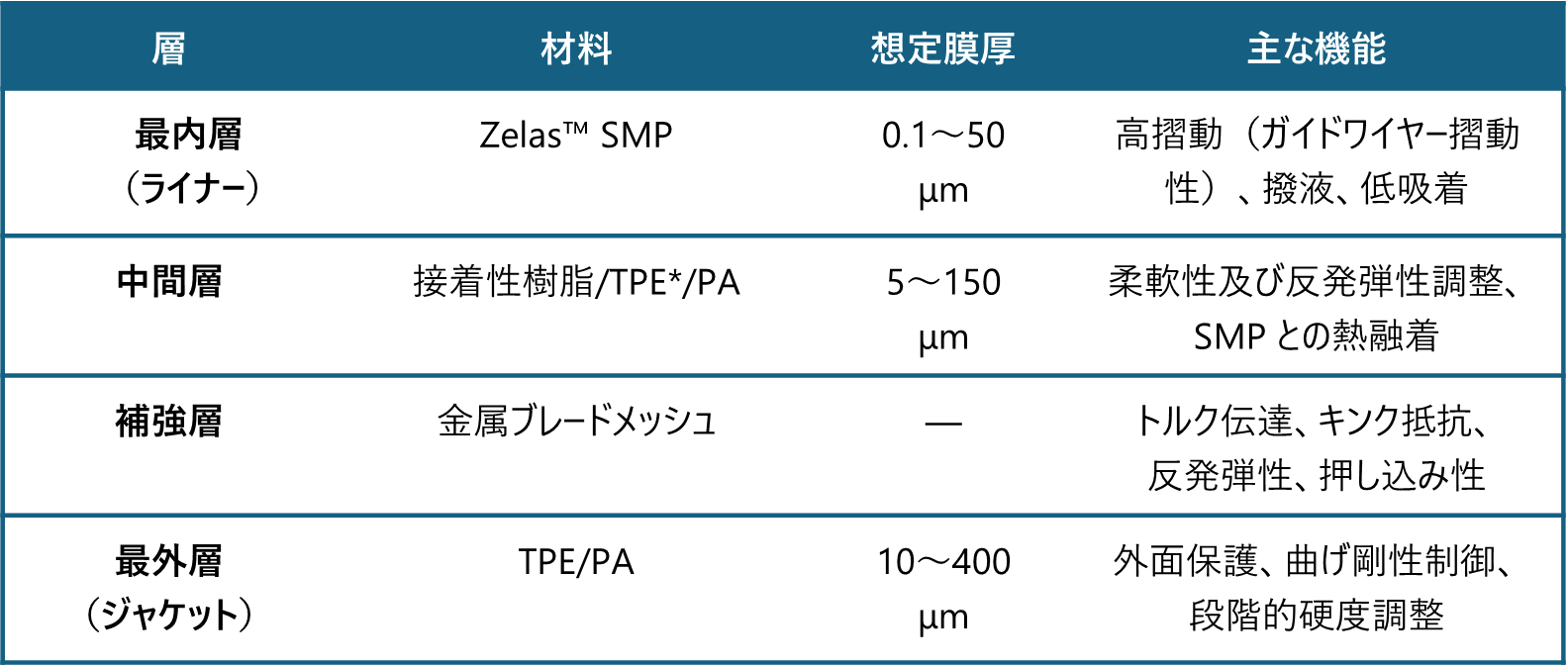
*TPE is an abbreviation for thermoplastic elastomer.
The innermost layer of Zelas™ SMP forms the sliding surface with the guidewire and is used as a substitute for a PTFE liner. The intermediate layer can be bonded without a primer due to its affinity with Zelas™ SMP, eliminating the chemical etching process often required with PTFE liners. However, surface treatments such as primers can be applied as appropriate to ensure further adhesion with adjacent layers. The process of directly coating the outer layer onto the blade mesh can be considered in the same way as in conventional catheter manufacturing, but in subsequent processes requiring molding and processing at high temperatures, such as the heat shrinkage process, it is desirable to optimize the conditions taking into account the heat resistance of Zelas™ SMP, which is a PP-based polymer. [7]
In designing flexible tip sections (soft tips), the low modulus of elasticity of Zelas™ SMP may be more advantageous than that of PTFE.
Furthermore, it is possible to dissolve or disperse Zelas™ SMP and use it as a liner coating. While there are limitations to the solubility of PP-based polymers, and optimization of applicable solvent systems and dispersion conditions will be necessary, this method may enable even thinner films.
Innermost and outermost layers of a high-performance catheter
High-performance catheters such as PCI balloon catheters, electrophysiological (EP) catheters, and peripheral vascular catheters sometimes require high sliding properties not only in the inner liner but also in the outer jacket. By using a high-sliding material in the outer layer, friction with the guiding catheter lumen and introducer sheath can be reduced, improving the insertability and operability of the device. Furthermore, increasing the sliding properties of the outer layer may reduce the reliance on hydrophilic coatings. In both the inner and outer layers, fluorine-based materials are sometimes used in composite structures with blade or coil reinforcement layers. Zelas™ SMP can be considered as an alternative material to fluorine-based materials in these catheter applications. [4]
Innermost and outermost layers of an endoscopic catheter
High sliding properties are considered important for endoscopic catheters and endoscopic channels (for water delivery, suction, forceps, etc.) from the following two perspectives:
• Internal channel surface: Ensures easy insertion of treatment instruments and reduces residue during cleaning and reprocessing after use. Minimizes adhesion of viscous bodily fluids and medications to the tube wall.
- Sheath outer surface: Improved ease of insertion into the digestive tract and bronchi, and ensures flexibility in curved sections.
Traditionally, PTFE or FEP is used for the inner surface of the internal channel, and the sheath typically consists of a multilayer structure of PTFE liner + blade or coil reinforcement + PA/TPU outer layer. All of these parts are candidates for PFAS replacement. [4]
Zelas™ SMP application image
Internal channels (water supply, suction, forceps channels):

The inner surface of the Zelals™ SMP is expected to improve the insertion of treatment instruments and facilitate the removal of bodily fluids and tissue residues during reprocessing (cleaning and disinfection) after use. It may also contribute to reducing protein adsorption, which is the starting point for biofilm formation. Similar to guiding catheters, adhesive resins and surface treatments can be applied to ensure adhesion between the Zelals™ SMP and other structural layers.
Sheath (outer tube):
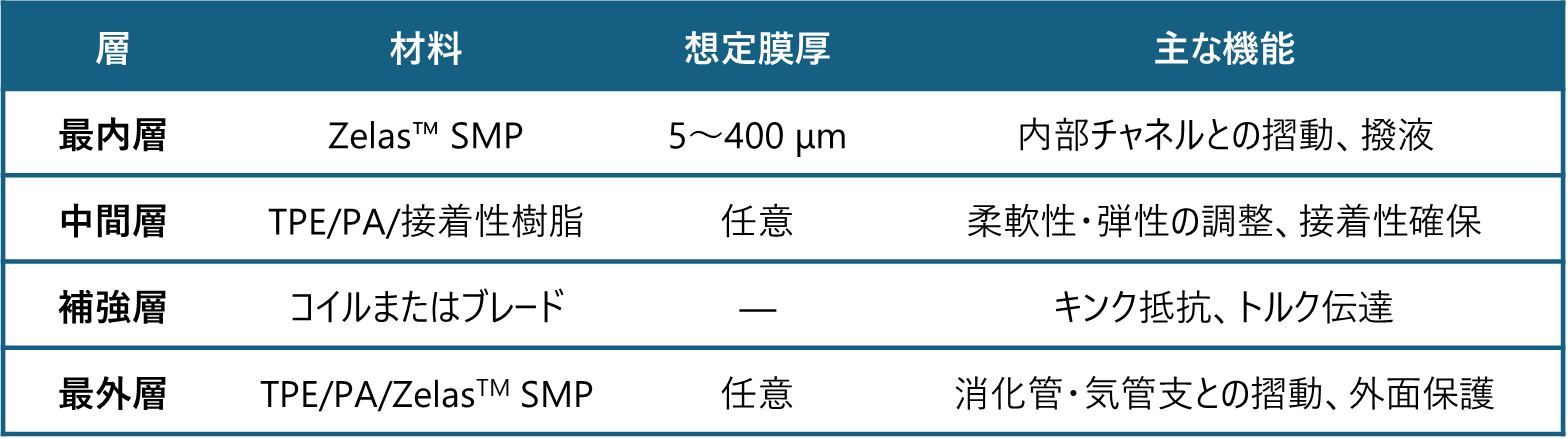
Another concept to consider is applying SMP to the outermost surface of the sheath to enhance sliding properties with the body cavity wall and further improve insertion.
Both the internal channel and the sheath can fulfill one of the above functions as a laminate. The composition, order, and number of layers are not limited to those described above, and surface treatments or coatings can be applied to the innermost and outermost layers.
Other uses
In addition to the above, the following are examples of medical device applications where high-friction fluoropolymer resins are used or are being considered for use. These applications can also be explored by extruding or coating Zelas™ SMP.
• Guidewire coating: PTFE coating or thin-walled tubing coating on the core wire. This provides both smooth movement and minimal invasiveness to the blood vessel wall. [1]
• Inner layer of stent delivery system: An inner liner for holding and transporting stents in a crimped state.
• Inner lining of blood lines in extracorporeal circulation circuits (ECMO/CPB): The fluid-repellent and low-adsorption properties at the blood contact surface may contribute to reducing priming fluid residue and protein adsorption.
• Infusion pump tubing: It may contribute to improved administration accuracy by reducing drug adsorption and residue on the inner surface of the tubing.
• Flow channels in POCT and diagnostic equipment: When delivering minute samples, the liquid-repellent and low-adsorption properties of the inner surface of the flow channel affect measurement accuracy.
In addition, coatings (such as spray application, dipping, or baking) may be used in conjunction with all of the above applications.
Pharmaceutical packaging
Laminating film for drug stoppers (vial stoppers, syringe gaskets, syringe caps)
Vulcanized elastomers such as butyl rubber and isoprene rubber are used as the base material for gaskets on vial stoppers and pre-filled syringes. Fluorine-based films such as PTFE and ETFE are commonly laminated to the liquid-contacting surfaces to prevent rubber component leaching, reduce particulate matter, and suppress drug adsorption. [9][10][11][12]
Zelas™ SMP application image
Configuration 1: Conventional rubber substrate + Zelas™ SMP laminate
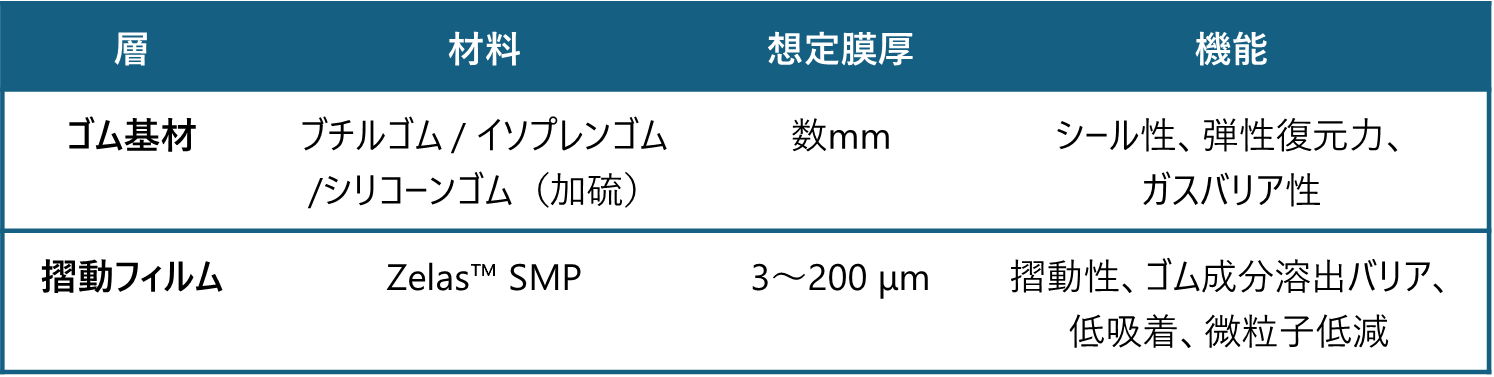
This concept leverages the high sliding properties of Zelas™ SMP to replace conventional PTFE/ETFE laminates with Zelas™ SMP film. Its low bleed-out characteristics and low permeability comparable to PP also make it suitable as a barrier between chemicals and rubber substrates. [10][9]
Configuration 2: Substrate substitution from vulcanized rubber to TPE (Zelas™) + SMP
By replacing vulcanized rubber with TPE, the vulcanization process itself can be eliminated, enabling integrated molding through co-extrusion and co-molding with SMP. Surface treatment (such as primer application and corona treatment) also becomes unnecessary, leading to process rationalization and cost reduction. For example, Zelas™ TPS/TPO is a PP-based TPE with high chemical affinity to SMP and excellent interlayer adhesion.
Innermost and outermost layers of the fluid delivery tube
In chemical manufacturing processes and filling lines, fluorine-based liners are sometimes used on the inner surface of liquid transfer tubes to minimize elution, adsorption, and residue in the chemical solution. Furthermore, in roller pump tubes, low friction is required on the sliding surface (outer surface) with respect to the pump rollers.
Zelas™ SMP, which excels in these characteristics and also has superior extrusion properties,can be considered as an alternative material.It can be easily multilayered with other resins, includingTPE, and can contribute to the multi-functionalization of tubes.
others
• Pre-filled syringe barrel surface: In addition to conventional silicone oil curing, fluorine-based coatings are being considered in some cases.
• Inner surface of transport containers for pharmaceuticals and biopharmaceuticals: Fluorine-based materials may be considered for liquid-repellent coatings aimed at reducing residues of viscous pharmaceuticals and biopharmaceuticals.
Zelas™ SMP may also be considered as an alternative material for the above applications.
In addition to liners and laminates, coatings (such as spray application, dipping, or baking) may be used in conjunction with each application.
Disclaimer
About products in the development stage
Zelas™ SMP is a material still under development and a pre-market product as of the time of writing this article (March 2026). Material specifications, performance values, and recommended processing conditions may change without notice as development progresses. The physical properties and structural examples described in this article are reference values based on typical evaluation conditions and do not guarantee the same performance under all usage conditions.
Regarding suitability for use and compliance with regulations
The application examples and layer configuration examples described in this article are conceptual proposals demonstrating the potential applicability of Zelas™ SMP and do not guarantee suitability, safety, or regulatory approval (Pharmaceuticals and Medical Devices Act, FDA, CE marking, national regulations, etc.) as specific medical device or pharmaceutical packaging.
The scope of application, grace period, and final decision regarding PFAS regulations (including the proposed ECHA REACH restriction) have not been finalized as of the time of writing this article and may change in the future. The final judgment and evaluation of regulatory compliance must be carried out under the responsibility of the user (medical device manufacturer/pharmaceutical packaging manufacturer).
For actual material selection and application considerations, please contact Mitsubishi Chemical's sales department.
Organization / Page / URL
ECHA /Registry of Restriction Intentions — PFAS /https://echa.europa.eu/registry-of-restriction-intentions/-/dislist/details/0b0236e18663449b
ECHA /Hot Topics — Perfluoroalkyl Chemicals (PFAS) /https://echa.europa.eu/hot-topics/perfluoroalkyl-chemicals-pfas
FDA / PFAS in Medical Devices / https://www.fda.gov/medical-devices/products-and-medical-procedures/pfas-medical-devices
References
- PFAS in Medical Devices | FDA - PFAS in Medical Devices ... The ECRI review found no conclusive evidence of patient health issues as...
- Revision of EU PFAS restriction proposal - Sustainable Futures - PFAS (per- and polyfluoroalkyl substances), often referred to as “forever chemicals”, have recently ...
- ECHA Sets Timeline for PFAS Restriction Assessment Proposal ... - On August 27, 2025, the European Chemicals Agency (ECHA) announced updated progress on the EU's prop...
- An Overview of Braid Reinforced Tubing for Catheters and Other ... - Braid-reinforced tubing has three layers: Inner liner; Braid reinforcement layer; Outer jacket. The ...
- ECHA's Risk Assessment Committee Adopts Opinion on PFAS ... - On March 3, 2026, the Risk Assessment Committee (RAC) of ECHA has concluded its assessment of the res...
- ECHA's Risk Assessment Committee Adopts Opinion on PFAS Restriction ... - On 3 March 2026, the European Chemicals Agency (ECHA) announced that its Risk Assessment Committee (...
- A Step-by-Step Guide to Constructing a Catheter with ... - Filmcast PTFE liners are renowned for their lubricious properties, making them essential for high-pe...
- A Review of Available Angioplasty Guiding Catheters, Wires and ... - The basic equipment involved in percutaneous coronary interventions - guiding catheters, guide wires...
- HK1239601A1
- WO2011059823A1
- US20020142124A1
- JP2002209975A
- What are viable alternatives to PTFE in catheter coatings? - Loaded Innovations - Alternatives to PTFE in catheter coatings that balance performance and manufacturability, as regulat...
- EverGlide+: PFAS-Free Liner for Next-Generation Catheter ... - Looking for a PFAS-free PTFE liner alternative for your catheter? Explore EverGlide+ to improve bond...
- PFAS Free Solutions Transforming the Medical Tubing Industry - The medical tubing industry is shifting as PFAS regulations tighten. Discover Saint Gobain and Junko...