
Selection Guide for Elastomer Materials for Medical Devices - Novel Flexible TPU: ChronoFlex™ S
This article is primarily aimed at those who are experiencing challenges with existing medical TPUs and silicones, and those who want to confirm their direction in material selection. We will organize the basic axes for selecting elastomer materials for medical devices (flexibility, durability, long-term implantation, processability, and sustainability), and provide an overview of the challenges of conventional materials such as silicones and carbonate-based TPUs. Furthermore, we will focus on "ChronoFlex™ S," an aromatic polycarbonate-based TPU that combines flexibility and long-term implant compatibility, and also has a 36% bio-based content, and clearly explain its specific applications in cardiovascular and neurovascular catheters and balloons.
Even if the intended use or specifications haven't been finalized, or even if you're still in the early stages of planning, please feel free to contact us for a consultation.
Table of Contents [hide]
- 1.What are elastomers suitable for medical devices?
- 2.Types and Selection Methods of Medical Elastomers
- 3.A new option to bridge the gap between silicone and TPU: ChronoFlex™ S
- 3.1.Low-hardness medical TPU
- 3.2.Medical Elastomers and Sustainability
- 3.3.Comparison of Material Types
- 4.Features of Chrono Flex™ S
- 4.1.Flexibility and long-term implant fit
- 4.2.Durability and wear resistance
- 4.3.Moldability and Adhesion to Other Materials
- 4.4.From the perspectives of regulations, quality, and sustainability
- 5.Applications
- 6.Summary
What are elastomers suitable for medical devices?
For minimally invasive medical devices such as catheters, stents, and artificial heart valves, elastomer materials that offer both "tissue-friendly softness" and "long-term reliability" are essential. These materials require flexibility to conform to blood vessels and organs, a certain level of rigidity necessary for insertion and manipulation, and biocompatibility to maintain performance even during long-term placement.
Traditionally, materials such as silicone, which offers excellent flexibility and biocompatibility; TPU, which boasts high mechanical strength and moldability; and PVC, which offers cost advantages, have been used selectively depending on the application. Meanwhile, amidst the trend towards decarbonization and environmental considerations, the medical field is also increasingly exploring bio-based materials, and there is a growing movement to add "sustainability" as a new criterion for material selection. ChronoFlex™ S is attracting attention as a material that bridges the performance gap between silicone and TPU while simultaneously being bio-based.
Types and Selection Methods of Medical Elastomers
Main elastomers and their characteristics
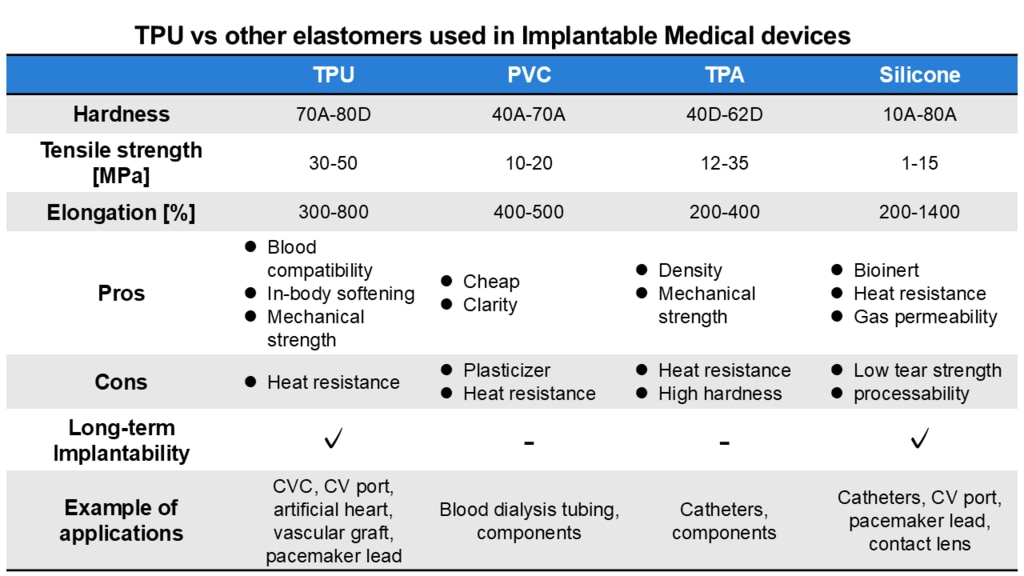
The main elastomers used in medical devices can be summarized as follows:
• TPU (Thermoplastic Polyurethane): Excellent blood compatibility, mechanical strength, and internal softening properties, and has a proven track record in long-term implantation applications such as CVCs, artificial hearts, vascular grafts, and pacemaker leads.
• PVC (polyvinyl chloride): Inexpensive and highly transparent, it is widely used in hemodialysis tubes and other applications, but plasticizers and heat resistance are challenges.
• Other TPEs (thermoplastic elastomers) such as TPA: While they have high mechanical strength and rigidity, they are primarily on the hard side and have limitations in flexibility.
• Silicone: While possessing high biocompatibility, heat resistance, and gas permeability, it has limitations in tear strength, abrasion resistance, and moldability for multilayer tubes and complex shapes.
The challenges of silicone and TPU, respectively.
For long-term implantation, silicone and carbonate-based TPUs are primarily used, but both have trade-offs.
silicone
• Advantages: It is very soft, has excellent biocompatibility, and has a long track record of successful long-term implants.
• Challenges: Relatively low tear strength and abrasion resistance make extrusion, multi-layer tube molding, and heat fusion with other materials difficult.
Carbonate-based TPU
• Advantages: High mechanical strength and biocompatibility, long-term implant compatibility.
• Challenge: The polymer skeleton is inherently rigid and hard, making it difficult to design in the low-hardness range of "less than 70A".
Furthermore, from an environmental and regulatory perspective, concerns are growing about materials that rely solely on fossil fuels, making the selection of "sustainable medical elastomers" a new challenge.
Furthermore, oils and other substances with plasticizing effects used in the plasticization of resins carry a risk of leaching during long-term implantation in the body, and are therefore generally avoided from the standpoint of safety and long-term performance stability.
A new option to bridge the gap between silicone and TPU: ChronoFlex™ S
Low-hardness medical TPU
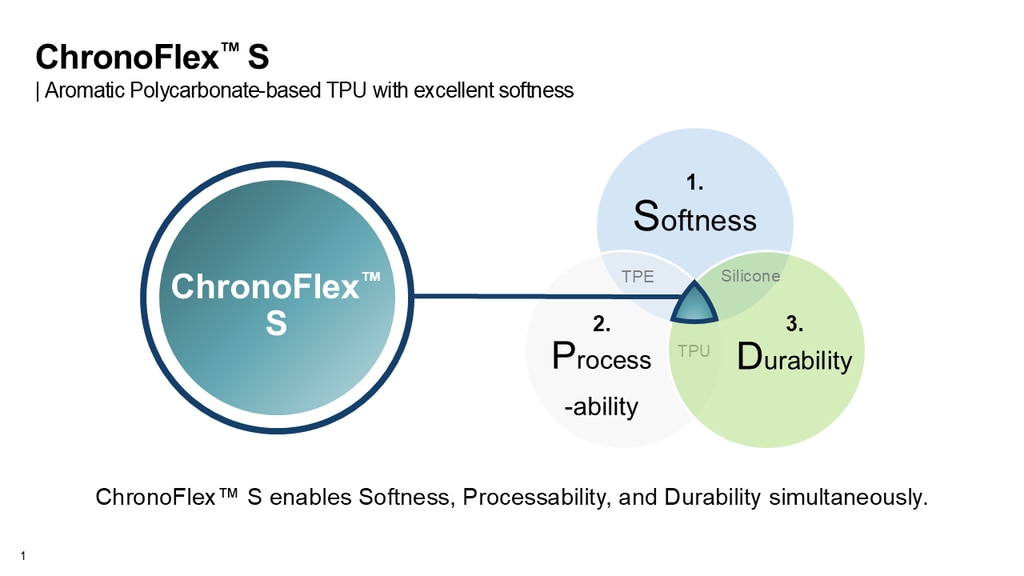
ChronoFlex™ S is a new medical-grade TPU that features a polycarbonate-based skeleton, preferred for long-term implant applications, while achieving a flexible hardness of around Shore A60 using only TPU without the use of plasticizers.
Leveraging our long track record as a medical-grade TPU supplier and our advanced compounding technology, we control the crystallization of hard and soft domains, suppressing instability such as the gradual increase in hardness. This allows us to simultaneously achieve flexibility superior to conventional TPU and the high mechanical strength and wear resistance characteristic of TPU.
Medical elastomers and sustainability
One of the key features of ChronoFlex™ S is its 36% bio-based content (ASTM D6866). This means that it is a TPU in which a portion of the raw materials have been replaced with biomass-derived materials, and that the material design contributes to reducing the carbon footprint compared to conventional pure fossil resource-derived TPUs.
In the medical device field, safety, performance, and regulatory compliance are the top priorities, but in recent years, an increasing number of device manufacturers are also focusing on "environmental impact throughout the entire lifecycle" and "material selection from an ESG perspective." ChronoFlex™ S maintains the performance and safety required for long-term implants while incorporating bio-based materials, making it an easily accessible option for companies that want to make sustainability one of their evaluation criteria for material selection.
Comparison of material types
When comparing ChronoFlex™ S with other materials, the following points can be made:
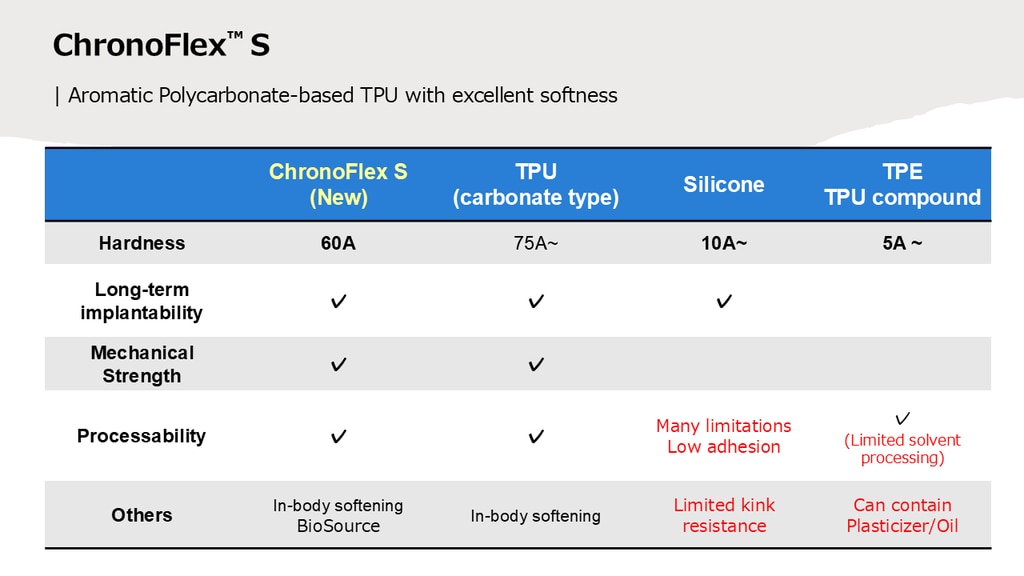
- This material is a suitable choice for applications that require both flexibility and long-term implant compatibility, as well as processability such as extrusion, injection molding, and coating, where intermediate properties between silicone and TPU are needed.
Unlike compound TPEs containing plasticizers, this is pure TPU and plasticizer-free, making it suitable for applications where the risk of hardness changes due to plasticizer bleeding needs to be suppressed.
-It also supports solution molding, contributing to the realization of composite structures such as thin layers and multilayer structures (lamination with other materials).
- The use of biomass raw materials makes it a viable option for companies that want to include environmental considerations as an evaluation criterion when selecting materials, as it allows them to easily balance performance and sustainability.
Features of ChronoFlex™ S
Flexibility and long-term implant compatibility
ChronoFlex™ S boasts a low hardness of 60A, along with a low modulus of elasticity and high elongation, providing a soft feel that easily conforms to blood vessels and tissues. Its ability to soften within the body ensures maneuverability during insertion, and it becomes even softer after placement, contributing to design considerations that allow for adjustment of flexibility during use.
Furthermore, the formulation is designed with long-term implant use in mind for medical-grade TPU, and resistance to oxidation and hydrolysis has been taken into consideration. This is expected to suppress changes in physical properties during long-term placement and maintain stable performance.
Durability and wear resistance
ChronoFlex™ S maintains high tensile and tear strength, addressing the often challenging aspects of tear strength and abrasion resistance in low-hardness elastomers. It has been shown to maintain better abrasion resistance than silicones and TPEs with similar hardness (60A), and has obtained excellent test results for tear strength and abrasion resistance under conditions simulating repeated deformation, such as catheter bending and insertion/removal.
moldability and adhesion to other materials
ChronoFlex™ S, like conventional TPUs, is compatible with a wide range of processing methods, including extrusion, injection, compression molding, solution casting, dip casting, dip coating, spray coating, and electrospinning. Available in both pellet and solution (THF, DMAC, or a mixture of solvents), it can be developed into diverse forms such as tubes, balloons, coatings, and fibers.
Furthermore, ChronoFlex™ S 60A exhibits high adhesion to polyamide elastomers via heat fusion, and its major advantage lies in its ability to "directly fuse without adding an adhesive layer" in multilayer catheter structures. This contributes to process simplification, reduced outer diameter, and reduced risks associated with adhesives.
From the perspectives of regulations, quality, and sustainability.
When selecting elastomers for medical devices, in addition to physical properties, compliance with standards, quality control, and, more recently, sustainability are important evaluation criteria.
ChronoFlex™ S is designed to meet the following medical requirements:
• USP Class VI compliant
• ISO 10993-5 (cytotoxicity) compliant
• Plasticizer-free (reduces hardness changes and potential toxicity risks caused by plasticizer bleeding)
• USDA biocertification obtained
This offers a concrete option for companies that want to explore "environmentally friendly medical elastomers" utilizing biomass-derived raw materials, while ensuring compliance with various biosafety evaluations.
Applicable use
Cardiovascular and neurovascular catheters
Cardiovascular and neurovascular catheters are constructed with multilayer structures and composite materials. While the tip and outer layers require high flexibility, the overall structure also needs to be able to transmit torque and push effectively.
assignment
• A soft tip and outer layer are needed to minimize damage to the blood vessel wall.
• Bonding between layers in a multilayer structure requires adhesives or primers, which leads to an increase in outer diameter and additional manufacturing steps.
• We want to avoid damage and performance degradation due to kinking or bending.
Usage examples for Chrono Flex™ S
• By using ChronoFlex™ S for the outer layer or chip, the softness and bioavailability of 60A make it a viable material option when considering minimally invasive designs.
• By using ChronoFlex™ AL or polyamide elastomers for the shaft and intermediate layer, and directly bonding them to ChronoFlex™ S via heat fusion, the number of adhesive layers and adhesives is reduced.
• High mechanical strength and kink resistance enable both smaller diameter and thinner wall thickness, while maintaining safety.
Balloon catheter
Balloon catheters present challenges in both materials and processes, including balloon compliance, shaft connection, and surface treatment for drug coating.
assignment
• We want to meet both high compliance and sufficient strength requirements simultaneously.
• The process becomes complicated because adhesive or primer is required for joining to the shaft.
• The pretreatment process for drug coating is burdensome.
Usage examples for Chrono Flex™ S
• By being used as a balloon material, its elongation and elastic properties make it applicable to balloon design aimed at compliance adjustment.
• Because the shaft can be directly bonded to the TPU or polyamide elastomer via heat fusion, adhesives and surface treatments can be reduced, thereby lowering the outer diameter and process load.
• Its solution form makes it easy to combine with the design of drug coating layers and surface modification processes.
Other uses
• Stent coating: A surface layer that utilizes flexibility, abrasion resistance, and chemical resistance.
• Long-term implant components such as artificial heart valves: Elastic components that utilize high biocompatibility and mechanical strength.
summary
When selecting elastomer materials for medical devices, the following points are important:
• Flexibility (hardness, elastic modulus, ability to soften within the body)
• Durability (tensile strength, tear resistance, abrasion resistance, suitability for long-term implantation)
• Moldability (ease of extrusion, injection, coating, and multilayering)
• Adhesion to other materials (necessity of adhesive, heat fusion properties)
• Standards and quality (USP/ISO compliance, presence or absence of plasticizers, raw material management)
• Sustainability (bio-based content, environmental impact)
When silicone lacks strength and processability, and conventional TPU isn't soft enough, why not consider ChronoFlex™ S as a candidate for your elastomer material selection, as it offers a balance of performance, processability, and sustainability?
For detailed comparisons of the physical properties of elastomers for medical devices, and for considering their appropriate use in catheter and balloon design, please refer to the ChronoFlex™ S technical documentation.
The following are examples of technical inquiries.
Those considering TPU materials for medical applications
・Those who have experienced problems with existing medical-grade TPU or silicone.
・Those who want to technically organize the direction of material selection.
Please feel free to contact us with any technical questions or inquiries regarding grade selection, taking into account the background and current status of your considerations.
<Notes>
The information contained in this article is based on sources available at the time of publication; however, we do not guarantee its accuracy, completeness, or timeliness. Please evaluate and judge the suitability, safety, and legality of the information for your intended use.
The information provided regarding material properties, sterilization compatibility, processability, etc., does not guarantee equivalent performance across all grades and usage conditions. Please evaluate and determine suitability based on your own product.