

What are thermoplastic resins that can be bonded to glass?
Thermoplastic resins that can bond to glass are attracting attention in fields such as electronic components, solar panels, medical equipment, automobiles, and building materials. In addition to advantages such as lower volatile organic compounds (VOCs) compared to solvent-based adhesives, they also offer significant benefits in terms of production efficiency and environmental friendliness.
Table of Contents [hide]
- 1.Glass-bondable thermoplastic resin
- 1.1.Acid-modified resins
- 1.2.EMMA
- 1.3.Silane-modified resin ("Linklon™")
- 1.4.Resin + Silane Coupling Agent
- 2.Adhesion at room temperature and in humid, heat-resistant environments.
- 2.1.Various bonding methods and their advantages
- 2.2.What is laser welding?
- 2.3.Advantages of laser welding
- 3.Introducing Linklon™
- 4.Diverse lineup
Glass-bondable thermoplastic resin
Acid-modified resin
Acid-modified resins are materials in which acidic functional groups are introduced into thermoplastic resins such as polyolefins. By enhancing their interaction with glass surfaces, they enable glass bonding without the use of adhesives.
Features
• Relatively low cost
• Extensive experience in resin modification
• Glass bonding is possible under certain conditions.
EMMA
EMMA (ethylene-methacrylic acid copolymer) is a copolymer resin with polar groups that can be used for glass bonding.
Features
• High initial adhesion to glass
• Easy to achieve both flexibility and transparency
Silane-modified resin ("Linklon™")
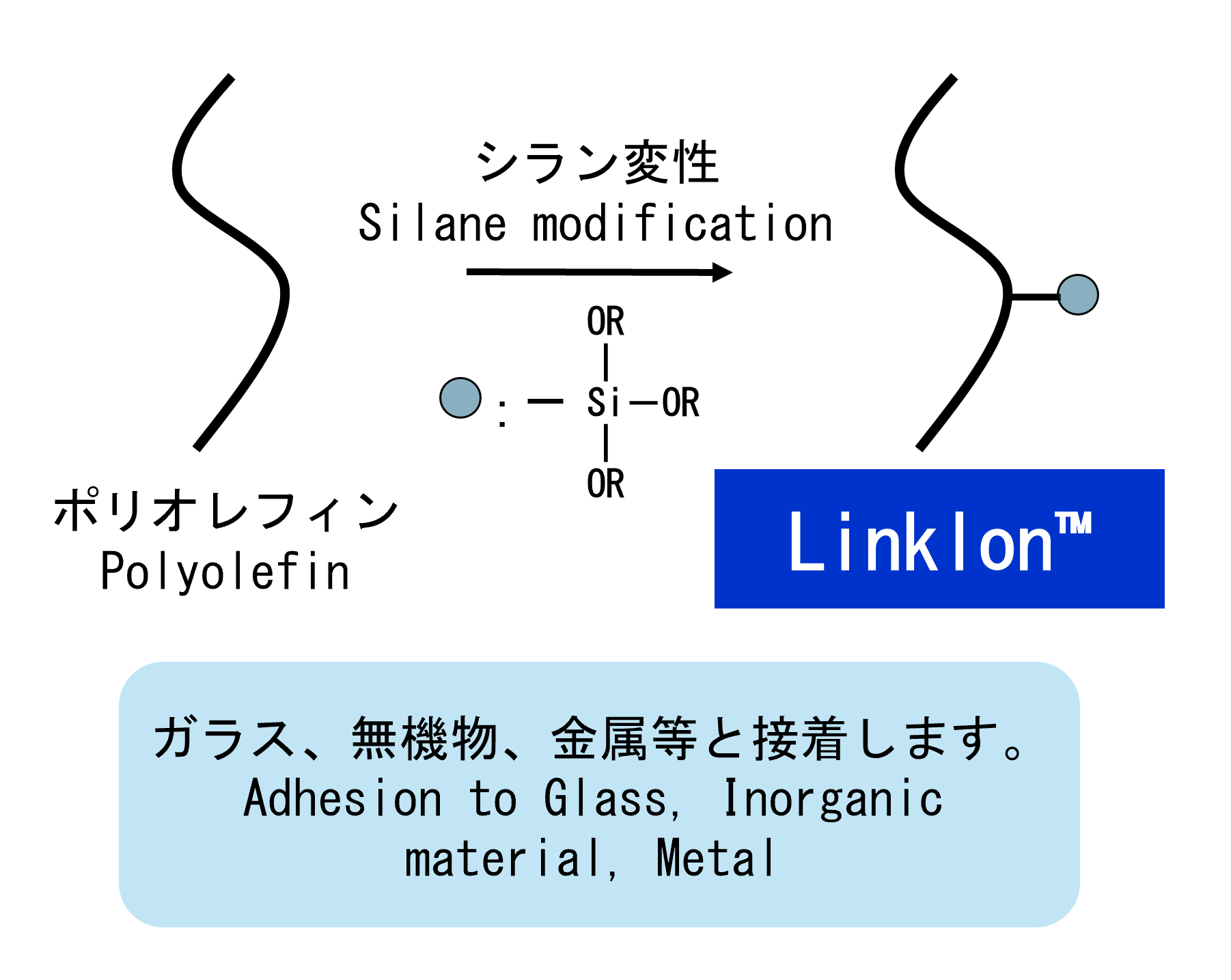
Silane-modified resins are materials that incorporate silane groups, which can chemically bond with glass, into the resin.
Mitsubishi Chemical's "Linklon™" is a material that utilizes this silane modification technology with high precision.
Features
• Forms strong chemical bonds with the glass surface.
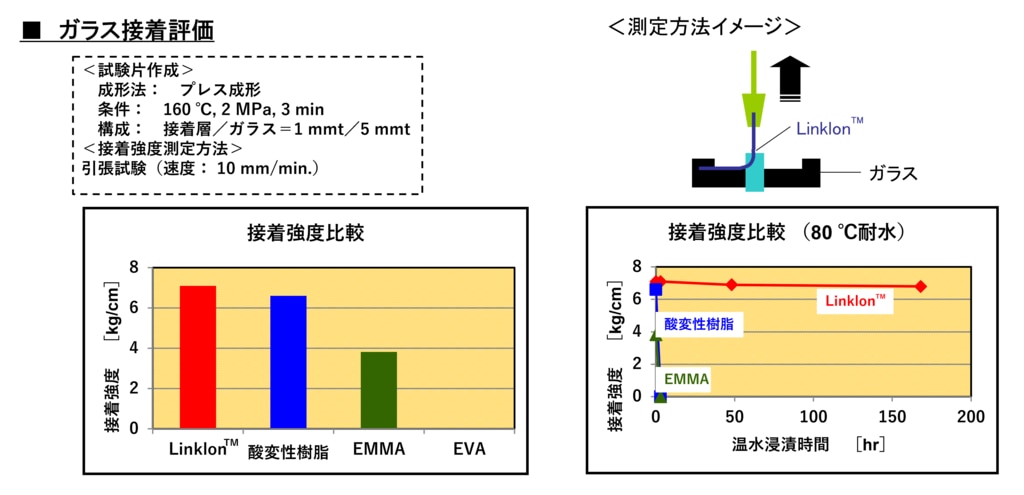
• Stable adhesion from room temperature to high temperature and high humidity environments.
Resin + silane coupling agent
Adding a silane coupling agent to existing resins is also a widely used method.
Features
• Existing materials can be utilized
• High degree of freedom in material selection
Adhesion at room temperature and in humid, heat-resistant environments.
Acid-modified resins and EMMA exhibit good adhesion at room temperature, but they share a common problem: their adhesive strength tends to decrease under high temperature and high humidity conditions.
Various bonding methods and their advantages
Heat welding offers the following advantages:
• Enables large-area joining
→ Easy to apply to building materials, enclosure components, etc.
• The device configuration is relatively simple.
→ Easy to keep implementation costs down
What is laser welding?
Laser welding is a method of joining resins together, or resins and glass, by using laser light to locally heat and melt only the bonding interface.
Because it enables non-contact, high-precision bonding, it is attracting attention for applications in precision parts and electronic components.
Laser welding uses the following principles:
- Laser light passes through a transparent material (glass or transparent resin)
- The resin at the bonding interface absorbs the laser and generates heat.
- The resin melts locally and integrates at the interface.
- Cooling creates a highly precise joint.
If necessary, using a resin containing a laser absorbent allows for stable welding.
Advantages of laser welding
The main advantages of laser welding are as follows:
• Non-contact/high-precision joining
→ Supports micro-components and complex shapes.
• Small thermally affected area
→ Suitable for electronic components and precision parts
• High quality in appearance
→ Weld marks are less noticeable
Introducing Linklon™
Linklon™ is a material made by introducing silane groups into polyolefin resin, which can maintain high adhesive strength to glass even in humid and high-temperature environments.
Diverse lineup
Linklon™ features a wide range of products that allow you to select the optimal performance for your application and design requirements.
The base polyolefin resin can be selected according to customer requirements.
We offer material design tailored to product design requirements, including flexibility, durability, and processability.
Furthermore, Linklon™ covers a wide hardness range from 65A to 55D.
It can accommodate a wide range of applications, from those requiring flexible components to those requiring relatively high rigidity.
Furthermore, by utilizing silane modification technology,
Another major feature of Linklon™ is that the bonding strength to glass can be adjusted according to the application.
Designs that want to avoid excessive adhesive strength, or applications where long-term reliability is important,
We can design an optimal balance to suit your operating environment and required performance.