
Zelas™, which can be heat-sealed to COP! A thorough explanation of how to use it with IV bags.
COP resins have gained widespread use in the pharmaceutical and diagnostic fields in recent years due to their excellent properties such as low adsorption, high transparency, and high gas barrier properties. However, limitations in bonding methods and combinations with other materials, such as difficulty in thermal fusion and inability to adhere to other materials, can sometimes be a bottleneck in product development. These challenges can be overcome by using COP in combination with Mitsubishi Chemical's Zelas™. This article provides a clear explanation of everything from the basics of COP to the specific uses of Zelas™ and COP in IV bags, ports, microfluidics, and other applications.
Table of Contents [hide]
Characteristics of COP
Cyclic polyolefins and their characteristics
COP (Cyclic Olefin Polymer) is an amorphous resin primarily composed of cyclic olefin monomers. Due to the following characteristics, it is valued in pharmaceutical and diagnostic applications and is increasingly occupying an important position as a "high-performance plastic" that improves the quality and stability of pharmaceuticals.
・High transparency
It has glass-like transparency, making the contents highly visible.
・Low adsorption
It has minimal adsorption of proteins, peptides, and antibody drugs, thus suppressing the decrease in drug concentration.
• Excellent dimensional stability and rigidity
Due to its high Tg (glass transition temperature) and minimal deformation, it is suitable for precise shapes and microstructures.
• Good chemical resistance
It is stable against many pharmaceuticals and solvents and is attracting attention as a potential alternative to glass containers.
• Gas barrier properties
Compared to general-purpose polyolefins (PP, PE), it has superior gas barrier properties, which can suppress the evaporation and deterioration of chemical solutions.
Applications where COP is useful
The following three areas are typical applications where COP is widely adopted:
1) Vial bottles and pre-filled syringes
As a glass alternative aimed at reducing the risk of breakage, suppressing the generation of fine particles, and reducing leaching, it is being evaluated as a container material that can balance content protection and ease of handling, especially for biopharmaceuticals and high-value drugs.
2) Innermost layer of the IV bag
To suppress the adsorption of active ingredients, the innermost layer is made of COP (polypolymer polymer), and the outer layer is combined with materials such as PP (polypropylene) or PE (polyethylene). These "low-adsorption bags" and "high-performance infusion bags" are expected to be used for anticancer drugs, expensive medications, and nutritional infusions.
3) Microfluidic channels
Leveraging its high transparency and dimensional stability, it is widely used as a microfluidic substrate material. It is selected as a material with excellent optical measurement properties and microfabrication capabilities in analytical and diagnostic chips, POC diagnostic equipment, and cell and blood analysis chips.
Development Background of Zelas™CP
Despite its excellent performance, COP has been reported by the market to be a persistent source of trouble in the field, particularly regarding its processing characteristics and heat fusion properties.
1) Thermal fusion between COPs is difficult.
At temperatures below Tg, bonding hardly occurs, and even when heated above Tg, sufficient bonding strength may not be obtained under certain conditions.
2) Thermal fusion of COP and dissimilar materials (PP, PC, etc.) is difficult.
A large difference in surface free energy can make it difficult to achieve good adhesion at the interface.
Therefore, the following process has traditionally been adopted:
◦ Surface modification such as plasma treatment and corona treatment
◦ Lamination and bonding by applying a special adhesive.
However, these processes not only complicate the workflow, but also increase capital investment and process control costs in surface modification processes, and raise concerns about residual solvents and leached substances when solvent-based adhesives are used. Particularly in pharmaceutical and diagnostic applications, safety requirements are high, so there is a strong need to avoid using adhesives as much as possible, and there has been a market demand for a simpler method of bonding using heat fusion.
Solved when combined with Zelas™!
Responding to such market demands, Mitsubishi Chemical developed Zelas™. By using your existing COP and selecting Zelas™ as the adhesive layer or mating material, strong bonding becomes possible using only multi-layer extrusion molding or heat fusion.
There are three main ways to use it, but on this page we will introduce IV bags, specifically methods 1 and 2.
1. Middle layer of the IV bag
2. Infusion bag port material
3. Cover material for microfluidic channels
How to use the middle layer of an IV bag
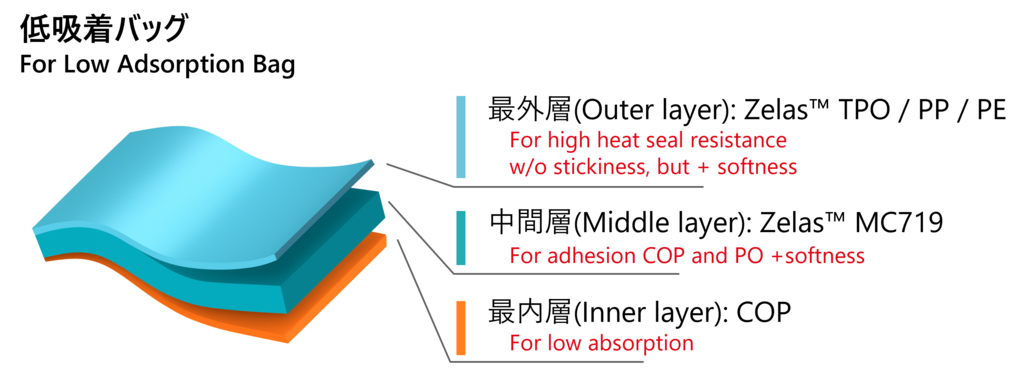
COP, which has low adsorption of proteins, peptides, and antibody drugs, is used as the innermost layer of low-adsorption infusion bags. If you want to try a COP innermost layer bag but are hesitant due to structural design and adhesion to the outer layer, this can be resolved by using Zelas™ MC719 as an intermediate layer.
- The COP layer and the polyolefin layer can be firmly integrated using only multi-layer extrusion.
- Does not impair the overall flexibility of the bag.
How to use with an IV bag port
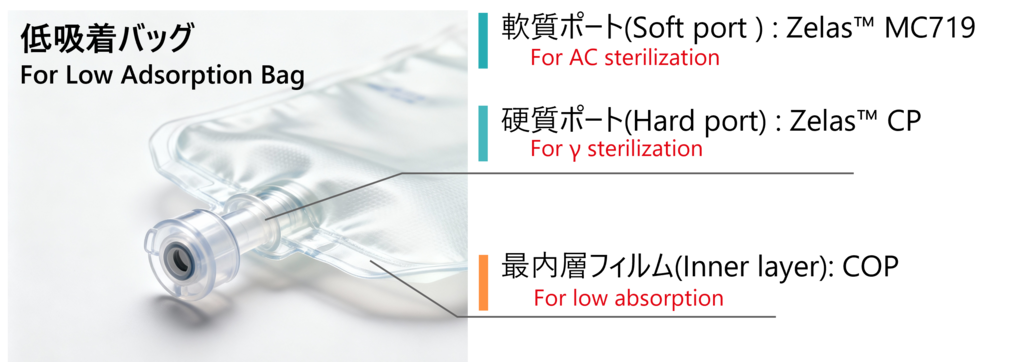
In the innermost layer of a COP bag, bonding the "ports" to the COP film is a major challenge, just as it is with the "bag body." Zelas™ enables heat fusion bonding to the COP film with both flexible and rigid port materials.
• Flexible port (Zelas™ MC719)
Suitable for drop ports/waste ports and other applications where flexibility is required.
o The flexibility of the material easily matches that of the bag itself.
Compatible with AC sterilization
• Rigid ports (Zelas™ CP series)
Suitable for applications requiring rigidity, such as rigid connection parts and piercing parts.
o Maintain high transparency
gamma-ray sterilization compatible
If you have any problems at COP
While COP is a key material supporting the high functionality of pharmaceutical and diagnostic devices, its difficulty in thermal bonding often becomes a major bottleneck in mass production and process design. Mitsubishi Chemical's Zelas™ offers a solution that enables strong bonding using only multilayer extrusion molding or thermal bonding when combined with COP. If you are facing challenges such as "difficulty bonding COP to COP or COP to PP or PE" or "wanting to use COP in low-adsorption bags and microfluidics but are concerned about seal design," please consider using Zelas™. Why not accelerate the development of next-generation pharmaceutical and diagnostic devices with the new combination of "COP × Zelas™" that maximizes the potential of COP?