
Why are resin surfaces "difficult to wet"?
Zelas™親水グレードは、射出成形や押出成形といった一般的な樹脂加工によって、成形品表面に親水性を発現させるよう設計された親水性樹脂です。従来、樹脂表面の濡れ性を高めるためには、プラズマ処理、親水性コーティング、乾燥、検査などの後工程が必要になる場合があります。Zelas™親水グレードは、成形後の表面処理工程を削減できる可能性があり、毛細管、マイクロ流路、液体ハンドリング部材、IVD・医療機器部材などでの工程合理化に貢献します。
Why are resin surfaces "difficult to wet"?
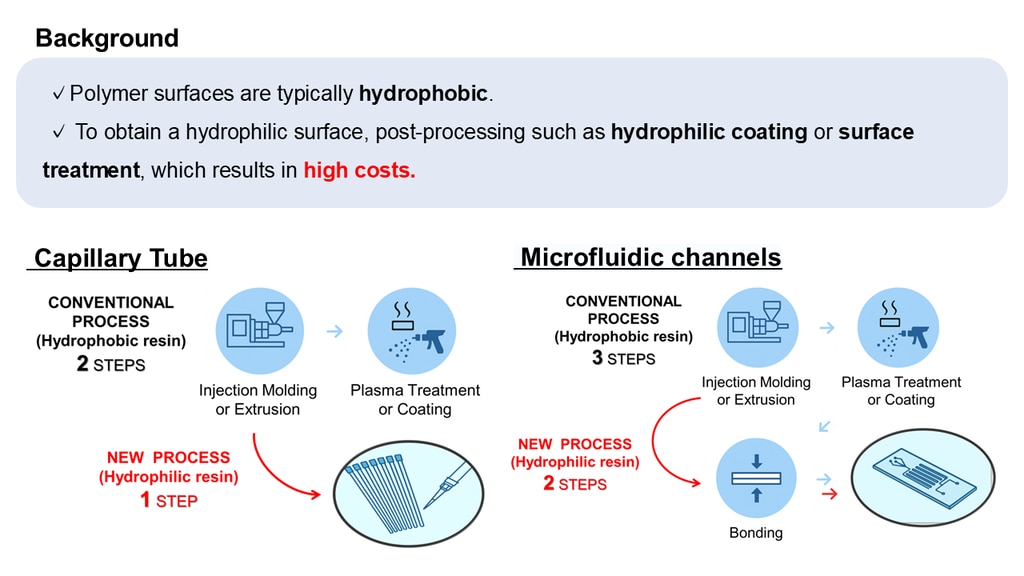
The "wettability" of a resin surface is a crucial factor that affects the measurement accuracy and workability of blood testing equipment and microfluidic devices. Most resins exhibit hydrophobicity, meaning they repel water-based liquids such as water and blood, which can lead to problems like liquid pooling, bubbles, and unstable flow.
Therefore, for devices that accurately and reproducibly aspirate liquid samples, post-treatment to make the surface hydrophilic is essential. Conventionally, methods to "make the surface wettable" have been widely used, such as hydrophilic coatings, atmospheric pressure plasma, and corona treatment.
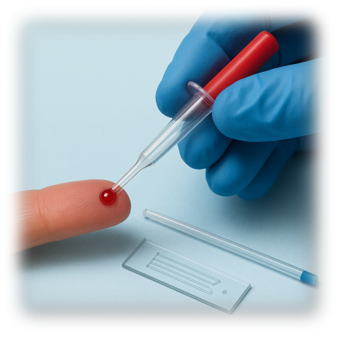
However, post-processing to obtain a hydrophilic surface always involves a trade-off between cost and man-hours. Introducing dedicated coating equipment or plasma processing equipment requires an initial investment, and processes such as managing chemicals and processing conditions, pre-treatment, coating, drying, and inspection accumulate on the manufacturing line. The more processes there are, the longer the production lead time becomes, the more man-hours are required, and the greater the final product cost.
Furthermore, issues such as uneven film deposition, uneven processing, and performance fluctuations due to aging are common themes that require careful design and evaluation in both conventional processes and new materials, and are always points of concern for those working in development and mass production.
成形のみで表面親水化、後処理工程を削減
Against this backdrop, Mitsubishi Chemical is developing Zelas™ hydrophilic grade, which can exhibit surface hydrophilicity simply through molding.
Zelas™ hydrophilic grade
Extrusion molding and injection molding can be performed without various treatments associated with hydrophilization.
This material is designed to exhibit hydrophilicity on its surface through only common resin processing processes.
対象部材 | 従来プロセス | Zelas™親水グレードを用いる場合 | 期待される効果 |
|---|---|---|---|
毛細管・チューブ | 射出成形または押出成形 → プラズマ処理→コーティング | 射出成形または押出成形 | 親水化の後工程削減の可能性 |
マイクロ流路部材 | 成形 → 表面処理→コーティング → 接合 | 親水性材料による成形 → 接合 | 工程集約、設備・スペース・管理負荷の低減可能性 |
液体ハンドリング部材 | 成形 → 親水化処理 → 乾燥・検査 | 親水性材料による成形 | 工程短縮および品質管理項目の最適化可能性 |
Traditionally, after molding, the product had to be sent to a surface treatment line for coating, drying, and inspection. However, with Zelas™ hydrophilic grade, hydrophilicity is imparted during the molding process, potentially reducing pretreatment steps, hydrophilic coating application, and drying steps.
While interactions with liquids and long-term stability require evaluation based on individual applications and conditions, the idea of not needing a dedicated process for hydrophilicity makes it an attractive option from the perspective of equipment, personnel, and space.
Development material:Zelas™CPhydrophilic grade
Features and Functions
✓Ithas high transparency and provides a hydrophilic surface without post-processing.
✓Dependingon the type of contents, additives may leach out, so single use is recommended.
✓Hardnessand physical properties can be adjusted through compound design. Currently,we can provide development materials in the amorphous olefin type (Zelas™CP).
✓ Zelas™CPhasbeen confirmed to produceminimal elution even after gamma irradiation, andto meet the requirements of Japanese Pharmacopoeia Test 7.02 (elution test).
✓ TPS and TPO types are currently under development. They can also be applied to general and industrial uses.
🎦A video showing how liquid smoothly fillsa capillary tube.
👉 This simulates a capillary tube used for blood tests, allowing you to observe how the liquid flows smoothly from the opening to the tip.
🎦A video showing liquid spontaneously flowing througha microfluidic chip.
👉 This will help you understand how even in channels with very narrow width and depth, the hydrophilic properties allow the liquid to move forward steadily.
Note: These videos are of the older grade, but the same effect can be obtained with the grades listed below.
grade
Evaluation Items | Test Conditions | Unit | Zelas™CP XHP303 | Zelas™CP XHP304 |
|---|---|---|---|---|
MFR (230°C, 21.2 N) | ISO 1133-1 (for reference) | g/10 min | 8 | 8 |
Density | ISO 1183 reference | g/cm³ | 0.94 | 0.94 |
Flexural modulus | ISO 178 (for reference) | MPa | 1500 | 1500 |
HAZE (2 mm) | Reference: ISO 14782 | % | 2 | 2 |
Total light transmittance (2 mmt) | ISO 14782 reference | % | 92 | 92 |
Melting peak temperature | MCC method | °C | 114 | 114 |
Contact angle* (distilled water) | MCC method | ° | 50 | 15 |
Examples of Sterilization Methods | — | — | Gamma-ray Sterilization / EOG | Gamma-ray Sterilization / EOG |
- *The contact angle was measured 7 days after molding using a 2 mm thick injection-molded sheet.
- The above figures are representative values and are not guaranteed.
- Please evaluate and determine the suitability, safety, and legality of this product for your intended application.
We offer two gradeswithdifferent hydrophilicity levels (contact anglesof 50degrees and15degrees).
Regarding sterilization processes, which are crucial for medical and analytical devices,the CPtypecan handlegamma ray sterilization in addition to EOGsterilization.
We can also introduce you to ourTPSandTPO products, which are currently under development. Please contact us for more details.
Key points to consider when evaluating single-use recommendations.
Zelas™hydrophilic grade is currently positioned as a "development material," and there are several points to note.
*Depending on the type of contents, the additivesmay leach out, so single-use is recommended at this time.
* Because interactions with actual contents such as blood and reagents vary depending on the application, individual evaluations of elution properties, functional stability, and safety based on the customer's expected conditions are essential.
* From a regulatory and certification standpoint, we recommend that you consider early on what kind of testing is required for the entire device and proceed with it in parallel with material evaluation.
Zelas™ Hydrophilic Grade as a Co-creation Partner
Zelas™hydrophilic grade is a material that can provide three values to devices such as blood test capillaries, microfluidic chips, and hydrophilic tubes: "achieving hydrophilicity without hydrophilization treatment," "improving liquid controllability," and "reducing costs and man-hours by reducing post-processing steps."
On the other hand, optimizing performance, ensuring long-term stability, and complying with regulations require careful consideration tailored to the specifications of each individual device.
ThetwoCPtype Starting with the grade property tables and video evaluation examples, please tell us about your specific challenges regarding the design conditions of capillaries and microfluidics, sterilization conditions, and evaluation plans using actual liquids.
Because this is a development material, we can collaborate on everything from formulation design to evaluation protocols. Please feel free to contact us for more information or to request samples.