
Latest Regulatory Trends for Food Contact Materials and Key Considerations for Material Selection by Application
Regulations on food contact materials are becoming increasingly stringent in various countries. When selecting materials for food packaging and other food contact applications, it is important to consider not only functionality but also compliance with the regulatory requirements of each market. Materials must also be selected appropriately based on required properties, such as barrier performance, flexibility, and heat resistance, as well as conditions of use. Mitsubishi Chemical provides material solutions for food contact applications, focusing on Tefabloc™, Modic™, and NOVADURAN™, according to specific applications and structures.
Table of Contents [hide]
- 1.Background and trends in various countries regarding strengthened regulations on food contact materials
- 2.Comparison of the current state and key points of food contact regulations in various countries.
- 2.1.Japan: Establishment of a national positive list and JCII voluntary standards
- 2.2.United States: Regulation by the FDA
- 2.3.Europe (EU): The need for a Declaration of Conformity (DoC) and transition testing.
- 2.4.China: Regulation based on national standards
- 3.Mitsubishi Chemical's food contact materials
- 3.1.Features and Uses of Modic™
- 3.2.Features and Applications of Tefabloc™
- 3.3.Features and Applications of NOVADURAN™
- 3.4.Barrier and Functional Materials/Film Products
- 4.Points to note when implementing
- 5.ReferenceURL
Background and international trends regarding stricter regulations on food contact materials
Regulations on food contact materials are becoming stricter worldwide. Each country is working on improving its systems and reviewing their implementation, and the requirements for verifying material compliance are becoming more sophisticated year by year.
In Japan, the positive list system for food utensils, containers, and packaging will be fully implemented on June 1, 2025. Underthis system, it will be necessary to check the listing status of base polymers at the monomer level and additives at the substance level. Manufacturers of final products will be responsible for determining whether the materials they use comply with the system.
Meanwhile, other countries besides Japan are also continuing to strengthen regulations.
In Europe, the enforcement of plastics regulations will be tightened by the amendment (EU) 2025/351 to (EU) 10/2011.
A large-scale update of the GB standard is underway in China.
Against the backdrop of these changes in the regulatory environment, food contact materials are not simply judged on whether they are "usable," but rather on whether they are "usable" or not.
It is essential to make decisions based on"in which markets (regions) and under what conditions it can be used."
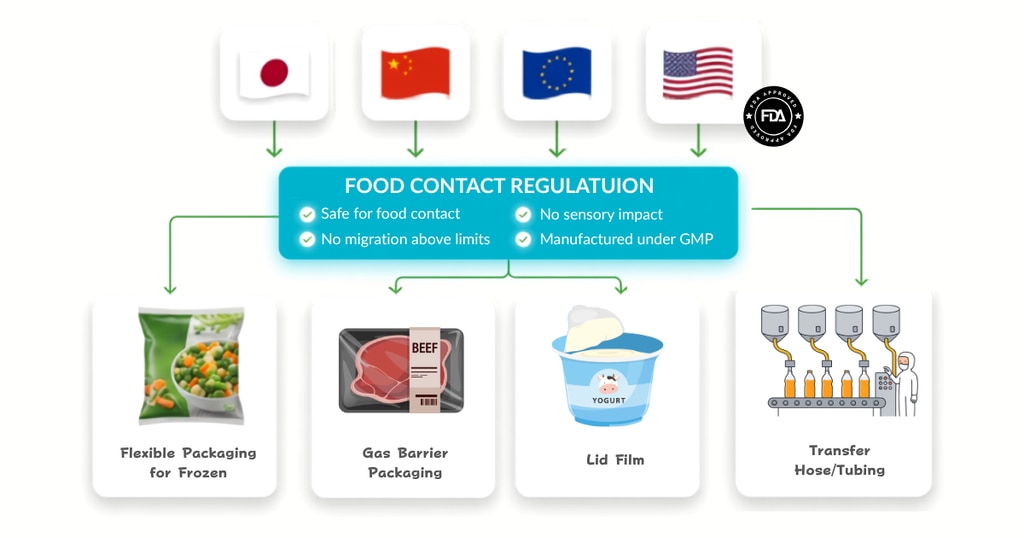
A comparison of the current state and key points of food contact regulations in various countries.
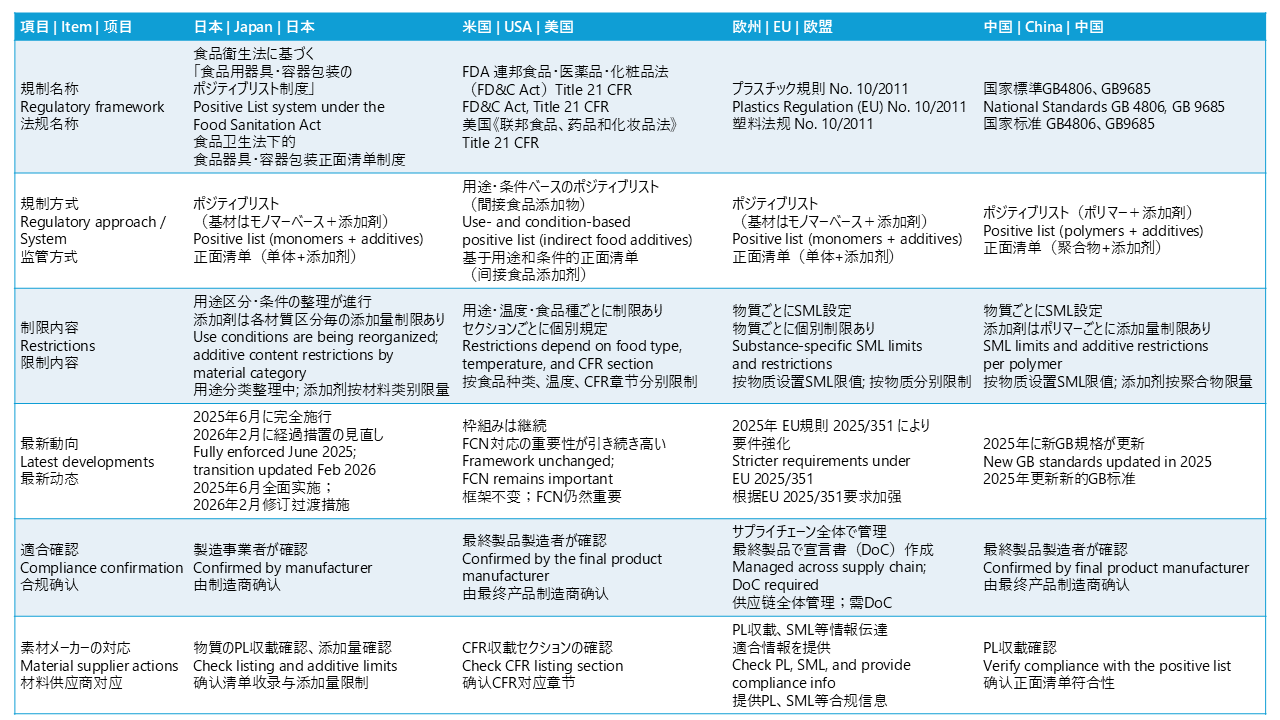
Regulations for food contact materials vary from country to country, but in all regions, compliance verification at the material level and evaluation as a final product are crucial. Below is a summary of the basic approaches in Japan, the United States, Europe, and China.
Comparison items | Japan | US | European Union (EU) | China |
|---|---|---|---|---|
Regulatory System and Major Laws | The "Positive List System for Food Utensils, Containers, and Packaging" based on the Food Sanitation Act | FDA regulations on food, drugs, and cosmetics | Plastics Regulation (EU) No. 10/2011 | National standards GB 4806 and GB 9685 |
Regulatory approach | Positive list approach | Positive list system based on intended use and conditions | Positive list approach | Positive list approach |
Main restrictions and control items | The classification of uses and conditions of use are being clarified. | There are restrictions depending on the type of food, the temperature at which it is used, and the applicable category in the Federal Code of Regulations. | A specific migration limit (SML) is set for each substance. | A specific migration limit (SML) is set for each substance. |
Recent major trends | The system will be fully implemented in June 2025. | The regulatory framework will continue. | EU Regulation 2025/351 strengthens requirements. | The GB standard will be updated in 2025. |
The entity responsible for confirming conformity | Manufacturer confirmed | Confirmed by the final product manufacturer | Manage across the entire supply chain | Confirmed by the final product manufacturer |
Required actions from material suppliers | Confirm the inclusion status of the target substance in the positive list and the amount of additives used. | Check the relevant provisions and sections of the Code of Federal Regulations (CFR). | Provides information on positive list inclusion, SML, and compliance. | Check the status of inclusion on the positive list. |
Japan: National positive list establishment and JCII voluntary standards
In Japan, the positive list system for food utensils, containers, and packaging was fully implemented on June 1, 2025.
The listing status of base polymers must be checked at the monomer level, and that of additives must be checked on a substance-by-substance basis. The manufacturer of the final product is responsible for determining whether the materials used comply with the regulations.
Furthermore, JCII (Japan Center for Food Contact Materials Safety) has been operating a positive list based on industry self-regulatory standards even before the national system was established.
If a product meets our voluntary standards, we issue a certificate of confirmation, which remains an effective method for determining the suitability of food contact materials in Japan.
United States: Regulated by the FDA
In the United States, the positive list for food contact materials is under the jurisdiction of the FDA (Food and Drug Administration) and is systematically defined in Title 21 CFR. Regulation of food contact materials is mainly managed in Parts 170-189, which deal with food additives.
Furthermore, in the United States, the definition of usage conditions is very detailed, and suitability must be determined by combining factors such as temperature and application classification.
For substances that cannot be addressed solely through existing CFR listings, safety data will be submitted to the FDA via the FCN (Food Contact Notification) system to individually confirm the appropriateness of their use.
In recent years, the requirements for these safety assessments have become more stringent, increasing the importance of prior verification.
Europe (EU): The need for a Declaration of Conformity (DoC) and transition testing.
In Europe, a positive list (Union List) for food contact plastics is defined in Regulation (EU) 10/2011.
In principle, substances not listed in the Union List cannot be used; however, NIAS (Non-Intentionally Added Substances), impurities, and reaction products are handled on a case-by-case basis, subject to individual safety assessments.
The responsibility for creating a Declaration of Compliance (DoC) lies with the final product manufacturer, and raw material manufacturers are required to provide the necessary information for creating the DoC, such as SML (Specific Migration Limit) and QM (Quality Limit).
In Europe, transition testing is also an important factor in the decision-making process. The manufacturer of the final product confirms compliance based on the test results.
Furthermore, the amendment to (EU) 10/2011, (EU) 2025/351, clarifies the management of recycled plastics and the conformity assessment requirements for products containing recycled materials, requiring compliance with the latest requirements.
China: Regulations based on national standards
In China, positive lists for food contact materials are defined in GB4806 and GB9685.
Regarding plastics, the materials and products are specified in GB4806.7, and the additives used are controlled in accordance with GB9685.
There are usage limits for additives depending on the base material, and SML (Standard Milk-to-Liquid) values are also set for each substance.
In September 2025, a large-scale update of relevant national standards was also carried out, and the management framework for food contact materials was reviewed.
This update clarifies the standards and testing/evaluation criteria for food contact materials, making the verification requirements for each material clearer. For the Chinese market, it is important to select materials based on the latest GB standards.
Mitsubishi Chemical's food contact materials
Mitsubishi Chemical offers a variety of resin materials tailored to specific applications and structures for food contact applications.
In food packaging and related fields, the required properties vary greatly depending on the application, such as areas where flexibility and sealing properties are needed, adhesive and release designs in multilayer structures, and components requiring shape stability and heat resistance.
Furthermore, compliance with food contact regulations in each country must be considered, making it crucial to select materials from both a functional and regulatory perspective. To meet these requirements, we can select materials tailored to your application, primarily focusing on Tefabloc™, Modic™, and NOVADURAN™.
Next, we will explain the characteristics and uses of these materials.
Modic™ Features and Applications
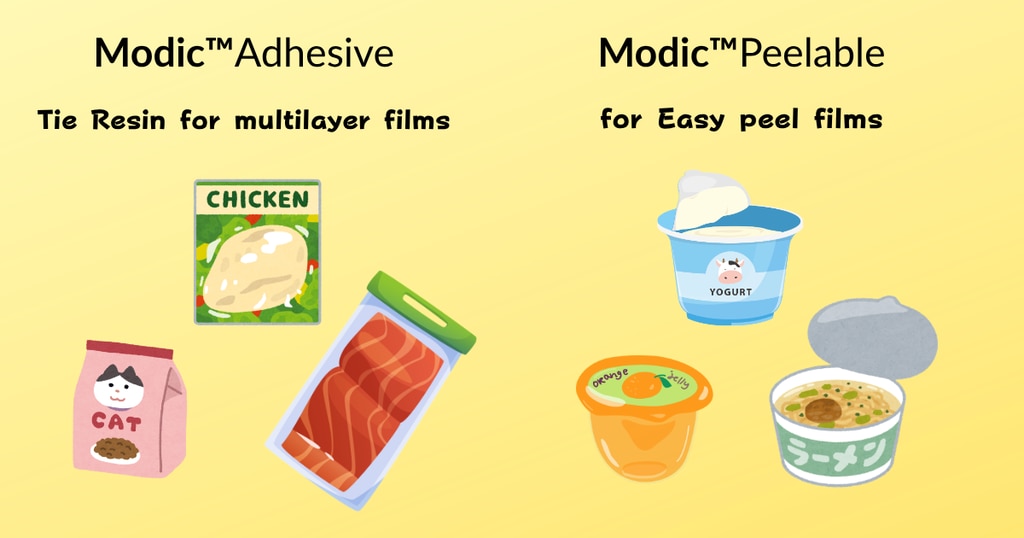
Modic™ is an adhesive resin that bonds different materials together.
It can impart adhesion to PA, EVOH, PET, other resins, and metals, and is used in multilayer films and laminate structures. In addition to being an adhesive, it is also suitable for applications such as improving the impact resistance and flexibility of resins as a modifier for EVOH and PA, and functions as a compatibilizer to suppress phase separation between different resins. A major feature is that it can play a role not only in adhesion but also in balancing the physical properties of the entire material.
In food packaging, in addition to ensuring interlayer adhesion and combining different materials, peelable types are also considered for lids and seals where ease of opening is a key design consideration. Peelable types offer a smooth peeling feel and a clean peel surface, and exhibit stable peeling characteristics over a wide heat-seal temperature range. The lineup includes PP/PE series, TPC series, special series, and peelable types, making it easy to choose the right type for your application.
In addition to complying with Japan's positive list system, we also offer grades that meet the US FDA, European EU (PIM), and Chinese GB standards for food hygiene.
Features and Applications of Tefabloc™
Tefabloc™ is a thermoplastic elastomer suitable for food contact applications.
It offers a wide range of grades, from soft to high hardness, and is characterized by its ability to easily adjust the balance between flexibility and rigidity according to the application. In addition to excellent weather resistance and heat resistance, it is easy to process with general-purpose molding machines and is also easy to recycle sprues and runners, making it a user-friendly material from a manufacturing perspective.
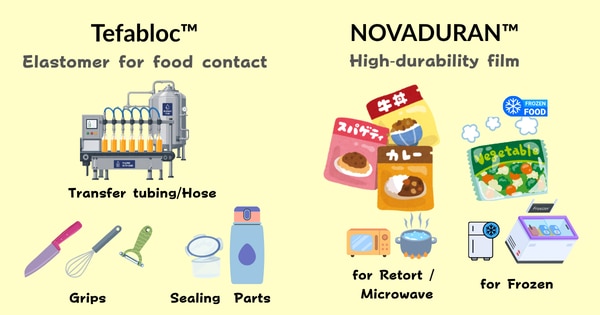
In food contact applications, it is easily applicable to beverage delivery tubes and hoses, bottle caps, gaskets, seals, and food conveying belts, and is being considered for applications where both hygiene and functionality are required. Furthermore, it is being expanded into fields where direct contact is expected, such as kitchen tools and dental care products. The ability to easily choose the appropriate series for each application, such as for extrusion, injection molding, and oily foods, is also an attractive feature.
In terms of food hygiene compliance, we offer grades that conform to Japan's positive list system. For overseas markets, we also have some grades that comply with the US FDA and the European Union (PIM).
Features and Uses of NOVADURAN™
NOVADURAN™ is a PBT (polybutylene terephthalate) resin that possesses excellent moldability, heat resistance, chemical resistance, and dimensional stability.
Leveraging its heat resistance and dimensional stability, this material is suitable as a functional component in food contact applications. In the food packaging sector, it is suitable for applications requiring high temperatures and dimensional stability, such as film outer layers and components for freezing and retorting. Its stable moldability and chemical resistance contribute to improved reliability of packaging structures.
Furthermore, we offer both homo-PBT and copolymer PBT, allowing for adjustment of the balance of crystallinity, flexibility, and toughness according to the application. It is also easily combined with existing packaging materials such as PET and can be dry-blended, making it a valuable material for increasing design flexibility in composite structures.
In line with food hygiene standards, we offer grades that comply with Japan's positive list system.
Barrier and functional materials/film products
In packaging design, functions such as inhibiting oxygen and gas permeability, heat resistance, and chemical resistance are also important considerations.
The Mitsubishi Chemical Group also develops barrier and functional materials such as Soarnol™ and GOHSENOL™ to address these functional requirements, supporting the functional design of food packaging materials.
Furthermore, in packaging structure design, there are many cases where considerations are required not only for the material itself but also for its application in film form. The Mitsubishi Chemical Group offers a variety of films for food packaging, and it is possible to consider both the material and the film aspect according to the application and required characteristics.
Points to note when implementing
Compliance with regulations for food contact applications requires an understanding of market-specific standards and accurate information dissemination within the company's supply chain. Since food contact material regulations in each country and region are frequently revised, always check the latest official information and guidelines before implementation.
As a compound manufacturer, Mitsubishi Chemical verifies product compliance through surveys with various raw material manufacturers and provides responses and grade recommendations based on the latest regulations in each country. However, since regulations and interpretations may change in the future, please contact your sales representative individually for specific regulatory confirmations and grade selections.
Due to the nature of compound products, it may take some time to confirm the formulation and raw materials used. We ask for your understanding that we require sufficient lead time in advance when inquiring about and responding to inquiries regarding compliance with regulations in various countries.
Mitsubishi Chemical offers sample provision and technical consultation regarding various food contact materials.
We will suggest the most suitable grade for your needs, so please feel free to contact us.
Reference URL
- Consumer Affairs Agency, "Regarding the Positive List System for Food Utensils, Containers, and Packaging (from June 2025 onwards)"
https://www.caa.go.jp/policies/policy/standards_evaluation/appliance/positive_list_new
・JCII "Food Contact Materials Safety Center"
https://www.jcii.or.jp/pages/65/
• U.S. Government Publishing Office, “Title 21 – Food and Drugs, Vol.3 (Contains Parts 170–199, including 174–178)”
https://www.govinfo.gov/content/pkg/CFR-2025-title21-vol3/pdf/CFR-2025-title21-vol3.pdf
・ European Commission, “Commission Regulation (EU) No 10/2011 on plastic materials and articles intended to come into contact with food”
https://eur-lex.europa.eu/eli/reg/2011/10/2026-02-23
・National Health Commission (NHC), “Announcement No.6 of 2025 – National Food Safety Standards”
https://www.nhc.gov.cn/sps/c100088/202509/5dc5e1e2b26d4d27a7913b9e71bbe931.shtml