

Trends in PVC (polyvinyl chloride) in the medical field and alternative resins.
Flexible polyvinyl chloride (PVC) is widely used in medical settings for IV bags, IV tubes, blood bags, etc., due to its chemical stability and excellent flexibility and durability. However, concerns about safety due to the leaching of plasticizers used in PVC are leading to a reassessment of its use. On the other hand, the change in material often makes conventional joining methods unusable, posing challenges in assembly with other components. This article will summarize the challenges and regulatory trends surrounding PVC, and provide a technical explanation of PVC alternative resins, including materials offered by Mitsubishi Chemical, as well as assembly methods.
Table of Contents [hide]
- 1.Main concerns regarding the use of PVC in medical applications
- 1.1.Health concerns due to plasticizer (DEHP) leaching
- 1.2.Concerns about a decrease in content due to adsorption of active ingredients.
- 1.3.DEHPフリー医療用PVC
- 2.Soft PVC substitute resin
- 2.1.医療用チューブ向け材料
- 2.2.医療用バッグ向け材料
- 2.3.TPS(スチレン系熱可塑性エラストマー)
- 2.4.TPU(熱可塑性ポリウレタン)
- 2.5.PB(ポリブタジエン)
- 2.6.PE(ポリエチレン)
- 2.7.PP(ポリプロピレン)
- 2.8.EVA(エチレン・酢酸ビニル共重合体)
- 3.If you are considering PVC alternative materials
Main concerns regarding the use of PVC in medical applications
Health concerns due to the leaching of plasticizers (DEHP)
Flexible PVC is treated with plasticizers to provide flexibility, but it has been reported that DEHP (di-2-ethylhexyl phthalate), in particular, can leach out upon contact with blood or lipid-soluble chemicals.
In Japan, in 2002, the Ministry of Health, Labour and Welfare issued a notice to medical institutions regarding DEHP leaching from PVC medical devices. For feeding tubes used for newborns and infants, early discontinuation of use and switching to alternatives are recommended, and priority should be given to switching to alternatives for highly susceptible patients. 1)
Furthermore, while DEHP is classified as a "reproductive toxicity 1B substance" in the EU, the expiration date for DEHP use in medical devices has been revised following the REACH amendment in November 2023. (Application deadline: January 1, 2029; Expiry date: July 1, 2030) 2)
Furthermore, regulatory and legislative efforts are progressing, such as the "Toxic-Free Medical Devices Act" in California, USA, which aims to ban the use of DEHP in certain medical devices after 2030. 3)
Decrease in content due to adsorption of Drugs
In addition to health risks, there have also been reports of cases where the expected drug effect is not fully achieved. Because the surface and plasticizer of soft PVC are hydrophobic, highly lipid-soluble drugs (insulin, nitroglycerin, diazepam) tend to adsorb to the inner surface of the tube, leading to a significant decrease in content. This can result in reduced and inconsistent dosages for actual patients, so switching to tube materials with less adsorption is being considered. 4)5)
DEHPフリー医療用PVC
血液回路、輸液セット、カテーテル、呼吸・麻酔用途向けに、DOTP、TOTM、DINCH等の代替可塑剤を用いた医療用PVCコンパウンドとチューブを用意しています。硬度、色、X線造影性、加工方法に応じたご相談が可能です。
Soft PVC substitute resin
医療用チューブおよびバッグに用いる材料には、柔軟性、透明性、耐熱性、耐衝撃性に加え、滅菌適性、薬剤・脂肪乳剤との相互作用、接合・加工性など、用途ごとに異なる要求特性があります。下表では、チューブおよびバッグ用途で検討される代表的な樹脂・エラストマーについて、一般的な特性と加工上のポイントを整理しています。
材料選定では、求められる機械特性だけでなく、実際の滅菌条件、接触する薬剤・輸液、接触時間、使用温度、接合方法、製品設計および規制要件を含めて個別に評価することが重要です。
医療用チューブ向け材料
熱可塑性材料 | 主要特性・加工上のポイント |
|---|---|
スチレン系エラストマー TPS (Zelas™ TPS) | ・オートクレーブ滅菌、γ線滅菌およびEOG滅菌に対応可能 |
ウレタン系エラストマー TPU(ChronoFlex™) | ・γ線滅菌およびEOG滅菌に対応可能 |
ポリブタジエン PB | ・γ線滅菌およびEOG滅菌に対応可能 |
医療用バッグ向け材料
材料 | 主要特性・加工上のポイント |
|---|---|
PE | ・γ線滅菌およびEOG滅菌に対応可能 |
PP | ・オートクレーブ滅菌およびEOG滅菌に対応可能 |
EVA | ・γ線滅菌およびEOG滅菌に対応可能 |
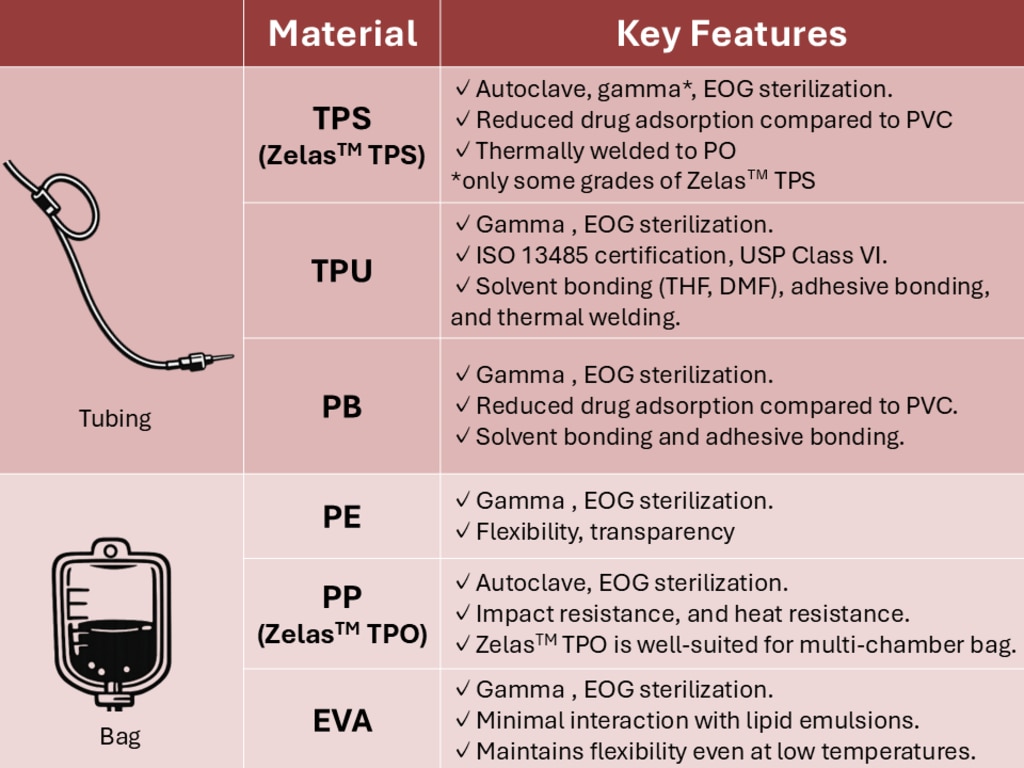
*This table provides general information about each material group and representative grade. Actual sterilization suitability, interactions with drugs and lipid emulsions, bonding properties, transparency, and mechanical properties may vary depending on the grade, additives, molding conditions, component design, sterilization conditions, and usage environment.
*Evaluation of drug adsorption and interactions with lipid emulsions depends on the type of drug/formulation, concentration, contact area, contact time, temperature, and flow rate. Please conduct actual equipment evaluation with the final product, as well as E&L evaluation and biocompatibility evaluation as needed.
TPS (Styrene-based thermoplastic elastomer)
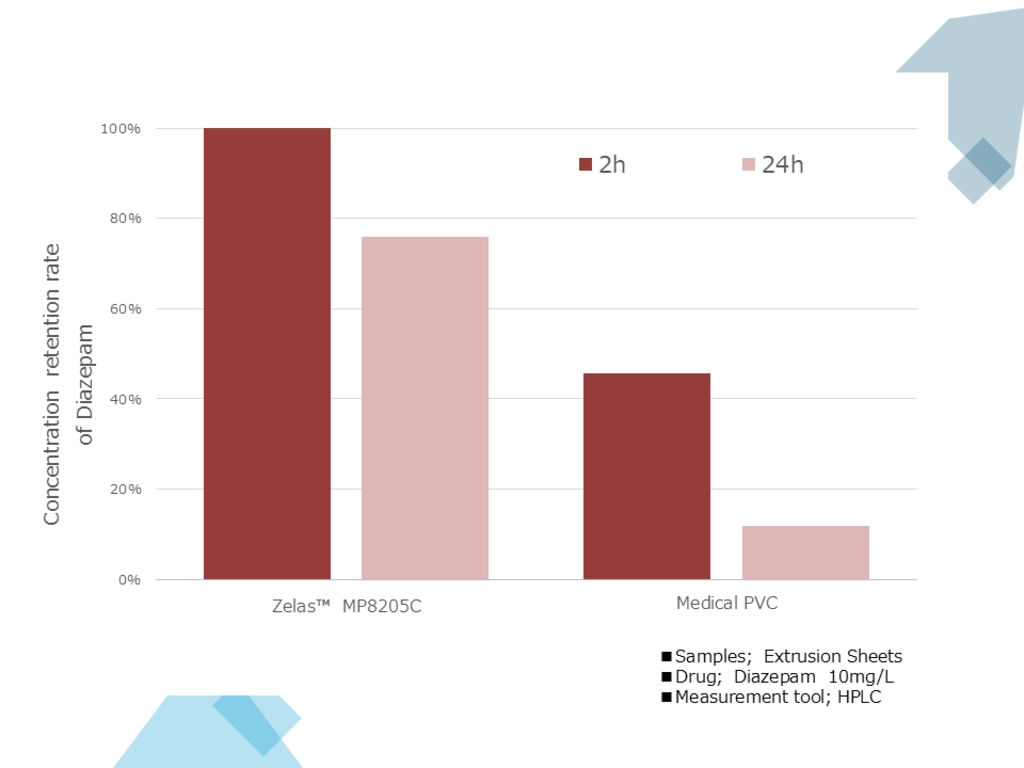
TPS is a styrene-based thermoplastic elastomer with good rubber elasticity and high hygiene properties, making it widely used in the medical field for tubes, gaskets, rubber stoppers, and other applications. Mitsubishi Chemical's Zelas™ TPS (MP8205C) has shown that it maintains a higher concentration retention rate compared to PVC in adsorption tests with diazepam (a benzodiazepine derivative), a well-known anxiolytic (see figure below), suggesting its potential use as a medical tube that does not impair drug efficacy. Furthermore, Mitsubishi Chemical has developed a next-generation tube grade (Zelas™ MP6301C) that exhibits low elution even after gamma ray sterilization (25 kGy), enabling final post-packaging sterilization of disposable products such as infusion tubes.
Main features:
• Available in grades compatible with various sterilization methods (autoclave, gamma ray, EOG).
• Reduced drug adsorption compared to conventional PVC.
• Can be welded with PP (polypropylene) using heat, and is also compatible with ultrasonic welding and laser welding.
TPU (Thermoplastic Polyurethane)
TPU is a thermoplastic polyurethane elastomer with excellent mechanical strength and flexibility, and its high biocompatibility makes it suitable for use in long-term indwelling devices such as catheters and implants.
Mitsubishi Chemical offers a lineup of TPU products, including ChronoFlex™ (carbonate-based) and ChronoThane™ (ether-based), and is expanding its offerings into the high-value-added medical device market.
Main features:
• Supports gamma ray sterilization and EOG sterilization.
• Produced and developed under ISO 13485 certification, and conforms to various biological safety assessments, including USP Class VI.
• Solvent bonding (THF, DMF, cyclohexanone), adhesive bonding, and heat welding are possible.
PB (Polybutadiene)
PB, which is mainly composed of 1,2-polybutadiene, is used as a medical tubing material because it has good flexibility and mechanical strength while also being excellent in drug non-adsorption.
Main features:
• Supports gamma ray sterilization and EOG sterilization.
• Excellent non-adsorption properties for lipid-soluble drugs
• Solvent bonding or adhesive bonding is used, but surface treatment may be recommended to improve adhesion.
PE (Polyethylene)
Polyethylene (PE) is a representative polyolefin that has been used in the medical field for a long time. Low-density polyethylene (LDPE) and linear low-density polyethylene (LLDPE) have excellent flexibility and stress crack resistance. By combining them as one layer in a multilayer structure, it is possible to optimize the balance of drug compatibility, flexibility, and sealing properties.
Main features:
• Compatible with gamma ray sterilization and EOG sterilization (autoclave sterilization is not supported).
• Adhesive/solvent bonding is generally difficult, but heat welding is possible with polyolefins (ultrasonic welding and laser welding are also possible).
PP (Polypropylene)
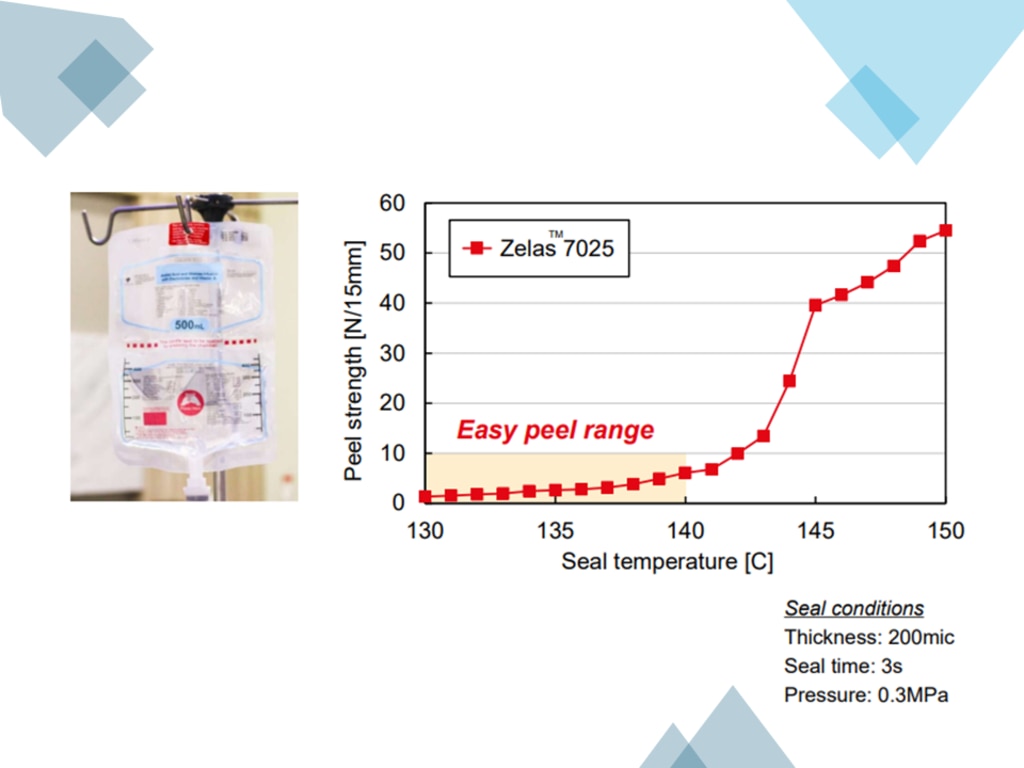
Polypropylene (PP) offers excellent heat and chemical resistance and is primarily used in bags requiring autoclave sterilization. Mitsubishi Chemical's Zelas™ TPO is a thermoplastic olefin-based elastomer compound for medical applications, designed to maintain the heat and chemical resistance of PP while providing rubber elasticity and flexibility. Zelas™ 7025, in particular, is suitable for the inner layer of multi-compartment bags because its seal strength can be controlled by the heat-seal temperature (see diagram below). Zelas™ TPO offers grades suitable for each layer, including the intermediate layer, adhesive layer, and outer layer, and has a wealth of experience in this area.
Main features:
• Suitable for autoclave sterilization and EOG sterilization (not suitable for gamma ray sterilization)
• Excellent flexibility, transparency, impact resistance, and heat resistance
• Adhesive/solvent bonding is generally difficult, but heat welding is possible with polyolefins (ultrasonic welding and laser welding are also possible).
EVA (ethylene vinyl acetate copolymer)
EVA is an ethylene-vinyl acetate copolymer and has a proven track record, particularly as a material for IV bags used in TPN (total parenteral nutrition).
Main features:
• Grades suitable for gamma-ray and EOG sterilization are available.
• Minimal interaction with lipid emulsions
• Flexible even at low temperatures
Due to its relatively high gas permeability, multilayer construction with PP or COC/COP is considered for applications requiring oxygen or water vapor barriers.
If you are considering PVC alternative materials
While there is a growing movement to replace PVC with other materials due to health risks and concerns about decreasing content, PVC has established unique assembly methods such as high-frequency welding and adhesive bonding. Therefore, when switching to alternative materials, the challenge of "how to join them" is often encountered.
At Mitsubishi Chemical, we not only provide PVC alternative materials, but also a wide range of technical data on suitable assembly methods. We can offer concrete proposals tailored to your application and challenges, from material selection to processing and joining methods. Please feel free to contact us if you are considering PVC alternatives.
<Notes>
The information contained in this article is based on sources available at the time of publication; however, we do not guarantee its accuracy, completeness, or timeliness. Please evaluate and judge the suitability, safety, and legality of the information for your intended use.
The information provided regarding material properties, sterilization compatibility, processability, etc., does not guarantee equivalent performance across all grades and usage conditions. Please evaluate and determine suitability based on your own product.
References
1) Pharmaceuticals and Medical Devices Agency, Pharmaceutical Safety and Security Notification No. 1017002, "Regarding Plasticizers (DEHP) Leaching from Polyvinyl Chloride Medical Devices" https://www.pmda.go.jp/safety/info-services/devices/0116.html
2)European Commission. Commission Regulation (EU) 2023/2482 of 13 November 2023 amending Regulation (EC) No 1907/2006 of the European Parliament and of the Council as regards the substance bis(2-ethylhexyl) phthalate (DEHP) in medical devices. Official Journal of the European Union, L 2023/2482, 14 November 2023. https://eur-lex.europa.eu/eli/reg/2023/2482/oj
3) California State Legislature. Assembly Bill No. 2300, Chapter 562: Medical devices: Di-(2-ethylhexyl) phthalate (DEHP). Approved by Governor September 25, 2024. California Health and Safety Code, Division 104, Part 3, Chapter 18, Sections 109050-109052. https://leginfo.legislature.ca.gov/faces/billNavClient.xhtml?bill_id=202320240AB2300
4) Treleano, A.; Wolz, G.; Brandsch, R.; Welle, F. Int. J. Pharm., 2009, 369, 30-37.
5) Baker, RC; Josephson, RL Drug Intell. Clin. Pharm., 1983, 17, 726–731.