
Material selection, bonding, sterilization, and drug compatibility of PVC-free IV sets: Technical challenges and evaluation points during development.
Developing a PVC-free IV set involves more than simply replacing one material with another. In addition to addressing regulations and risk management regarding plasticizers such as DEHP, it is necessary to comprehensively achieve tubing flexibility, drip chamber transparency, bonding tightness, post-sterilization strength, drug compatibility, and quality reproducibility during mass production. This paper will organize the material composition using medical-grade TPS, TPO, and PP for the tubing and drip chambers that make up IV sets, the changes in bonding methods due to the elimination of PVC, and the considerations for drug compatibility that should be checked when selecting materials.
Table of Contents [hide]
- 1.The background behind the attention given to PVC-free IV sets
- 1.1.What is the difference between PVC-free and DEHP-free?
- 1.2.Challenges of drug adsorption to PVC and evolving regulations in various countries
- 1.3.Regulation of DEHP in various countries
- 1.4.Concerns about a decrease in content due to adsorption of active ingredients.
- 2.Material composition of the PVC-free IV set
- 3.Bonding and evaluation challenges arising from PVC-free materials
- 3.1.1: Materials do not adhere well to each other.
- 3.2.2: Changes to the assembly method
- 3.3.3: Selection of Sterilization Method
- 4.Proposal of materials and bonding methods using Zelas™
- 4.1.Medical-grade compound resin Zelas™
- 4.2.Recommended material composition
- 4.3.Method of bonding each part
- 4.4.When using certain chemicals, attention should also be paid to their adsorption to materials.
- 5.Technical Support for PVC-Free IV-Set Development
- 6.Frequently Asked Questions (FAQ)
- 7.References
The Background Behind the Growing Interest in PVC-Free IV Sets
Developing a PVC-free IV set cannot be done simply by replacing PVC tubing with another material. In addition to the material composition of the tubing, drip chamber, spike, and connector, the entire IV set must be designed and evaluated, taking into account the joining method, post-sterilization performance, liquid tightness, drug sorption, extracts and leachates, and quality reproducibility during mass production.
What is the difference between PVC-free and DEHP-free?
"PVC-free" and "DEHP-free" are not synonymous. PVC-free means that PVC is not used as a constituent material, while DEHP-free means that DEHP (bis(2-ethylhexyl) phthalate, DOP) is not used. Therefore, flexible PVC products that use plasticizers other than DEHP are not PVC-free even if they are DEHP-free.
Furthermore, the scope and criteria for "free" may vary depending on product specifications and customer requirements. When comparing and adopting a product, it is necessary to individually check the target area, target substance, content standards, and verification methods.
Term | meaning | Points to note |
|---|---|---|
PVC-free | This expression indicates that PVC (polyvinyl chloride) is not used in the entire product or in specified components. | TPS, TPU, TPO, PP, PE, and silicone are potential candidates. Not using PVC does not mean that all additives, phthalates, chlorine-based substances, and extracts/leachates are absent. |
DEHP-free | The basic design means that only DEHP (= bis(2-ethylhexyl) phthalate, DOP) is not used or contained. The possibility of using other phthalate esters, such as DINP, DIDP, DBP, etc., remains. | This includes PVC products that use plasticizers other than DEHP, so it applies to cases where PVC is used but the type of plasticizer has been changed. |
Plasticizer-free | Generally, this refers to intentionally omitting plasticizers used to adjust the flexibility and processability of resins, but the definition may vary, so confirmation is necessary. | The definition of plasticizers can vary depending on product and customer specifications. It is necessary to confirm whether low-molecular-weight plasticizers, high-molecular-weight plasticizers, secondary plasticizers, and oily/ester-based additives are included. |
Phthalate-free | Generally, this expression means that the phthalate esters designated as the target are intentionally not used, or are used at concentrations below the specified level. | You need to confirm the scope of the target substances. Sometimes it only covers DEHP, DBP, BBP, and DIBP, while other times it may include DINP, DIDP, DNOP, DEP, and others. |
Background for PVC-Free IV sets
While plasticizers are added to flexible PVC to impart flexibility, DEHP (di-2-ethylhexyl phthalate) has been reported to leach out upon contact with blood or lipid-soluble chemicals.
In the selection of materials for intravenous fluid sets (IV sets), the shift towards PVC-free and DEHP-free options is becoming a global trend. This is driven by safety concerns regarding DEHP (bis(2-ethylhexyl) phthalate), which has been used as a plasticizer to make PVC more flexible, as well as changes in regulations and customer requirements in various regions.
Regulatory Developments Concerning DEHP
In Japan, in 2002, the Ministry of Health, Labour and Welfare issued a notice to medical institutions regarding DEHP leaching from PVC medical devices. For feeding tubes used for newborns and infants, early discontinuation of use and switching to alternatives are recommended, and priority should be given to switching to alternatives for highly susceptible patients. 1)
Furthermore, while DEHP is classified as a "reproductive toxicity 1B substance" in the EU, the expiration date for DEHP use in medical devices has been revised following the REACH amendment in November 2023 (application deadline: January 1, 2029, expiration date: July 1, 2030). 2)
Furthermore, in California, USA, AB 2300 will regulate the use of intentionally added DEHP in applicable intravenous solution containers from January 1, 2030, and in intravenous tubing from January 1, 2035. Scope, definitions, and exceptions must be confirmed for each applicable product. 3)
Decrease in content due to adsorption of Drugs
In addition to health risks, there have also been reports of cases where the expected therapeutic effect is not fully achieved. Because the surface and plasticizer of soft PVC are hydrophobic, for drugs such as insulin, nitroglycerin, and diazepam, which have been reported to interact with IV set materials or experience decreased concentrations during administration, it is necessary to confirm the compatibility of the wetted parts, including the tubing, with the drug solution.
Switching to tube materials with lower adsorption is being considered because it can lead to a decrease in the actual dosage administered to patients and inconsistencies in the dosage. 4)5)
Material composition of the PVC-free IV set
In the material composition of the IVC-free IV set, materials are selected based on the required properties for each part.
The tubing requires flexibility and bend resistance, the drip chamber needs transparency that makes it easy to check dripping and appropriate rigidity, and the spikes and connectors need mechanical strength, moldability, and dimensional stability when connected.
List of material components for set IV
IV Set Area | Examples of conventional materials | PVC-free candidates | Main points to consider |
|---|---|---|---|
Tube | plasticized pvc | TPS, TPU | Flexibility, transparency, kink resistance, drug compatibility, sterilization compatibility |
IV drip chamber | PVC, TPO | TPO(PP-based elastomer) | Droplet visibility, transparency, moldability, and connection to tubes. |
Plastic spikes | ABS, PC, PP | PP, ABS, PC | Rigidity, moldability, puncture resistance, andbondingwith tubes |
Connectors and other parts | PVC, PC, PP etc. | PP, ABS, PC etc. | Liquid-tightness and compliance with connection standards. |
Changes in material composition and challenges
In conventional IV sets, plasticized PVC has been widely used for the tubing, drip chamber, and surrounding connection points. This is because PVC can be given flexibility by adjusting the amount of plasticizer added, and a good balance of transparency, moldability, and ease of joining can be obtained.
On the other hand, PVC-free designs replace PVC itself with alternative materials such as medical-grade TPS/TPE, TPO, PP, PE, and TPU. In this case, the approach shifts from using a single material group to construct multiple parts, as with PVC, to using different materials depending on the function required for each part.
For example, since tubes require flexibility, transparency, and bend resistance, thermoplastic elastomers such as medical-grade TPS are potential candidates.
The drip chamber needs to be transparent enough to easily check the dripping process and have sufficient rigidity to maintain its shape. Materials such as TPO, PP, and PC are being considered.
Plastic spikes, luer connectors, clamps, etc., require rigidity, dimensional stability, and moldability to withstand loads during connection and operation, making PP, ABS, PC, etc., suitable materials.
However, material substitution is not completed at the component level. PVC is a polar material, and assembly processes using high-frequency welding and adhesive bonding have been established.
In contrast, polyolefin and elastomer materials such as PP, TPO, and TPS are nonpolar, and the same bonding conditions may not be applicable. For PVC-free applications, the assembly process needs to be redesigned depending on the combination of materials, including adhesives, primers, ultrasonic welding, and laser welding.
Joining and evaluation challenges arising from PVC-free materials
For PVC-free IV sets, it's necessary to verify not only whether the materials can be joined after replacement, but also whether the required liquid-tightness, strength, and appearance can be stably maintained during mass production. The main technical challenges are the following three points:
1: The materials do not adhere well to each other.
TPS, TPO, and PP are non-polar materials, and conventional adhesives and bonding conditions used for PVC may not provide sufficient strength. It is necessary to evaluate a combination of primer, adhesive, surface treatment, and bonding surface design.
2: Changes to the assembly method
For joining non-polar materials, options include ultrasonic welding, laser welding, and adhesives specifically designed for non-polar resins. However, changing materials can necessitate significant changes to assembly methods, posing a major development challenge for manufacturers.
3. Selection of sterilization method
After sterilization using methods such as EO (ethylene oxide) sterilization or autoclaving, we confirm that the material properties, transparency, bonding strength, and liquid tightness are maintained. Evaluation is necessary not only for the sterilization suitability of each material, but also for the final assembly. If adhesives are used in the assembly of parts, the type of adhesive must also be considered when selecting a sterilization method.
In recent years, radiation sterilization, such as gamma-ray sterilization, has been gaining popularity due to its convenience, and it is expected that radiation sterilization, which is simpler to use, will be chosen more frequently for PVC-free IV sets as well.
Selected Zelas™ TPS grades are formulated to reduce yellowing after gamma irradiation. Physical properties and joint performance should be verified at the intended irradiation dose and in the final component configuration.。
Proposed Materials and Bonding Methods Using Zelas™
Medical-grade compound resin Zelas™
Mitsubishi Chemical'sZelas™is a polymer compound intended for medical and pharmaceutical applications.
The material types launchedincludethree types: TPS,TPO, andCP. These materials, which utilize qualified raw materials, are produced on ISO 9001certified compounding lines, comply with national pharmacopoeia and biological safety standards, and have a long track record of use in medical devices and pharmaceutical packaging.
Recommended material composition
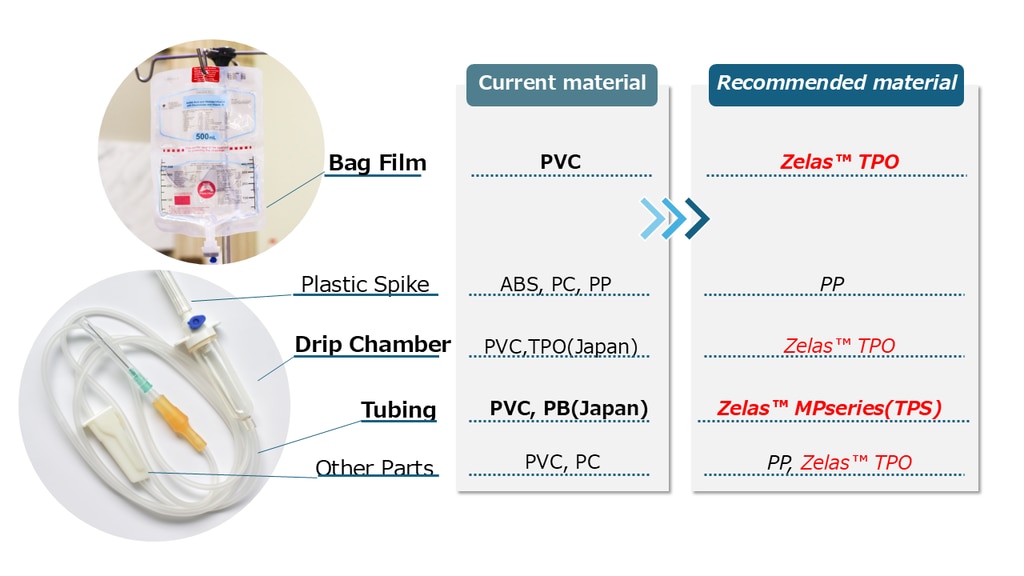
For IV sets, a possible configuration is to combine TPS for the tubing, TPO for the drip chamber, and PP for the spikes, balancing the functionality of each component with the interlocking properties. These material combinations consist of non-polar resins, and because the materials have similar properties, combinations with similar polarity and melting characteristics may facilitate thermal bonding and adhesive selection.
Combining polar resins with non-PVC materials (such as TPU tubes and PC drip chambers) and non-polar resins with non-PVC materials (such as TPS tubes and PP/Zelas™TPO drip chambers) expands the assembly options.
However, the final bond quality needs to be verified for each material grade and part shape.
Joining Methods for IV-Set Components
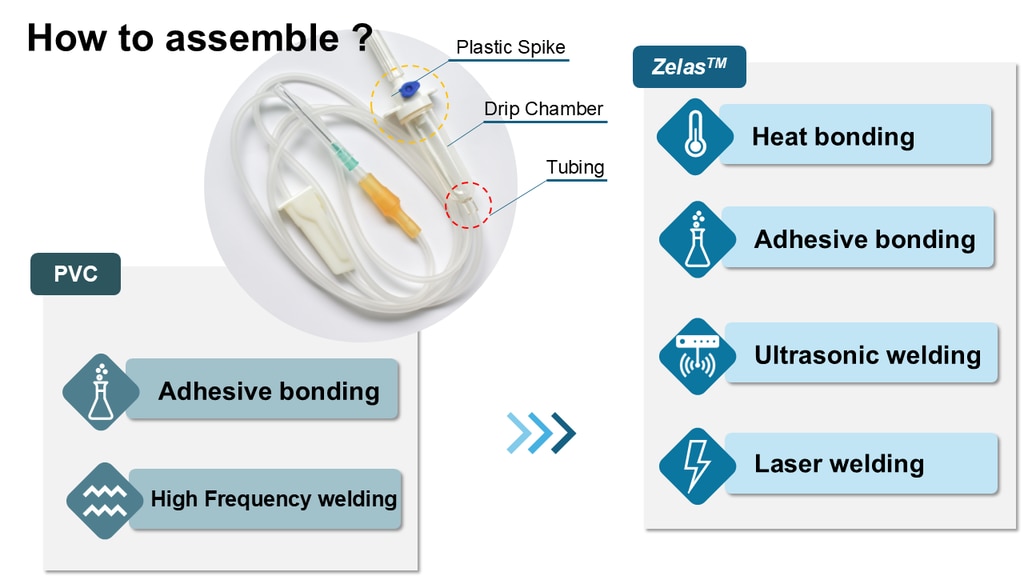
In terms of bonding methods, for PVC IV sets, solvent-based bonding or bonding using a high-frequency welder were commonly used.
When boinding non-polar resins, the choice of bonding method and adhesive type is crucial for assembly.
Depending on the Zelas™ grade, mating material, component geometry, and performance requirements, joining methods such as adhesive bonding, ultrasonic welding, laser welding, and thermal welding may be considered. The applicable method and process conditions should be verified for each component design.
For detailed connection data, please download the document below and check the details.
Drug Sorption to IV-Set Materials
In selecting materials for the IV set, drug adsorption is not the primary issue for all drugs.
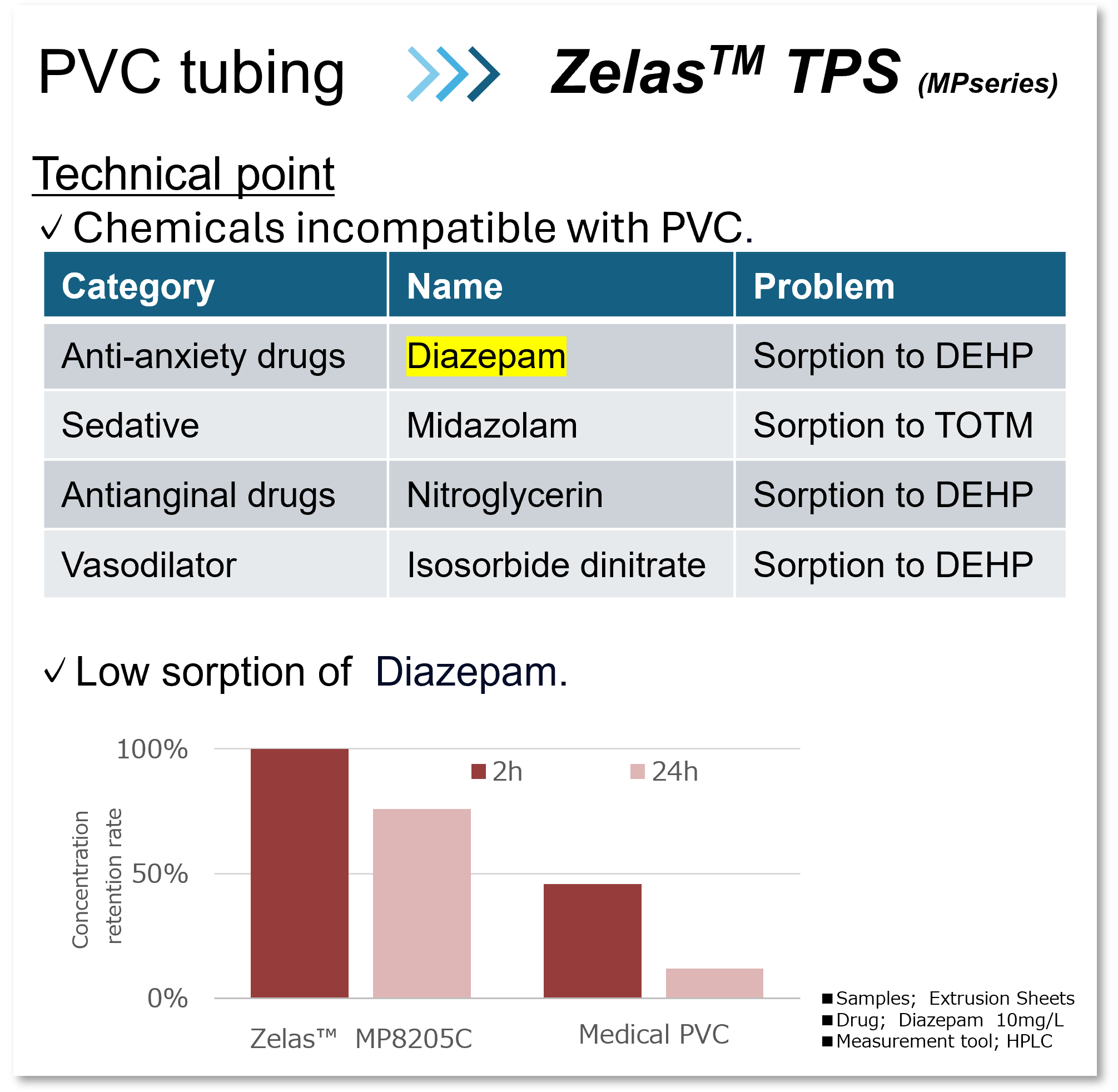
When administering medications that have been reported to interact with IV set materials, such as insulin, nitroglycerin, and diazepam, it is important to confirm the drug compatibility of not only the storage container but also the entire infusion set and the wetted parts, including the tubing.
In particular, with elastomer materials used in tubes and the like, the phenomenon of chemicals being adsorbed onto the material surface or diffused and absorbed into the resin is collectively called sorption.
In fact, when Mitsubishi Chemical conducted evaluations, they confirmed that the concentration of the chemicals decreased due to sorption in both polyvinyl chloride resin and styrene elastomer (TPS).
In Mitsubishi Chemical’s sheet-level study, extruded sheets of Zelas™ TPS MP8205C and medical-grade PVC were exposed to a 10 mg/L diazepam solution. Drug concentration was measured by HPLC after 2 and 24 hours. Under the stated test conditions, the Zelas™ grade showed a higher percentage of the initial diazepam concentration retained than the medical-grade PVC reference. These results should not be extrapolated to other drugs, material grades, or finished IV sets without product-specific testing.
The results will vary depending on the target drug, tube inner diameter, wall thickness, length, flow rate, contact time, drug concentration, temperature, wetted surface area, sterilization conditions, and the configuration including the drip chamber and connector. For products where drug compatibility is important, evaluation under the final IV set and actual usage conditions is necessary.
Medical-grade TPS can be considered as a tubing candidate for PVC-free IV sets, combining its properties of flexibility, transparency, light weight, thermal stability, and plasticizer-free properties. In applications handling specific adsorption-sensitive drugs, comparative evaluation with PVC can be used as reference information for material selection. However, it cannot be said that "TPS will have low adsorption with all drugs" or "PVC-free means there are no concerns about drug adsorption." Results vary depending on the material grade, additives, molding condition, IV set component configuration, and usage conditions, so it is important to incorporate evaluation plans for each target drug from the design stage.
Technical Support for PVC-Free IV-Set Development
To successfully transition to PVC-free IV sets, it is crucial not only to replace materials but also to design the configuration of the tubing, drip chamber, spike, and connector, as well as the joining method, process conditions, liquid tightness, post-sterilization propertiesextractables and leachables(E&L), drug compatibility, and mass production quality reproducibility as an integrated whole.
By proceeding step-by-step from material screening and selection of joining methods to strength and liquid-tightness evaluation of prototype parts, and finally to drug compatibility and post-sterilization evaluation of the final IV set, challenges can be identified from the early stages of development, minimizing rework. In particular, drug compatibility should not be judged solely on representative material values or sheet evaluation, but should be confirmed based on the target drug and actual usage conditions.
Mitsubishi Chemical goes beyond simply proposing materials; it also supports customers in bonding, optimizing process conditions, and conducting technical reviews.
Please contact us if you would like to discuss specific material compositions or evaluation methods.
Frequently Asked Questions (FAQ)
Q1. What material compositions are possible for a PVC-free IV set?
A possible configuration would involve using medical-grade TPS for the tubing, TPO for the drip chamber, medical-grade PP for the plastic spikes, and PP, ABS, PC, etc., for other components. As the material combination shifts from being primarily PVC-based to primarily non-polar materials, the joining method will also need to be designed accordingly.
Q2. When changing the tubing in an IV set from PVC to TPS, what should be evaluated?
In addition to flexibility, transparency, flexural resistance, moldability, sterilization compatibility, and bonding properties, we also confirm compatibility with the target drug solution. When handling specific drugs, we evaluate the concentration retention rate and extracts/elutes under the final IV set and actual usage conditions.
Q3. What is the reason for using PP-based elastomer (TPO) in the drip chamber?
Mitsubishi Chemical's TPO grades for drip chambers offer a balance between transparency, which allows for easy monitoring of the dripping state, and the flexibility and rigidity necessary for molding. It can be considered as a candidate for PVC-free configurations, including bonding designs with TPS tubing and PP spikes.
Q4. How do you choose between ultrasonic welding and adhesive bonding using the PVC-free IV set?
Selection must be based on the part shape, material combination, required liquid tightness and strength, reproducibility during mass production, and the risk of extractive and leaching substances. Furthermore, some joining methods may require specific part shapes, so selection must be made considering the manufacturing process. Additionally, the joint strength may vary depending on the type and grade of materials and their compatibility.
Q5. If the product is PVC-free, will concerns about drug adsorption be eliminated?
It's not guaranteed that the adsorption will disappear. Adsorption varies depending on the properties of the chemical, the type of material, the components of the resin, additives, molding condition, wetted surface area, flow rate, and contact time. For chemicals where adsorption sensitivity is a concern, evaluation under the final IV set and actual usage conditions is necessary.
References
1) Pharmaceuticals and Medical Devices Agency (PMDA), Notification No. 1017002, "Regarding Plasticizers (DEHP) Leaching from Polyvinyl Chloride Medical Devices" https://www.pmda.go.jp/safety/info-services/devices/0116.html
2)European Commission. Commission Regulation (EU) 2023/2482 of 13 November 2023 amending Regulation (EC) No 1907/2006 of the European Parliament and of the Council as regards the substance bis(2-ethylhexyl) phthalate (DEHP) in medical devices. Official Journal of the European Union, L 2023/2482, 14 November 2023. https://eur-lex.europa.eu/eli/reg/2023/2482/oj
3)California State Legislature. Assembly Bill No. 2300, Chapter 562: Medical devices: Di-(2-ethylhexyl) phthalate (DEHP). Approved by Governor September 25, 2024. California Health and Safety Code, Division 104, Part 3, Chapter 18, Sections 109050-109052. https://leginfo.legislature.ca.gov/faces/billNavClient.xhtml?bill_id=202320240AB2300
4) Treleano, A.; Wolz, G.; Brandsch, R.; Welle, F. Int. J. Pharm., 2009, 369, 30-37.
5) Baker, RC; Josephson, RL Drug Intell. Clin. Pharm., 1983, 17, 726–731.