
How can we make the hydrophilic surface on polymers?
Polypropylene and polyethylene are known as "water-repellent" materials. This article explains the reason for this, starting from the basics of wettability, and outlines five hydrophilization methods, including plasma treatment and coating. Furthermore, it introduces key points for selecting materials that achieve the "sliding properties when wet" required in the design of sliding parts and flow channels in medical devices, along with materials developed by Mitsubishi Chemical.
Table of Contents [hide]
- 1.Why Do Olefin-Based Resins Repel Water?
- 2.Five approaches to hydrophilization
- 2.1.Plasma Corona Treatment
- 2.2.UV and Chemical Treatment
- 2.3.Hydrophilic coating
- 2.4.Roughness Control
- 2.5.Material Modification
- 3.Examples of applications in medical devices
- 4.Conclusion
- 5.References
Why is olefin surface hydrophobic ?
Polyolefins such as polypropylene (PP) and polyethylene (PE) have very few "polar functional groups" such as hydroxyl groups and carboxyl groups in their molecular chains. As a result, they have low surface free energy, making it difficult for polar liquids such as water, ink, and coating agents to spread. (Reference 1)
To determine the degree of hydrophilicity, it is generally evaluated using the "contact angle."
When water is dropped onto a flat surface of PP, the water contact angle typically reaches around 100°, which means that the water can barely wet the surface. The image on the right is a side view of water being dropped onto PP and amorphous olefin resins, showing that the water droplets are round and the contact angle is high. If the surface is treated to make it hydrophilic using some method, the angle of the water droplets becomes lower, as shown in the image on the right, indicating that the surface is easily wetted.
This contact angle varies depending on the material; compared to the contact angle of glass surfaces (approximately 50°) and metals or surfaces after hydrophilic treatment (around 20-40°), it is clear how much olefin repels water. (Reference 2)
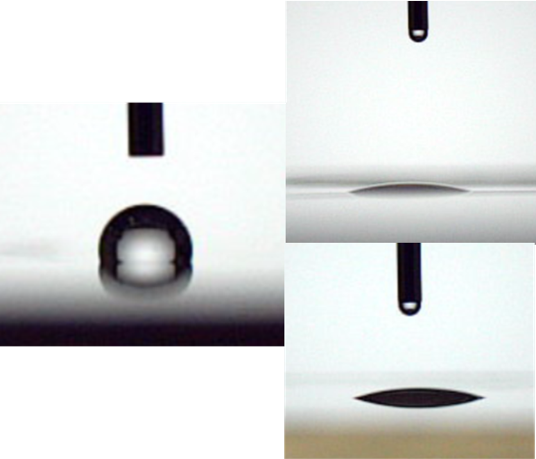
- Left: Olefin-based material
- Right: Zelas™ Hydrophilic Grade
This hydrophobicity isn't just a problem with water. In industrial settings, medical devices, and other applications, it manifests itself in the following ways:
- Water-based inks and paints are "repelled" by the olefin surface, resulting in uneven printing and pinholes.
- If adhesives or coatings do not spread sufficiently, it can lead to interfacial delamination or a decrease in peel strength after drying.
- The hydrophilic coating layer delaminates at the interface from the olefin substrate side, resulting in variations in sliding properties and anti-fogging performance between batches.
In all cases, the common challenge is that "liquids do not adhere well to low-polarity surfaces." Considering printability, adhesion, coating reliability, and even process design and quality assurance, hydrophilization (or hydrophilicization) is an issue that cannot be ignored.
Therefore, when designing the surface of olefin resins, it is necessary to consider not only water but also compatibility with "liquids in general."
5 approaches to hydrophilization
There are 5 major methods for making olefin resins hydrophilic.
method | Principle of performance realization | Features/Pros. | Main points to note/Cons. |
|---|---|---|---|
Plasma / Corona treatment | Surface oxidation, introduction of polar functional groups (-OH, -COOH, etc.) | Significant improvement in wettability immediately after treatment. | Hydrophobicity recovery (aging) can occur. |
UV and chemical treatment | Functional groups are introduced through photoreactions and oxidation reactions. | Suitable for flat plate and continuous processing lines. | Hydrophobicity recovery (aging) can occur. Pay attention to uneven processing, chemical management, and substrate damage. |
hydrophilic coating | A hydrophilic polymer layer is formed on the surface. | Easily exhibits superhydrophilicity and anti-fogging properties. | Addition of coating and drying process, Adhesion to the substrate is a challenge. |
Roughness control | Micro- and nano-structures change apparent wettability. If the contact angle of the resin itself is not low, it will come into contact with the water-repellent material. | High degree of freedom in functional surface design | Designing for stability is difficult when done independently. It requires combination with other hydrophilization methods. |
Material modification | The resin itself is given hydrophilic and polar components. Hydrophilicity is achieved through the dissolution of additives. | Reduced post-processing, easy to apply to complex shapes and internal surfaces. | Hydrophilic resins absorb moisture and water. In the case of additives, they are limited to single-use applications. |
Plasma / Corona treatment
Surface activation using plasma or corona is a method that introduces oxygen-containing functional groups such as -OH, -COOH, and C=O to the surface of polyolefins, thereby significantly reducing the contact angle. It has been reported that generating radicals on the surface of LD-PE by argon plasma treatment and graft polymerization of polar monomers (such as acrylic acid) can reduce the contact angle to 38°. (Reference 3)
However, the treatment effect has a temporal limit. This is due to a phenomenon called "hydrophobic recovery," where the treated surface gradually returns to its original hydrophobic properties over time. (References 3, 4)
For applications requiring long-term stable hydrophilicity, plasma treatment alone is insufficient, and a combination of graft polymerization or post-coating is necessary.
UV and chemical treatment
UV irradiation (especially deep ultraviolet and vacuum ultraviolet light from low-pressure mercury lamps) dissociates and excites oxygen molecules to generate ozone and reactive oxygen species, which oxidize the polymer surface, causing hydrophilization due to their functional groups.
Previous studies have shown that UV irradiation treatment on PP substrates reduces the contact angle. However, the reduction in PP is relatively small, tending to converge at approximately 80°. This highlights a material-specific challenge: PP does not react as significantly to UV or atmospheric pressure plasma as other materials (ABS, PC, etc.). (Reference 2)
In cases where low-density polyethylene (LDPE) and biaxially oriented polypropylene (BOPP) were surface-modified with vacuum ultraviolet light (VUV, 172 nm), it has been reported that immediately after treatment, the contact angle decreases and the material exhibits high hydrophilicity, but during storage, the wettability gradually decreases, and the material returns to its original hydrophobic state. (Reference 5)
Hydrophilic Coating
Applying hydrophilic polymers as a coating can achieve extremely high hydrophilicity (superhydrophilic: water contact angle of 10° or less), but adhesion to the substrate is the key to durability. The following are some of the challenges involved.
- With olefin substrates that have low surface energy, coating liquids tend to be repelled, making it difficult to form a uniform film.
- If the interfacial adhesion after drying and curing is low, delamination (peeling) will occur in sliding and humid environments.
- In reactive (UV-curing/thermosetting) coatings, it can be physically difficult to apply uniform light irradiation and heat to opaque materials or hollow/lumen structures.
Mitsubishi Chemical possesses olefin resins that are resistant to peeling. Later, we will discuss the combined use of this material with hydrophilic coatings.
Roughness control
This method involves changing the apparent contact angle by designing the micro- and nano-structures of the surface. However, it is difficult to maintain stable hydrophilicity over a long period of time through roughness control alone, and in practice, it is sometimes used in combination with functional group introduction or hydrophilic coatings.
Material modification
The greatest advantage of "material modification," which imparts hydrophilic and polar components to the resin itself, is that hydrophilicity can be achieved simultaneously with molding without any post-processing. This makes it possible to achieve the desired wettability from the molding stage, even for parts where surface treatment in subsequent processes is structurally difficult, such as the inner surfaces of complex shapes or narrow channels.
Mitsubishi Chemical is currently developing hydrophilic resins using hydrophilic agents. We will explain these materials in more detail later.
Examples of applications in medical devices
There are two main situations in the field of medical devices where hydrophilic properties of resins are necessary.
One type of component is one that requires the reliable drawing in and smooth flow of blood or saline solution, such as blood collection devices, microfluidic chips, and the narrow channels within syringes.
Another example is components such as catheters and guidewires, which repeatedly slide against each other while wet with blood and bodily fluids, and where low friction needs to be maintained.
For the former application, "fluid pathways and blood collection," a coating-free material modification (Method A: Zelas™ hydrophilic grade) that provides sufficient wettability to the surface through molding alone is effective.
For the latter "sliding and durability" applications, a configuration that combines a PP-based resin with polar groups and a hydrophilic coating to maintain high sliding and adhesion even under wet conditions (Method B: MC787AP/MC721AP + HydroMed™) is suitable.
2 Approaches used by MCC materials
Method A: Coating-less
Zelas™ Hydrophilic Grade (XHP109 / XHP304) Development Product
Zelas™ hydrophilic grade is a material that incorporates hydrophilic components into PP or amorphous olefin (Zelas™CP), resulting in a hydrophilic surface simply by molding.
- It eliminates the need for subsequent plasma treatment and coating processes, and can handle parts with complex shapes and internal lumens.
- The contact angle of the resin surface is approximately 15 degrees.
- The base resin is available in two types: amorphous olefin (XHP304) or PP-based elastomer (XHP109).
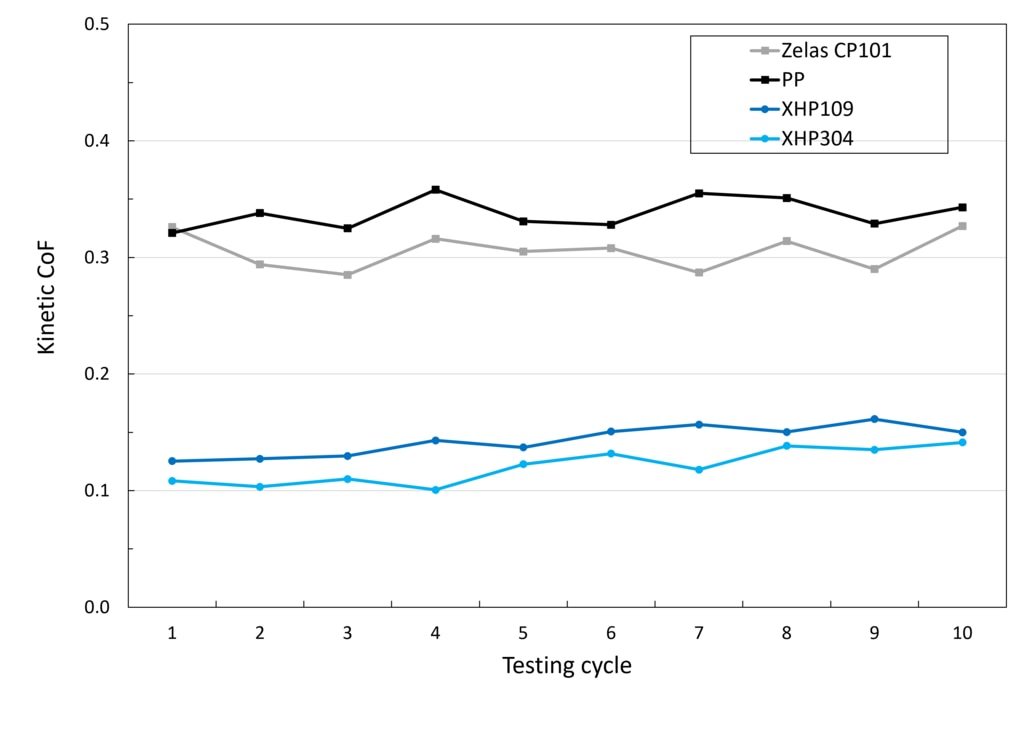
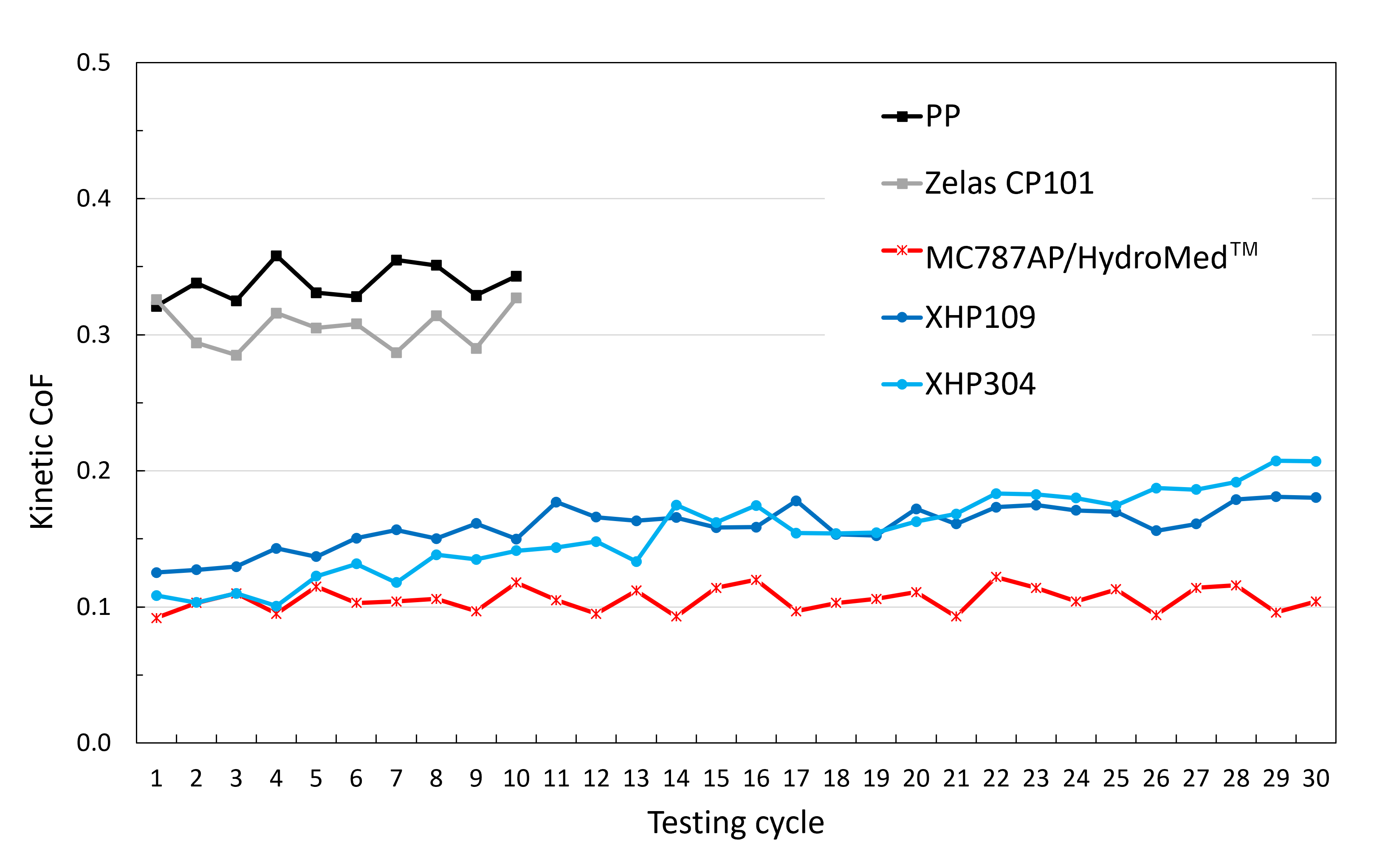
- Both XHP109 and XHP304 significantly reduce the sliding properties of the base resin before hydrophilization (initial COF ≈ 0.11-0.13).
- With repeated use, the sliding resistance in water will gradually increase, but sufficient lubrication can be maintained for single-use applications.
✅ Suitable applications: Blood collection devices, microfluidic chips, capillary tubes, etc.
Method B: High-durability coating
MC787AP/MC721AP(Base resin) + HydroMed™ (Hydrophilic coating)
This method is an approach that fundamentally improves the coating adhesion of PP substrates.
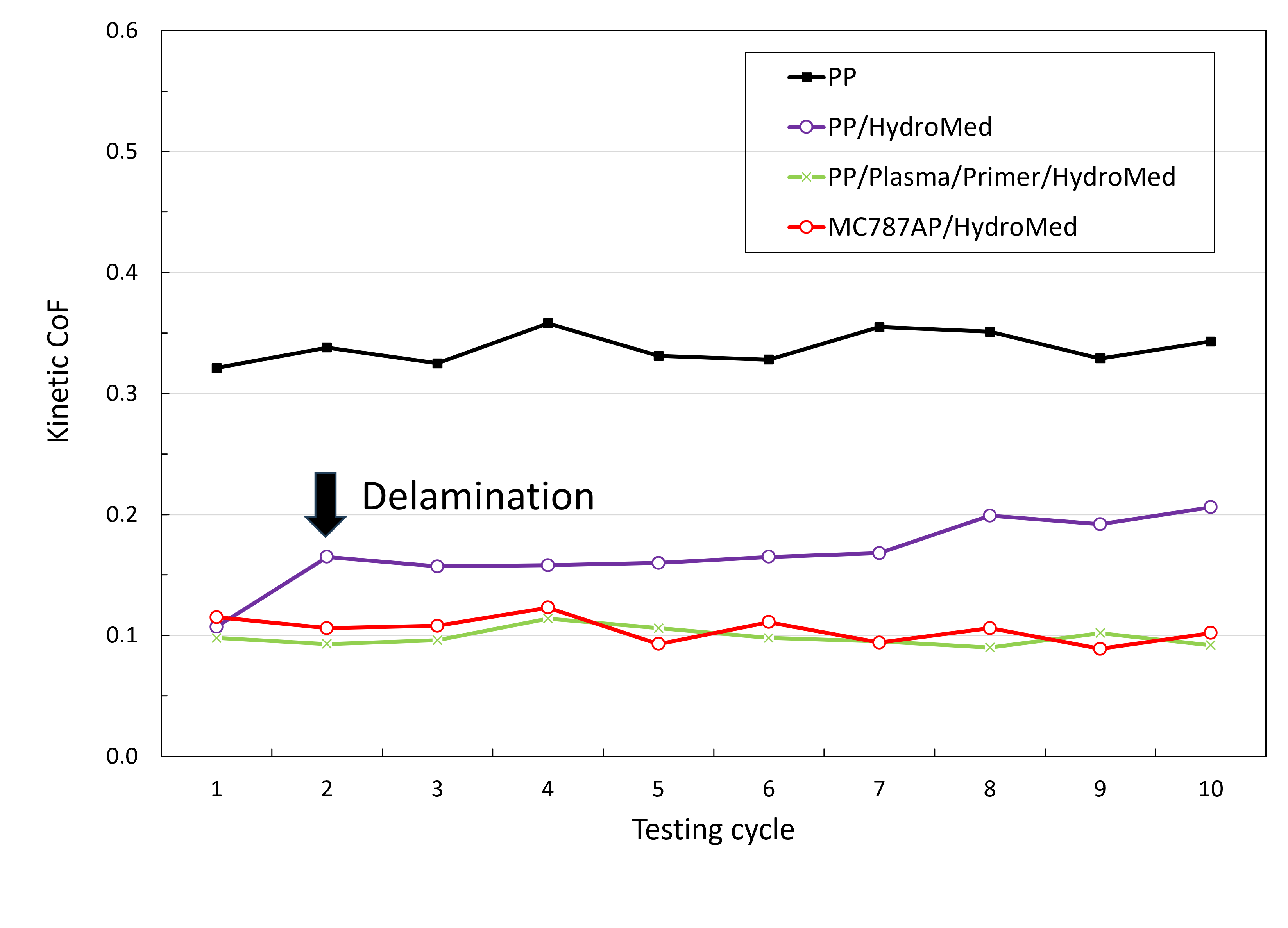
MC787AP and MC721AP are PP (polypropylene) materials with incorporated polar groups. These polar functional groups enhance interfacial affinity with coating materials, and it has been confirmed that hydrophilic coating materials (HydroMed™) adhere well and exhibit sliding properties even without plasma/corona pretreatment or primer treatment.
HydroMed™ D640 is a non-reactive, hydrophilic polyurethane that is already polymerized. It can be formed simply by dissolving it in ethanol (or a water/ethanol mixture) and dipping it in a coating solution; UV irradiation and heat curing are not required.
These combined effects result in,
- Coating of internal lumens and complex shapes is possible (because light irradiation is not required).
- Plasma pretreatment process is unnecessary (reduction of manufacturing process).
- No primer application is required (reduction in manufacturing steps).
- Underwater sliding performance test: COF ≈ 0.10 maintained even after more than 30 cycles of repeated use (highest durability, combination of MC787AP and HydrMed developed product).
✅ Suitable applications: Catheter interiors, guidewire liner interiors, injector and cylinder interiors (sliding surfaces), sliding parts of reusable devices
Selection Guide by Application and Requirements
Material composition | Conventional methods PP/Plasma/Primer/Coating (HydorMed™) | Method A: Zelas™ XHP109/304 (hydrophilic resin) | Method B: MC787AP or MC721AP/Coating (HydorMed™) |
|---|---|---|---|
Simplicity of the manufacturing process | × 4 Steps (Multiple Processes) | ◎ 1-Step Molding Only | △ A two-step coating process is required. |
contact angle | N/A | 15° | N/A |
Initial lubricity | ◎ (COF ≈ 0.09-0.10) | ○ (COF ≈ 0.11 to 0.13) | ◎ (COF ≈ 0.09-0.10) |
Repeated durability | ○ (Stable for 10 cycles) | △ (COF is showing an upward trend) | ◎ (Stable for 30 cycles) |
Suitability for internal coating | ◎ (Non-reactive, can be handled internally) | No coating required | ◎ (Non-reactive, can be handled internally) |
Plasma pretreatment | need | Unnecessary | Unnecessary |
Main uses | Generally used | Single use | Reusable and highly durable applications |
Conclusion
Hydrophilization of polyolefins can be achieved either by "modifying them later in the process" or by "changing the material itself."
These can be divided into two main design philosophies.
While plasma and coatings are easy to apply to existing materials, they have challenges such as hydrophobicity restoration and limitations in application to complex shapes.
In contrast, a material modification approach—such as Zelas™ hydrophilic grades and Zelas™ polar group-introduced PP—has the potential to achieve stable hydrophilicity while reducing the number of processes.
Mitsubishi Chemical offers evaluation support and sample provision using the two development materials mentioned above.
"We want to improve the sliding properties of olefin materials."
"We want to skip the coating process."
"We want to redesign the surface of single-use devices."
"Can't this be applied to industrial uses?"⇒ We can offer proposals for polar group-introduced olefins. Hydrophilic coatings are limited to medical applications.
Please feel free to contact us with any requests you may have.
References
- Hara, Shigeo; Tanaka, Toshihiro. "Chapter 6: Surface Tension, Interfacial Tension, and Contact Angle." *High-Temperature Physical Properties: A Handmade Laboratory - Measuring by Melting: A Measurement Guide Full of Trivia*, Agne Technical Center, 2011.
- Yoichi Obinata, Satoshi Nagatani. Surface modification and hydrophilicity evaluation of various substrates. Research Report of Nagano Prefectural Industrial Technology Center, 17, 97–100, 2022.
- Kricheldorf HR, et al. Modification of polyolefin surfaces by plasma-induced grafting. J Appl Polym Sci. 1996;59(10):1651–1657
- E. Occhiello, M. Morra, G. Morini, F. Garbassi, and P. Humphrey, J. Appl. Polym. Sci., 42, 551 (1991).
- Truica-Marasescu, F., Jedrzejowski, P. and Wertheimer, M.R. (2004), Hydrophobic Recovery of Vacuum Ultraviolet Irradiated Polyolefin Surfaces. Plasma Processes Polym., 1: 153-163.
Note: Regarding the available grades of polar group-containing PP-based elastomers.
We recommend the MC721AP to our Japanese customers and the MC787AP to our customers outside of Japan.