
Evaluation and Selection Points for PVC in Food Contact Materials: Explanation of Regulatory Compliance, Plasticizers, and Migration Assessment
When evaluating and selecting PVC as a food contact material (FCM), three points are important: (1) control of the compounding, (2) evaluation of migration to food, and (3) performance requirements for each application. In particular, for flexible PVC, the type of plasticizer and DEHP-free status affect physical properties, processability, migration characteristics, and regulatory compliance.
This article outlines the positioning of food-contact PVC, regulatory compliance, component management, migration assessment, and application-specific considerations, using food-grade hoses, tubes, gaskets, and packaging materials as examples. It also explains material selection considerations based on market conditions such as Japan, the EU, and the US, as well as usage conditions including oily foods, high temperatures, and prolonged contact.
Key points of this article
In evaluating PVC for food contact applications, three points are important: "component control," "migration evaluation," and "application-specific performance requirements."
For flexible PVC, DEHP-free plasticizers and migration evaluation are particularly important.
The points to check vary depending on the application (hoses, tubes, gaskets, packaging materials), the food they come into contact with, and the usage conditions.
Table of Contents [hide]
- 1.The role of PVC in food contact applications
- 1.1.Can PVC be used as a food contact material? Positioning by application
- 1.2.For food contact applications, evaluate the entire formulation.
- 1.3.The evaluation method varies depending on the food, application, and usage conditions.
- 1.4.What is food-grade PVC?
- 2.Performance required for food contact applications
- 3.Compliance with regulations on food contact materials
- 3.1.Componentmanagement
- 3.2.Migration Management
- 4.Why plasticizers are important in flexible PVC
- 4.1.Relationship between flexible PVC and plasticizers
- 4.2.Why are plasticizers attracting attention for food contact applications?
- 4.3.The concept of DEHP-free PVC
- 5.Evaluation items to be checked for food contact applications
- 6.Selection Flowchart for Food Contact Materials
- 7.Frequently Asked Questions (FAQ)
- 8.Points to note when implementing
- 9.ReferenceURL
The role of PVC in food contact applications
Can PVC be used as a food contact material? Its positioning by application.
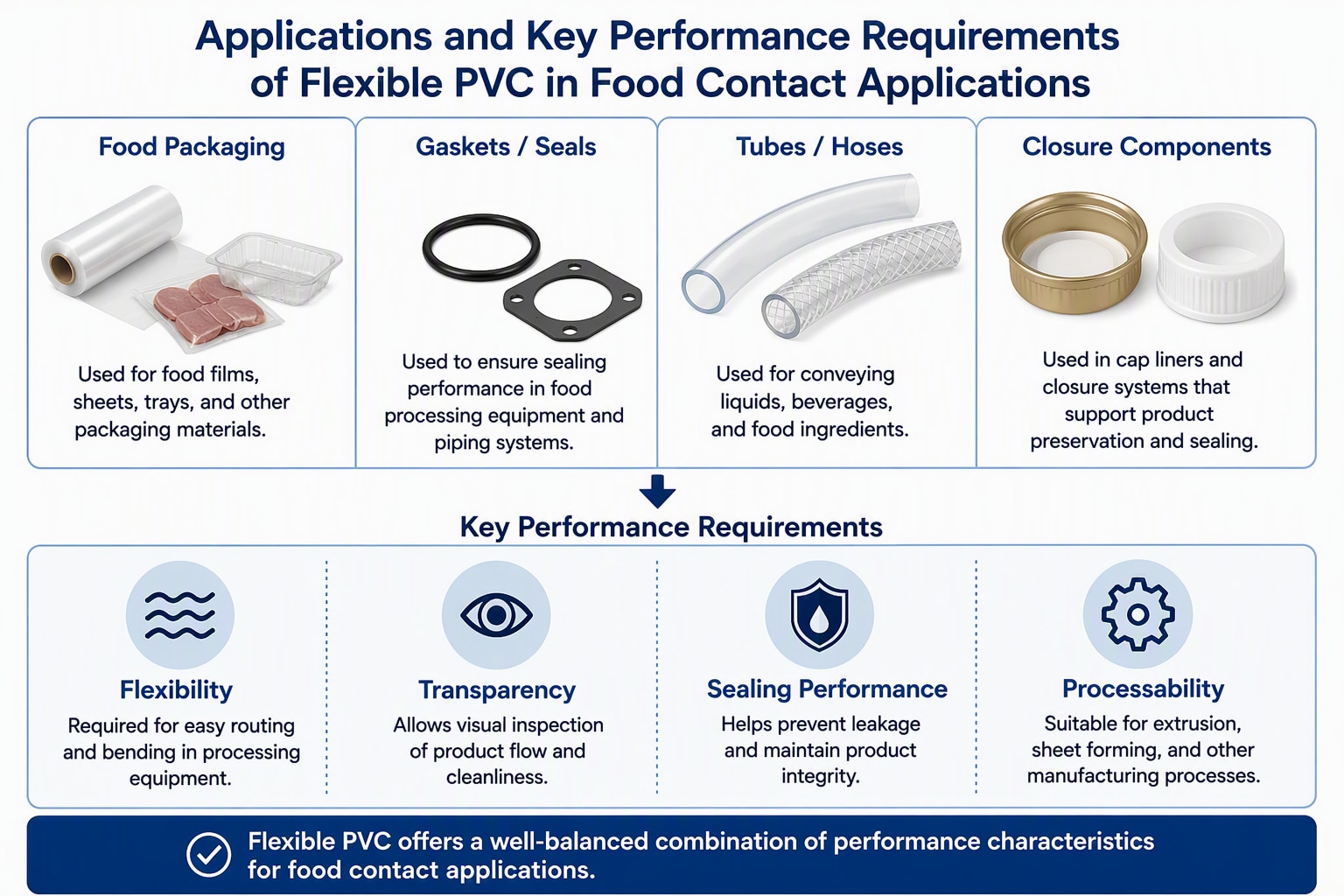
PVC (polyvinyl chloride) is one of the materials used in food packaging, food-grade tubes, hoses, gaskets, and other applications. Food contact applications include not only packaging materials but also fluid transport components and sealing components used in food manufacturing equipment.
On the other hand, unlike general applications, food contact applications require material selection that takes safety and regulatory compliance into consideration. Therefore, it is necessary to check not just whether PVC is used, but also what formulation it is, what kind of product it is used in, and under what conditions it comes into contact with food.
PVC can be considered a material for food contact applications after reviewing its composition, the usage conditions of the final product, and the regulations of the target market. However, this does not mean that PVC intended for general use can be used directly for food contact applications.
For food contact applications, the entire formulation is evaluated.
For food contact applications, the focus is not only on the resin itself, but on the entire set of components that make up the material.
For example, in the case of PVC, plasticizers, stabilizers, and other additives may be added in addition to the PVC resin. Even with the same PVC, the regulatory compliance, migration assessment, and physical property evaluation that need to be checked will differ depending on the composition and application.
Therefore, when evaluating food contact applications, it is important not to judge solely by the name of the material, but to confirm suitability by considering the composition of raw materials and additives used, the intended use of the final product, and the conditions of contact with food.
The evaluation method varies depending on the food, application, and usage conditions.
For applications involving contact with food, the points to check vary depending on the food being contacted and the usage conditions.
For example, water-based foods and oil-based foods may have different interactions with other materials and different component migration behaviors. Furthermore, the required heat resistance and evaluation conditions will differ between room temperature and high-temperature use.
Furthermore, even within the same PVC material, the required performance differs depending on whether it's used for hoses, tubes, gaskets, or packaging materials.
Therefore, when considering the application of PVC in food contact applications, it is important to consider not only the material itself, but also the food it will come into contact with, the application, and the environment in which it will be used.
What is food-grade PVC?
Generally, materials referred to as "food-grade PVC" refer to PVC compounds in which raw materials such as PVC resin, plasticizers, stabilizers, lubricants, and colorants have been selected with food contact applications in mind.
However, the term "food grade" alone does not mean that it complies with all food, temperature, contact time, and regional regulations. Actual adoption requires checking the regulations of the target market, the type of food, the temperature used, contact time, washing conditions, and the final product's transition assessment.
Performance required for food contact applications
For food contact applications, not only regulatory compliance and migration characteristics are required, but also performance tailored to the specific application.
PVC is a material that offers a good balance of flexibility, transparency, processability, and cost. In particular, its ease of imparting flexibility, ensuring transparency, and suitability for extrusion are some of the reasons why it is considered for food-grade hoses and tubes.
On the other hand, depending on the application, sealing properties, compression set resistance, chemical resistance, heat resistance, and low-temperature flexibility are important. Therefore, when adopting PVC for food contact applications, it is necessary to confirm not only regulations and transitions, but also the physical properties required for the product.
product | Main required characteristics |
|---|---|
hose | Flexibility, bending resistance, washability, pressure resistance |
Tube | Flexibility, transparency, bend resistance, low odor |
gasket | Sealing properties, compression set resistance, chemical resistance |
food packaging material | Storage stability, processability, and visibility of contents. |
Compliance with regulations on food contact materials
Ingredient management
In regulating food contact materials, one of the key considerations is the proper management of the ingredients that can be used.
Materials that come into contact with food may contain not only resins, but also various other substances such as plasticizers, stabilizers, lubricants, and colorants. Therefore, when using food-contact materials, it is necessary to check not only what materials are used, but also what components are included.
While the regulatory frameworks differ in Japan, the EU, and the US, all three countries emphasize the management of components used in food contact materials. When selecting materials, it is important to check not only the resin name but also the constituent components.
Related: A comparison of regulations in various countries and further details are explained in "Trends in PVC (Polyvinyl Chloride) and Alternative Resins for Food Contact Applications."
Migration Management
When considering materials that come into contact with food, it is necessary to consider not only the components used but also the possibility of those components migrating into food.
When food and materials come into contact, components from the materials may migrate to the food depending on the usage conditions. Since food-contact materials are required not to affect the quality or safety of food, evaluations are conducted that take into account the amount of migration to food and the usage conditions.
The importance of evaluating migration becomes particularly high under conditions such as contact with oily foods, high-temperature environments, and prolonged contact.
Therefore, in the evaluation of food contact materials, in addition to component management ("what is used"), migration management ("to what extent migration is possible") is also considered important.
Why plasticizers are important in flexible PVC
The relationship between flexible PVC and plasticizers
PVC is broadly classified into rigid PVC and flexible PVC. Rigid PVC is relatively rigid and is used for piping materials and sheets, while flexible PVC is used for applications where flexibility is required, such as hoses and tubes.
In flexible PVC, plasticizers are generally added at a concentration of 20-50 wt% to impart flexibility and processability. The plasticizers enter between the PVC chains and relax the interactions between molecular chains, thereby lowering the glass transition temperature (Tg) of the PVC.
As a result, PVC is given softness and flexibility, making it possible to mold and use it as flexible PVC.
Why are plasticizers attracting attention for food contact applications?
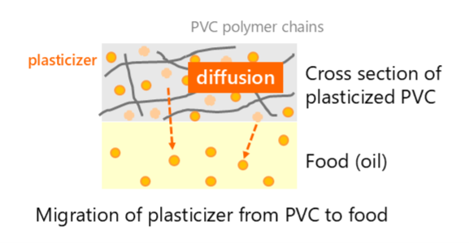
One reason plasticizers are attracting attention in food contact applications is that flexible PVC is a mixture of PVC and plasticizers. Typical external plasticizers are not chemically bonded to PVC, but are physically mixed with it. Therefore, plasticizers with smaller molecular weights are more likely to move through the material and potentially migrate to the food. In particular, evaluations that consider the behavior of plasticizers are important under conditions such as contact with oily foods, high-temperature environments, and prolonged contact.
For food contact applications, the possibility of this migration is an important point to consider when evaluating plasticizers.
Related: Detailed selection points for PVC plasticizers and a comparison of DEHP, ATBC, and TOTM are explained in detail in "Why do plasticizers migrate in food-contact PVC? Explanation of the characteristics and migration mechanisms of DEHP, ATBC, and TOTM."
The concept of DEHP-free PVC
In discussions about plasticizers in food contact applications, the concept of DEHP-free PVC is sometimes brought up.
DEHP (Di(2-ethylhexyl) phthalate) is one of the typical phthalate-based plasticizers, but in Japan, its use has been restricted since 2002 under the Food Sanitation Act for applications that come into contact with oils and fatty foods.
Furthermore, under the EU's REACH regulation, DEHP is regulated as an SVHC (Superficially Viable Chemical), and its use is restricted in toys and infant products. Given this background, designs that do not use DEHP are sometimes considered for food contact applications, taking into account migration risks and regulatory compliance.
However, the suitability of a material is not determined solely by whether or not it uses DEHP. In reality, it is necessary to evaluate the material based on the type of plasticizer used, the operating environment, and the applicable regulations.
Evaluation items to be checked for food contact applications
For food contact applications, the points to check vary depending on the food being contacted, the application, and the usage conditions. When selecting and evaluating materials, it is important to organize the following perspectives.
Checklist for each food item
food classification | Main evaluation items and required characteristics |
|---|---|
fat and oil food | Migration evaluation, oil resistance, presence or absence of swelling/softening. |
Foods containing alcohol | Alcohol resistance, migration evaluation, presence or absence of swelling and physical property changes. |
acidic food | Acid resistance, stability during long-term contact. |
water-based food | Low odor, long-term stability |
Check items based on usage conditions
Usage conditions/process | Main evaluation items and required characteristics |
|---|---|
Cleaning process (including CIP, etc.) | Chemical resistance, heat resistance, long-term durability |
High temperature filling/heating process | Heat resistance, migration evaluation, physical property changes |
Reusable | Durability, flexibility, fatigue degradation |
long term storage | Long-term stability, changes in appearance, changes in odor |
low temperature environment | Maintaining flexibility, impact resistance, and presence or absence of hardening. |
Therefore, when evaluating PVC for food contact applications, it is important to consider not only whether it is PVC, but also the food it will come into contact with, its intended use, and the conditions under which it will be used.
Selection flow for food contact materials
For food contact materials, simply selecting materials that comply with regulations is not enough. In reality, it is important to select materials after comprehensively considering the type of food they will come into contact with, their intended use, usage conditions, and required performance.
Selection process
-
Check the type of food (oils, alcohol, acid, water-based)
-
Clarify the application and required performance (hoses, tubes, gaskets, packaging materials)
-
Check the usage conditions (temperature, contact time, washing process, etc.).
-
Check the applicable regulatory requirements (Food Sanitation Law/Regulation (EU) No. 10/2011, GB 4806, GB 9685, etc.)
-
Check the ingredients and compatibility documents.
-
Comparing candidate materials (PVC, TPE, silicone, etc.)
-
Transition evaluation and physical property evaluation
-
Select the final materials
Concept of material candidates
In recent years, materials such as TPE and silicone have been considered as options in addition to PVC. However, no single material is always superior, and the most suitable material varies depending on the application.
Therefore, when selecting materials, it is important to comprehensively evaluate factors such as required performance, safety, regulatory compliance, processability, and cost, rather than simply choosing between "PVC or something else."
For example, there are cases where a flexible material other than PVC is required, or where TPE is a strong option depending on the application.
Related: If you are considering switching from PVC to alternative materials (such as TPE), please refer to "Trends in PVC and Alternative Resins for Food Contact Applications" and "Latest Regulatory Trends and Elastomers for Food Contact Materials" for further information.
Frequently Asked Questions (FAQ)
Q1: What is food-grade PVC?
This formulation, which includes PVC resin, plasticizers, stabilizers, and colorants, is designed for food contact applications. However, this does not mean that it will be suitable for all foods or usage conditions; it is necessary to check the regulations and usage conditions of the target market.
Q2: What is DEHP-free PVC?
DEHP-free PVC refers to a flexible PVC design that does not use DEHP, a typical phthalate-based plasticizer. Because migration evaluation of DEHP is particularly important when in contact with oils and fatty foods, designs using alternative plasticizers are considered for such applications. However, the suitability of a material is not determined solely by the absence of DEHP. A comprehensive evaluation is necessary, taking into account the type of plasticizer used, the foods it comes into contact with, and the usage conditions.
Related: Details on the characteristics and migration mechanisms of each type of plasticizer are explained in "Selection and Migration Mechanism of PVC Plasticizers".
Q3: How do you differentiate between PVC, TPE, and silicone for food contact applications?
For food contact applications, it's crucial to comprehensively evaluate required performance (flexibility, transparency, heat resistance), safety, regulatory compliance, and cost, rather than simply deciding between PVC, TPE, or silicone. When a material composition without plasticizers is required, TPE and silicone are potential candidates. On the other hand, if the flexibility, transparency, and processability of PVC are to be utilized, PVC formulations including DEHP-free PVC should also be considered.
Q4: Under what conditions is plasticizer migration more likely to occur in flexible PVC?
Because plasticizers are not chemically bonded to PVC resin, the risk of migration increases when three conditions coincide: contact with oily foods, high temperatures, and prolonged contact. Migration assessment becomes especially important when used with oily and fatty foods.
Related: Details on the characteristics and migration mechanisms of each type of plasticizer are explained in "Selection and Migration Mechanism of PVC Plasticizers".
Q5: Can the safety of food-contact materials be determined solely by the name of the resin?
No, that's not possible. For food contact materials, the entire composition, including plasticizers, stabilizers, lubricants, and colorants, is evaluated, not just the resin itself. Even with the same PVC, the results of regulatory compliance and migration evaluation will differ depending on the formulation and application conditions.
Q6: Are the points to check the same for food packaging materials, hoses, tubes, and gaskets?
They differ. For hoses, flexibility, bend resistance, and cleanability are important; for tubes, transparency, kink resistance, and low odor; for gaskets, sealing performance, compression set resistance, and chemical resistance are important; and for food packaging materials, storage stability, processability, and visibility are important. The evaluation criteria change depending on the application.
Points to note when implementing
Compliance with regulations for food contact applications requires an understanding of market-specific standards and accurate information dissemination within the company's supply chain. Since food contact material regulations in each country and region are frequently revised, always check the latest official information and guidelines before implementation.
As a compound manufacturer, Mitsubishi Chemical verifies product compliance through surveys with various raw material manufacturers and provides responses and grade recommendations based on the latest regulations in each country. However, since regulations and interpretations may change in the future, please contact your sales representative individually for specific regulatory confirmations and grade selections.
Due to the nature of compound products, it may take some time to confirm the formulation and raw materials used. We ask for your understanding that we require sufficient lead time in advance when inquiring about and responding to inquiries regarding compliance with regulations in various countries.
Mitsubishi Chemical offers sample provision and technical consultation regarding various food contact materials.
We will suggest the most suitable grade for your needs, so please feel free to contact us.
Reference URL
[1] Food contact regulations
- Consumer Affairs Agency, "Regarding the Positive List System for Food Utensils, Containers, and Packaging (from June 2025 onwards)"
https://www.caa.go.jp/policies/policy/standards_evaluation/appliance/positive_list_new
• U.S. Government Publishing Office, “Title 21 – Food and Drugs, Vol.3 (Contains Parts 170–199, including 174–178)”
https://www.govinfo.gov/content/pkg/CFR-2025-title21-vol3/pdf/CFR-2025-title21-vol3.pdf
・European Commission, “Commission Regulation (EU) No 10/2011 on plastic materials and articles intended to come into contact with food”
https://eur-lex.europa.eu/eli/reg/2011/10/2026-02-23
[2] DEHP and plasticizer related
- Ministry of Health, Labour and Welfare, "Q&A on Usage Regulations Regarding Synthetic Resin Utensils, Containers, and Packaging Made Mainly of Polyvinyl Chloride Containing Phthalates"
https://www.mhlw.go.jp/topics/bukyoku/iyaku/kigu/dl/3.pdf