
Trends in PVC (polyvinyl chloride) in food contact applications and alternative resins
For many years, PVC has been used in food contact applications as a material with an excellent balance of flexibility, airtightness, and processability. However, in recent years, there has been a growing movement to reconsider material selection that relies on PVC, against the backdrop of stricter regulations in various countries, requirements specific to export destinations, and a trend towards redesigning products to suit different applications. In particular, flexible PVC using plasticizers is easy to achieve good performance with, but it also presents more challenges in terms of transition and regulatory compliance.
Table of Contents [hide]
- 1.The role of PVC in food contact applications
- 2.Main concerns regarding the use of PVC in food contact applications
- 2.1.Migration of low molecular weight components and regulatory compliance
- 2.2.Quality effects due to interactions with food
- 2.3.Concepts for PVC Substitutes
- 2.4.Reasons why changing plasticizers is not a viable solution
- 2.5.Review from the product design stage
- 3.Alternative approaches and implementations using elastomers
- 4.Points to note when implementing
- 5.ReferenceURL
The role of PVC in food contact applications
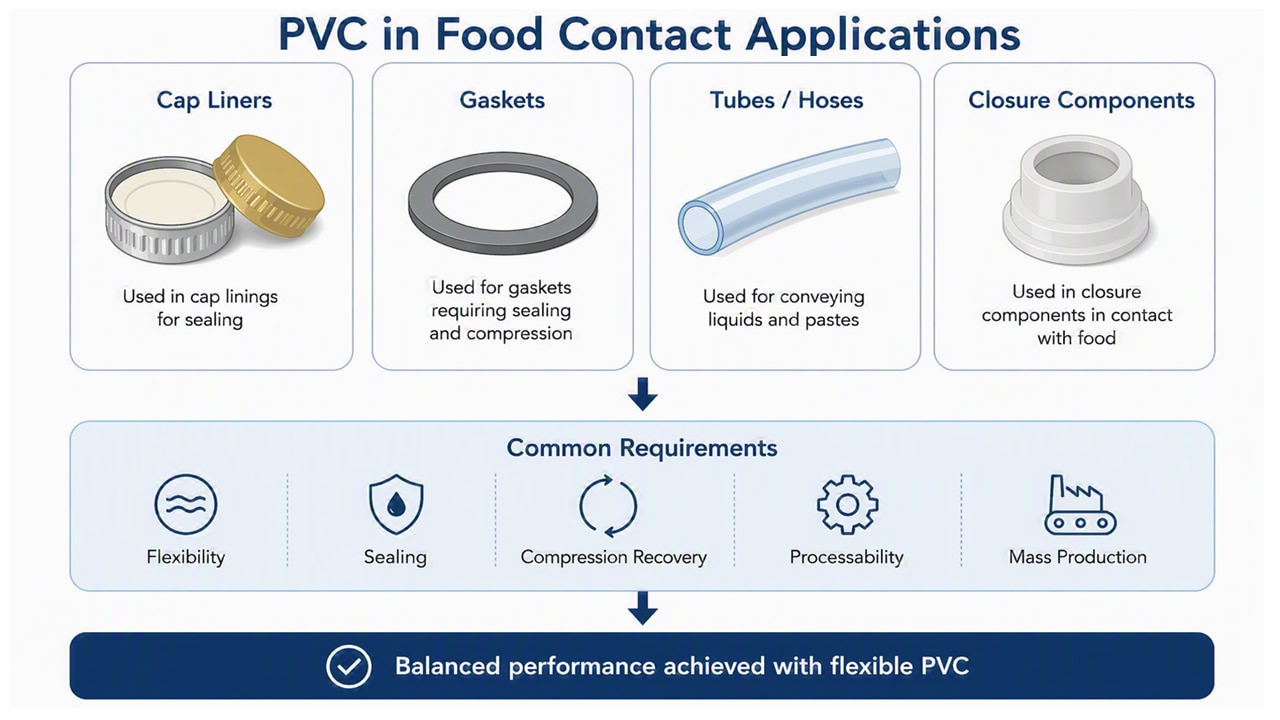
PVC has been widely used not only as a film for food packaging, but also as a sealing material and cap liner, as well as in other soft components that come into contact with food.
Furthermore, depending on the region and application, it is also used in gaskets, tubes, and hoses.
These applications require not only flexibility, but also sealing ability, compression recovery, processing stability, and suitability for mass production.
PVC has been used as a material that satisfies these requirements in a balanced way, but in recent years, changes in application conditions, quality requirements, and regulatory trends have led to calls for a review of conventional design approaches.
Main concerns regarding the use of PVC in food contact applications
While PVC is an excellent material, in recent years it has increasingly become a subject of design consideration depending on its application.
Here, we will mainly organize the information into "transfer of low-molecular-weight components" and "interactions with food."
These are all important considerations when thinking about the suitability of a material for contact with food.
Migration of low molecular weight components and regulatory compliance
In flexible PVC, it is common practice to use plasticizers in the design to achieve flexibility.
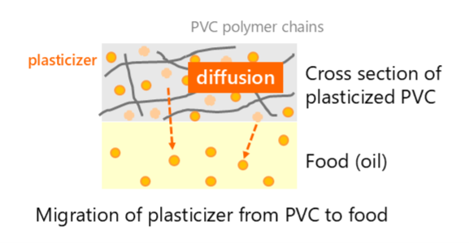
However, low-molecular-weight components such as plasticizers tend to migrate to food, making them an important factor to consider when evaluating compliance with regulations as food contact materials.
In recent years, regulations concerning food contact materials have become more sophisticated globally, and there is a growing trend towards requiring evaluations that include not only whether a substance is permissible to use, but also specific migration limits (SMLs) and usage conditions for each substance.
While the approach to these regulations varies from region to region, they all share a common emphasis on safety assessments based on transition characteristics and usage conditions.
In particular, phthalate esters such as DEHP (di(2-ethylhexyl) phthalate) are often evaluated from the perspective of migration characteristics and safety, and are considered important considerations in material design and regulatory compliance.
Below is a summary of the regulatory frameworks in various countries and their impact on PVC and plasticizers.
region | Regulatory framework | Main requirements | Effects on PVC/plasticizers |
EU | Regulation(EU) No.10/2011[1] | Specific migration limits (SMLs) for authorized substances | The phthalate migration and content are strictly controlled, which is a factor driving the shift towards low-migration materials. |
Japan | Food Sanitation Act / Positive List System [3] | • Material management using a positive list | The applicability of plasticizers depends on their listed status and may be restricted depending on the application; therefore, material selection must be based on the listed information. |
China | GB 4806 series | SML for each substance - Provisions for maximum usage and usage conditions | Plasticizers are managed as additives, and their suitability must be confirmed in terms of both usage conditions and migration characteristics. |
Taiwan | Food Safety and Hygiene Management Act[5] | • Usage restrictions depending on the intended use | Depending on the application conditions, the use of PVC may be restricted, and in particular, the risk of plasticizer migration must be considered in oil and fat food applications. |
India | Food Safety Standards(Packaging)Regulations2018[6] | SML for each substance • General safety and usage requirements | Emphasis is placed on evaluation based on migration amounts, and plasticizers are required to comply with OML and SML, which influences material design and formulation selection. |
関連:食品接触用PVCの規制対応、成分管理、移行評価、用途別の選定ポイントについては、「食品接触材料におけるPVCの評価・選定ポイント|規制対応・可塑剤・移行評価を解説」で詳しく解説しています。
Quality impact due to interactions with food
Safety is not the only challenge with PVC.
Interactions with food may result in odor transfer, flavor transfer, and changes in appearance.
In particular, flexible PVC contains plasticizers to provide flexibility, and these are typically present in relatively high amounts, around 20-40 wt%. Therefore, in oily foods, plasticizers and additives in the packaging material are more likely to migrate. Furthermore, oils and aroma components from the food can be absorbed into the material, potentially altering its properties.
For example, studies of food containers using PVC gaskets have reported that plasticizers migrate to food not only from the contact surface but also from within the material. This behavior may be observed not only with phthalates but also with other plasticizers, and the actual amount of migration may exceed assumptions based only on the contact surface. The effect may be more pronounced in oily and paste-like foods. [7]
関連:PVC可塑剤の種類や移行メカニズムは、「食品接触用PVCで可塑剤はなぜ移行する?DEHP・ATBC・TOTMの特徴と移行メカニズムを解説」で詳しく記載しています。
PVC alternatives
PVC has long been used in food contact applications because it offers an excellent balance of flexibility, airtightness, moldability, and cost.
However, because flexible PVC relies on plasticizers for its flexibility, there are more issues to consider regarding migration and regulatory compliance.
Therefore, when considering PVC alternatives, it is important to reorganize the information not simply by replacing the material name, but by considering which function each material should fulfill.
Reasons why changing plasticizers is not a viable solution
While changing plasticizers might seem to allow continued use of the same PVC, the debate over the transition remains, given that it involves low-molecular-weight components. For food contact applications, this may not offer a fundamental solution in terms of regulations and quality.
Therefore, depending on the application conditions, it may be more rational to reconsider the very concept of materials.
Rethinking from the product design stage
Replacing PVC is less about replacing a single material and more about redesigning the functional division of roles in packaging and components. It's crucial to define the required performance for each component, such as the seal, contact elements, and film, and then place the appropriate material in the necessary area.
Substituting PVC requires integrating material selection and product design into a single process.
Elastomer-based alternative approaches and implementations
One promising approach to these challenges is using elastomers (TPEs). Because TPEs can exhibit flexibility through their polymer structure itself, it is possible to design them without relying heavily on plasticizers.
As a result, it has the advantage of making it easier to incorporate considerations such as migration and regulatory compliance, which are important for food contact applications, into the material design process.
Flexible component design with Tefabloc™
In particular, Tefabloc™ TPS is a TPE suitable for food contact applications, offering a good balance of flexibility, processability, and application suitability.
Areas where it can be easily applied include packing and sealing parts, gaskets, tubes and hoses, and the areas around closures.
This material is easy to compare and consider as one of the options when you want to rethink the design of PVC, specifically its reliance on plasticizers.
In addition to Japan's positive list system, we also offer grades that comply with the US FDA and the European Union (PIM) standards for food hygiene.
Design principles for implementation
PVC replacement isn't always a simple matter of replacing it with a single material. Depending on the application, design considerations that include the structure and surrounding materials may be necessary.
By considering factors such as the balance between sealing and strength, the division of roles between contact and structural components, multi-layer construction, and adhesive design, it becomes easier to achieve both performance and regulatory compliance.
Mitsubishi Chemical supports material and structural design that takes into account application conditions and regulatory requirements, using Tefabloc™ as one of the options for flexible components.
It's not just about selecting materials; it's crucial to ensure the resulting configuration is actually functional.
Points to note when implementing
Compliance with regulations for food contact applications requires an understanding of market-specific standards and accurate information dissemination within the company's supply chain. Since food contact material regulations in each country and region are frequently revised, always check the latest official information and guidelines before implementation.
As a compound manufacturer, Mitsubishi Chemical verifies product compliance through surveys with various raw material manufacturers and provides responses and grade recommendations based on the latest regulations in each country. However, since regulations and interpretations may change in the future, please contact your sales representative individually for specific regulatory confirmations and grade selections.
Due to the nature of compound products, it may take some time to confirm the formulation and raw materials used. We ask for your understanding that we require sufficient lead time in advance when inquiring about and responding to inquiries regarding compliance with regulations in various countries.
Mitsubishi Chemical offers sample provision and technical consultation regarding various food contact materials.
We will suggest the most suitable grade for your needs, so please feel free to contact us.
Reference URL
[1] Commission Regulation (EU) 2023/1442 amending Regulation (EU) No 10/2011 on plastic materials and articles intended to come into contact with food
https://eur-lex.europa.eu/eli/reg/2023/1442/oj
[2] ECHA: REACH Regulation Annex XVII (Restriction List Overview)
https://echa.europa.eu/documents/10162/aaa92146-a005-1dc2-debe-93c80b57c5ee
[3] Consumer Affairs Agency: Handling of phthalates in food contact materials
https://www.caa.go.jp/policies/council/fssc/meeting_materials/assets/fssc_cms101_250626_05.pdf
[4] NHC: GB 9685 – Standard for Uses of Additives in Food Contact Materials
https://www.chinesestandard.net/PDF-EN/GB9685-2016EN-P18P-H15106H-760516.pdf
[5] TFDA: Regulations on the Labeling of Food Utensils, Food Containers, or Packaging
https://www.fda.gov.tw/eng/lawContent.aspx?cid=16&id=3090
[6] FSSAI: Food Safety and Standards (Packaging) Regulations, 2018 (Amendments)
https://fssai.gov.in/cms/amendment-fss-packaging.php
[7] Trends in Food Science & Technology, Vol. 17, No. 3, pp.105–112 (2006)