
nonspecific adsorption and sorption are crucial considerations in the selection of materials for clinical testing—how to choose specimen containers, tubes, and wetted materials.
In the development of clinical testing equipment and in vitro diagnostic devices, not only transparency and moldability, but also the selection of wetted materials that come into contact with samples and reagents affects the measurement results. In tests involving trace-level analytes, nonspecific adsorption, sorption, and leachables can affect recovery and measurement results.
This article explains, for developers involved in material selection for clinical testing, the reasons why measurement values and recovery rates may be lower than expected, the differences between adsorption, sorption, and leaching, and key points to consider when selecting wetted materials. In the latter half, we will also introduce an evaluation example of "Zelas™ CP," a medical compound that can be considered for applications ranging from containers to microfluidics and the inner layers of bags and tubes.
Table of Contents [hide]
- 1.Why do clinical test results sometimes come out lower than expected?
- 1.1.Changes in the measured components
- 1.2.Interactions with other components in the sample
- 1.3.nonspecific adsorption and sorption to containers and wetted components
- 1.4.leachables from containers and wetted wetted components
- 2.Considering low adsorption and sorption properties from a material perspective
- 2.1Method for suppressing nonspecific adsorption of proteins
- 2.2Method for suppressing sorption of low-molecular-weight compounds
- 3.The option of medical compound Zelas™ CP
- 3.1.Evaluation examples with suppressed protein adsorption
- 3.1.1.IgG adsorption Evaluation Results
- 3.1.2.Fibrinogen adsorption Evaluation Results
- 3.1.3.BSA adsorption evaluation results
- 3.2.Evaluation example that suppresses the decrease in concentration of low-molecular-weight compounds in liquid
- 3.3.Scope of application extending from containers to the inner layer of tubes
- 4.Finally, confirm with actual samples and final components—Practical points for selecting clinical laboratory materials
- 5.Frequently Asked Questions
- 6.Please consult us regarding the selection of materials for clinical laboratory components.
Why do clinical test results sometimes come out lower values than expected?
When measurement values or recovery rates in clinical tests are lower than expected, attention tends to focus on the decomposition of the sample being measured or the analytical conditions. However, these are not always the only causes. During collection, storage, dispensing, transport, and measurement, the sample comes into contact with various materials. First, it is necessary to pinpoint at which step the changes are occurring.
Changes in the measured component
The proteins and low-molecular-weight compounds being measured can change due to factors such as temperature, light, oxidation, and pH. Even if they are stable immediately after collection, their concentration and state may change over time. Standardizing and comparing pretreatment and storage conditions is the first step in identifying the cause.
Interaction with other components in the sample
Blood, urine, and other samples contain many components in addition to the target substance being measured. The state of the target substance and its detectability can change due to processes such as protein binding, enzymatic reactions, precipitation, and agglutination.
Furthermore, protein aggregation can be induced by a wide variety of conditions, including temperature, mechanical stress such as shaking and stirring, pumping, freezing and/or thawing, and formulation (Reference 1).
Furthermore, it is known that leachables from resins and glass, or the surfaces of resins and glass, can induce protein aggregation (Reference 2). This point will be discussed in detail in the section on "leachables from Containers and wetted components."
nonspecific adsorption and sorption to containers and wetted components
Another important factor to consider is interaction with containers and wetted components. Proteins and peptides can nonspecifically adsorption to surfaces such as sample containers, pipette tips, delivery tubes, and microfluidic channels.
- In the measurement of amyloid-beta in cerebrospinal fluid, it is known that the amount of adsorption varies depending on the material of the tubing used, the number of transfers, and the tubing volume, which affects the measured concentration.
- While it has been suggested that amyloid-beta peptides may have different effects on surface exposure depending on their isoform and peptide length, the reasons for this are not yet fully understood (Reference 3).
- It has been found that these adsorption can be suppressed by using low-binding tubes, and attention is being drawn to materials that suppress nonspecific adsorption (Reference 4).
- Studies using urine samples have also reported that multiple proteins and peptides adsorption onto the surface of collection and storage tubes. While the protein concentration in urine is extremely low, there have been reports of using hydrophilic coatings to suppress nonspecific adsorption (Reference 5).
With hydrophobic low-molecular-weight compounds, absorption into the polymer can occur in addition to adsorption onto the material surface. The term “sorption” encompasses both. The extent of sorption depends on the affinity between the compound and the polymer, as well as concentration, temperature, and contact time. Depending on the target analyte, sorption by the polymer should also be considered (Reference 6).
Leachables from containers and wetted components.
When considering interactions between samples and materials, it is important to consider not only the transfer of target analytes from the sample to the material, but also the transfer of material-derived substances into the sample. Substances that migrate from a material into a liquid under actual conditions of use are generally referred to as leachables.
- In resin containers and components, low-molecular-weight compounds such as additives, lubricants, release agents, unreacted components, and oligomers may transfer into the liquid. Regarding blood collection tubes, there have been reports of components originating from the tube wall, stopper, surfactants, and separating agents affecting blood analysis (Reference 7).
- Even with glass containers, interactions are not always absent. Depending on the pH and composition of the liquid, heating and storage temperatures, storage period, glass composition, molding history, and surface treatment, the glass surface and the liquid contents may interact, potentially causing glass constituent elements such as sodium, boron, aluminum, and silicon to migrate into the liquid (Reference 8).
- On the other hand, with resin components, additives, lubricants, oligomers, and components derived from the manufacturing process are subject to inspection. Since the expected leachables differ between resin and glass, it is important not to judge solely based on whether it is "glass or resin," but to consider the containers/components used, samples/reagents, storage conditions, and measurement systems in combination for inspection.
In other words, wetted materials can affect test results in both directions: through adsorption or sorption of sample components by the material, and through the migration of leachables from the material into the sample.
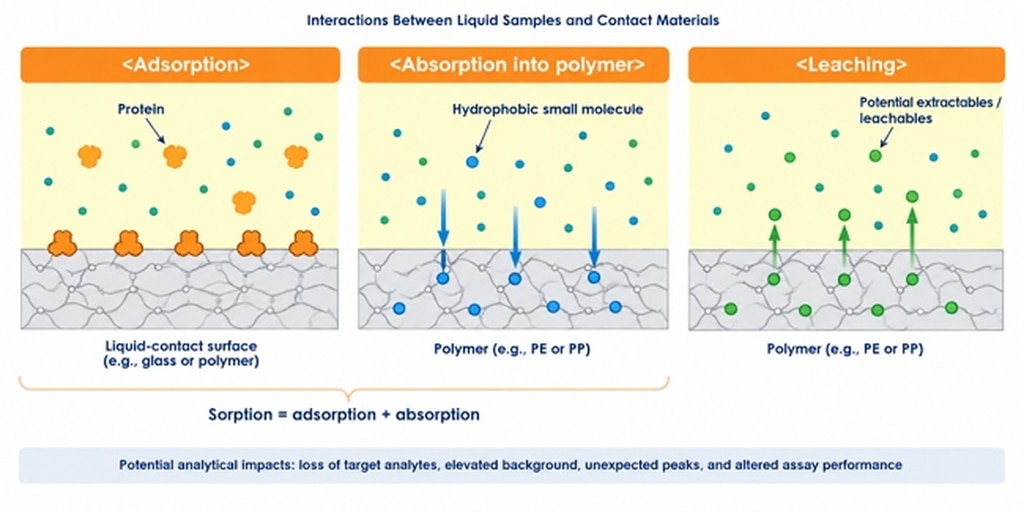
Figure 1. Interactions between wetted materials and samples: adsorption, absorption (sorption), and leaching. Proteins may undergo nonspecific adsorption onto liquid-contact surfaces. Hydrophobic low-molecular-weight compounds may also be absorbed into polymers; together, these processes are referred to as sorption. Material-derived substances may migrate into the liquid as leachables.
Considering low adsorption and sorption properties from a material perspective
Methods to suppress nonspecific adsorption of proteins
Surfaces that exhibit resistance to protein adsorption have been reported to possess characteristics such as hydrophilicity, electrical neutrality, hydrogen bond acceptance, and surface hydration. (Reference 9)
There are several options for suppressing nonspecific adsorption to liquid-contact surface. Typical methods include forming a hydrophilic or low-fouling coating on the surface, modifying the surface with plasma or UV to introduce and immobilize a hydrophilic layer or functional polymer, and covering unoccupied bonding sites in advance with a blocking agent (References 10, 12).
Using hydrophilic or zwitterionic polymers can form a strongly hydrated surface layer, making it easier to suppress proteins from approaching the surface and attaching nonspecifically (Reference 11).
On the other hand, when it comes to actual clinical testing components, there are other things to check besides performance. In complex microfluidic channels and on the inner surfaces of long tubes, uniform surface treatment can be difficult. Furthermore, the manufacturing burden and associated high costs due to additional processes, the durability of the treated layer, changes in performance during storage, post-sterilization characteristics, and leaching of coating components are all points that should be checked.
One option is to utilize the low adsorption and sorption properties of the material itself. By giving the substrate the necessary properties, it becomes easier to consider not only the molding of the entire container, but also the design of placing it in the liquid-contacting inner layer of a multilayer component. For example, by giving the outer layer strength and flexibility, and placing a low-adsorption material in the inner layer that comes into contact with the sample or reagent, it becomes easier to achieve both the necessary physical properties of the component and the function of liquid-contact surface.
approach | Typical example | Pros(Advantages) | Cons(Points to note) |
Hydrophilic and low-fouling coating | Surface layers such as PEG-based,MPC-based, and zwitterionic polymers | It is easy to impart high hydrophilicity and hydration to liquid-contact surface, it is easy to improve the surface properties of existing materials, and it is easy to maintain the mechanical properties of the substrate. | The uniformity, adhesion, and durability of the coating need to be confirmed. Application can be difficult on the inner surfaces of long tubes and complex flow channels. Evaluation of component leaching and changes over time is also necessary. |
Surface modification usingplasma,UV, etc. | Oxygen plasma,UV/ozone treatment,UVgrafting | It can be used as a pretreatment for subsequent coating and grafting, as it can alter the surface wettability and functional groups while minimizing the amount of chemicals used. | Depending on the processing conditions, the effect may be uneven, performance may decrease due to surface reorientation and hydrophobicity recovery after processing, and low adsorption depends on the modification conditions, substrate, and target protein. |
Surface coating with blocking agent | BSA, casein, surfactant, blocking buffer | It is relatively easy to use, easy to apply immediately before analysis, and easy to integrate into existing assay systems. | The blocking agent itself may affect the test results, there are limitations to the stability of the coating layer, and it is difficult to impart permanent low adsorption during the manufacturing stage of the containers and tubes. |
Use of substrates with low adsorption and sorption properties | Low protein adsorption resins, low extractables/leachables resins, functional polymers | It can potentially reduce the risk of peeling or unevenness of the surface treatment layer, make it easier to incorporate functionality into the entire molded product or the wetted inner layer, and simplify the manufacturing process. | The freedom to select materials is limited; it is necessary to balance strength, flexibility, transparency, moldability, and cost; since low adsorption, low sorption, and low leaching are not synonymous, they must be evaluated individually. |
Method for suppressing sorption of low-molecular-weight compounds
When considering the loss of low-molecular-weight compounds, it is necessary to consider "sorption," which includes not only adsorption to the material surface but also distribution into the material and migration into the interior. The degree of sorption depends on the affinity between the component and the material, the liquid composition, temperature, contact time, and liquid-contact surface (References 13, 14).
In reducing sorption, the selection of the material itself is crucial. If changing the material is difficult, a combination of measures is taken, such as placing sorption material in the inner layer of the wetted material, reducing liquid-contact surface and contact time, and reviewing the liquid composition and operating conditions (References 13, 14).
During evaluation, not only the container body but also all components that come into contact with the fluid, such as the cap, tubing, filter, and connector, should be considered. In particular, in long tubing or circulating systems, the tubing can be the main cause of sorption (Reference 15).
In order to reduce sorption, the selection of the material itself is important, but if changing the material is difficult, a combination of multi-layer structures, reduction of liquid-contact surface and contact time, and review of liquid composition and operating conditions can be used.
countermeasure | way of thinking | Points to note |
Selection of wetted materials | Select a material with low affinity for the target component (Reference14). Alternatively, a multilayer structure can be used, with sorption adsorption material placed in the inner layer (Reference13). | Don't judge solely by the material name; evaluate it based on its actual use in the solution. |
Reduction of liquid-contact surface and contact time | Review the container capacity, tube length and inner diameter in contact with the fluid, dead volume, and storage time (Reference15). | It is necessary to balance flow rate, sample volume, and operability. |
Control of liquid composition and temperature | Review pH, cosolvent, surfactant, and storage temperature (Reference6). | Check the stability of the samples and reagents and their impact on the measurement system. |
Evaluation under actual usage conditions | Measure concentration decrease and recovery rate using actual materials, actual liquids, and actual time. | This includes not only the container itself, but also the cap, tube, filter, etc. |
The option of medical compound Zelas™ CP
Zelas™ CP is an amorphous-polyolefin-based polymer compound designed for medical applications. Zelas™ CP is formulated for medical vials, syringes, and diagnostic components that require high transparency and low adsorption of proteins and antibodies. Furthermore, Zelas™ products are developed with medical device and pharmaceutical packaging applications in mind, and are intended for use in wetted components where hygiene is paramount.
Evaluation example with suppressed protein adsorption
Clinical laboratory tests may use samples and reagents containing components such as proteins, peptides, and antibodies that are easily adsorption onto the surfaces of containers and microchannels. When these components nonspecifically adsorption onto the liquid-contact surface of containers, tubes, and microchannels, the amount of the target sample remaining in the liquid decreases, potentially affecting measurement values and recovery rates.
Zelas™ CP is an amorphous polyolefin compound designed with low adsorption properties in mind, which are required for medical and clinical testing applications. We conduct evaluations to confirm low protein adsorption properties depending on the type of protein and the morphology of the components.
Figure 2 shows examples of protein adsorption evaluation using IgG, human fibrinogen, and bovine serum albumin (BSA). In each case, the amount of protein remaining on the surface of the wetted material is compared as the amount of protein adsorption per unit area.
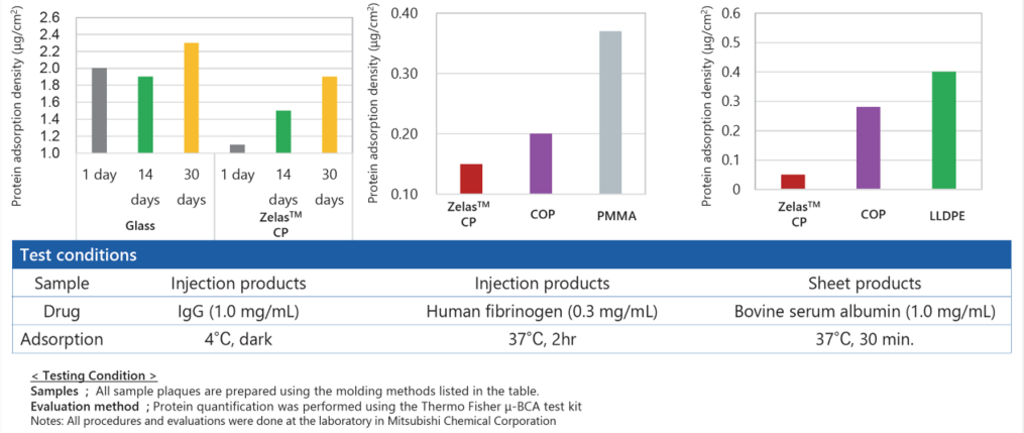
Figure 2. Examples of protein adsorption testing for Zelas™ CP. Protein adsorption density was compared for Zelas™ CP and reference materials using IgG, human fibrinogen, and bovine serum albumin (BSA). Results are from an in-house evaluation and are specific to the test conditions.
IgG adsorption evaluation results
In IgG evaluation using injection-molded products, Zelas™ CP showed a lower protein adsorption density compared to medical glass. In particular, at the 1-day and 14-day evaluation points, adsorption amount of Zelas™ CP was lower than that of glass, suggesting its potential to suppress protein adsorption even under long-term contact conditions.
Fibrinogen adsorption evaluation results
In a comparison of injection-molded products using human fibrinogen, Zelas™ CP showed lower protein adsorption densities than COP and PMMA. Under the conditions shown in Figure 2, Zelas™ CP adsorption approximately three-quarters of COP and approximately two-fifths of PMMA. Fibrinogen is one of the representative plasma proteins involved in blood coagulation. Therefore, this evaluation can be used as a reference for comparing the interaction with material surfaces when considering wetted components such as containers, flow channels, and test cartridges that come into contact with blood and plasma-derived proteins.
BSA adsorption evaluation results
In evaluations of sheet products using BSA (Bovine Serum Albumin), Zelas™ CP showed lower protein adsorption densities than COP and LLDPE. Under the conditions shown in Figure 2, adsorption amount of Zelas™ CP was lower than that of COP and also lower than that of LLDPE. BSA is widely used as a model protein. These results provide an example of evaluation when considering Zelas™ CP as a candidate low-adsorption material for applications not only in containers but also in sheets, films, and wetted layers of multilayer components.
Evaluation example that suppressed the decrease in concentration of low-molecular-weight compounds in liquid
Mitsubishi Chemical is proposing Zelas™ CP, a sorption resin, as an option to suppress sorption of components onto container materials. Zelas™ CP is a resin compound based on amorphous polyolefin and has been studied in fields such as medicine where it is necessary to suppress interaction with the contents. Taking advantage of its material properties, its application to other applications where reducing component sorption is required is also being considered.
To confirm the differences in sorption behavior depending on the material, we used tocopherol acetate (a vitamin E derivative) as an example of a lipid-soluble component and compared the remaining percentage of tocopherol acetate calculated from the amount absorption into LLDPE (linear low-density polyethylene), which is commonly used as an inner layer material for containers, and Zelas™ CP.
As a result, Zelas™ CP showed a higher retention rate compared to LLDPE, confirming that it suppressed absorption of tocopherol acetate.
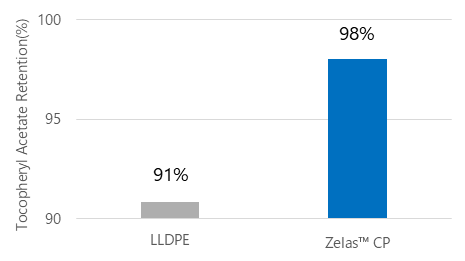
Figure 3. Comparison of tocopherol acetate retention in LLDPE and Zelas™ CP. Under the test conditions, Zelas™ CP showed higher liquid-phase retention of tocopherol acetate than LLDPE, indicating lower sorption of this lipophilic model compound.
Applications from Containers to Tubing Inner Layers
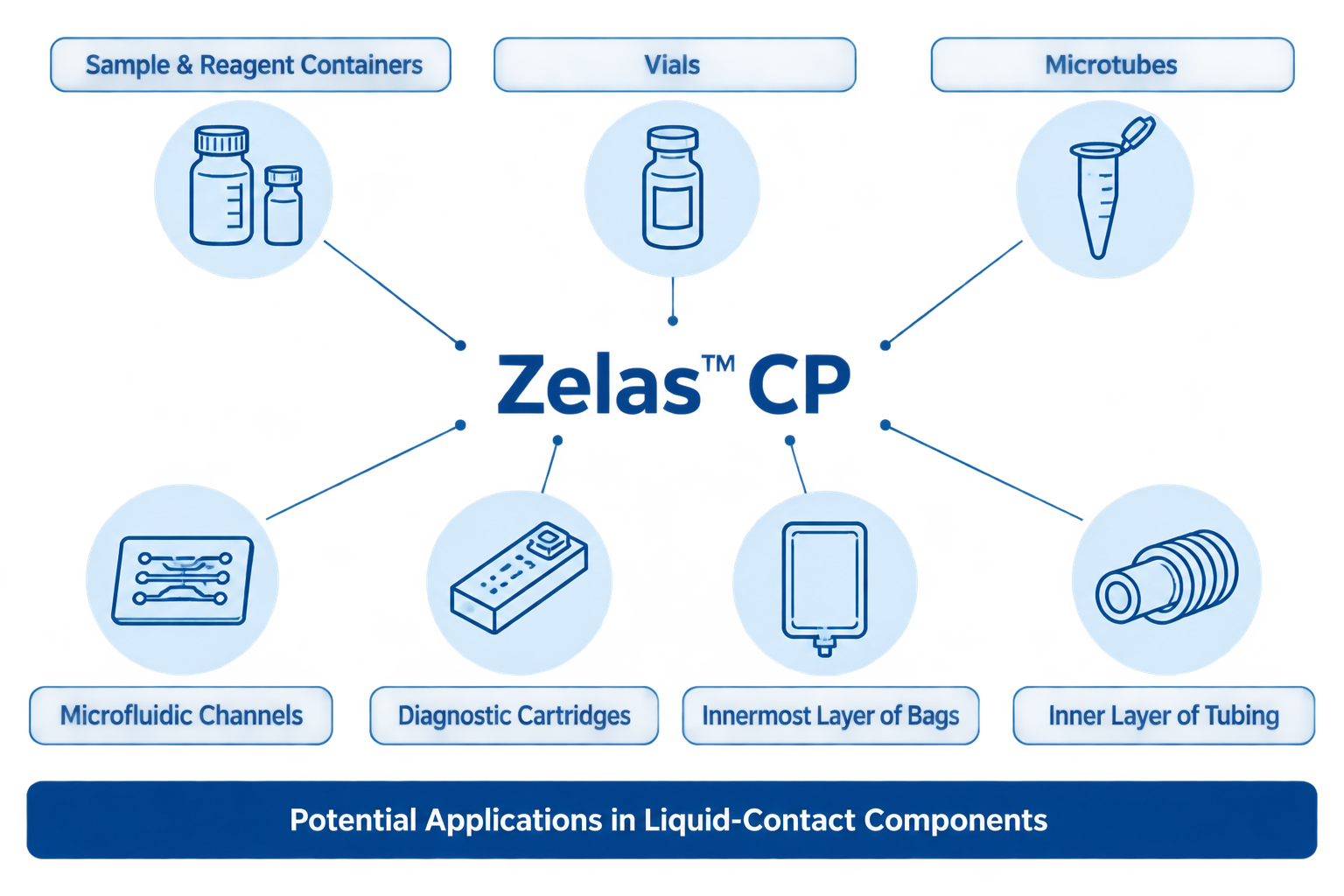
Zelas™ CP can be considered for application not only to containers molded from a single material, but also to components that combine different materials. It can be an option when you want low adsorption and sorption adhesion in parts that come into direct contact with the liquid contents, such as injection molded parts, films, liquid-contact inner layer of bags, and the inner layer of liquid delivery tubes.
component | Application image |
Sample and reagent containers, vials | The entire container is molded from Zelas™ CP.i. |
Microtubes, wells | Injection-molded component that comes into contact with a trace sample |
Microfluidic channels, inspection cartridges | Flow-channel substrates, cover materials, and liquid-contact layers. |
Soft bottles, bags | It can be combined with a flexible outer layer and configured to be placed in liquid-contact inner layer of bottles or bag containers. |
Fluid-transfer tubing | A multilayer structure combining a flexible outer layer with a wetted inner layer. |
Connectors and valve components | Injection-molded parts that come into contact with samples or reagents |
By supplementing flexibility, mechanical strength, and barrier properties with outer and intermediate layers, and placing Zelas™ CP in the inner layer that comes into direct contact with samples and reagents, it is possible to design a component that balances the necessary performance with the functionality of liquid-contact surface. The specific configuration needs to be confirmed, including the molding method, adhesion to the mating material, and sterilization conditions.
Finally, confirm with actual samples and final components—practical points for selecting clinical laboratory materials.
Even with low-adsorption and sorption materials, the same results may not be obtained for all measurement targets or samples. Interactions vary depending on the properties and concentration of proteins and low-molecular-weight compounds, the sample matrix, temperature, contact time, and liquid-contact surface.
After narrowing down the candidates using model materials, use actual samples and reagents with the final molded product to check the amount remaining in the liquid, measured values, recovery rate, and the effect of leachables. The key is to evaluate the entire contact history, including not only the container but also the pipette tip, flow path, tubing, and connector.
*Since multiple factors may be involved simultaneously, the above is just one example to consider when thinking about countermeasures.
FAQ
Q. What should be checked when selecting materials for clinical testing?
A. Organize the measurement target, sample matrix, concentration, liquid volume, liquid-contact surface, contact time, temperature, measurement method, and sterilization method. When handling low-concentration components, also consider checking the recovery rate, surface adsorption amount, and leachables using a blank solution.
Q. If a material has low protein adsorption, will it also show low sorption of low-molecular-weight compounds?
A. They are not necessarily the same. Proteins primarily adsorption to the surface, but low-molecular-weight compounds may also be absorption into the resin. Each component needs to be evaluated separately.
Q. Does using glass eliminate the risk of adsorption and leachables?
A. Proteins can adsorption to glass, and under certain conditions, metal ions and other substances in the glass may migrate to it. Do not decide based solely on whether it is glass or resin; compare them based on their compatibility with the measurement system.
Q. What materials can Zelas™ CP be used for?
A. We can consider applications for sample/reagent containers, vials, microtubes, microfluidic channels, test cartridges, liquid-contact inner layer of bottles, the inner layer of tubes, etc. Specific suitability can be proposed based on grade, molding method, mating material, sterilization method, and required specifications. Please contact us for details.
Q. Does Zelas™ CP eliminate the risk of leachables?
A. We cannot guarantee that there will be no leachables. Zelas™ products are formulated with hygiene in mind for medical device and pharmaceutical packaging applications, but ultimately, please evaluate them based on the target grade and actual usage conditions (wet conditions).
Please consult us regarding the selection of materials for clinical laboratory components.
Please tell us about any challenges you are facing regarding wetted components, such as nonspecific adsorption of proteins, reduction in the concentration of low-molecular-weight compounds in liquid, leachables, and material selection for microchannels and tube inner layers.
We will proposeZelas™ grades, component configurations, and evaluation methods based on the target components, component shapes, molding methods, sterilization conditions, and materials to be combined. Please contact us for material data, samples, and actual liquid evaluations.
References
(1) Mahler HC, Friess W, Grauschopf U, et al. Protein aggregation: pathways, induction factors and analysis. Journal of Pharmaceutical Sciences. 2009;98(9):2909–2934. https://doi.org/10.1002/jps.21566
(2) Bee JS, Randolph TW, Carpenter JF, et al. Effects of surfaces and leachables on the stability of biopharmaceuticals. Journal of Pharmaceutical Sciences. 2011;100(10):4158–4170. https://doi.org/10.1002/jps.22597
(3) Toombs J, Foiani MS, Wellington H, et al. Amyloid beta peptides are differentially vulnerable to preanalytical surface exposure, an effect incompletely mitigated by the use of ratios. Alzheimer's & Dementia: Diagnosis, Assessment & Disease Monitoring. 2018;10(1):311–321. https://doi.org/10.1016/j.dadm.2018.02.005
(4) Vanderstichele HMJ, Janelidze S, Demeyer L, et al. Optimized standard operating procedures for the analysis of cerebrospinal fluid Aβ42 and the ratios of Aβ isoforms using low protein binding tubes. Journal of Alzheimer's Disease. 2016;53(3):1121–1132. https://doi.org/10.3233/JAD-160286
(5) Kiyokawa I, Sogawa K, Ise K, et al. Adsorption of urinary proteins on the conventionally used urine collection tubes: possible effects on urinary proteome analysis and prevention of the adsorption by polymer coating. International Journal of Proteomics. 2011;2011:502845. https://doi.org/10.1155/2011/502845
(6) Fukahori M, Kakinuma K, Seki M, et al. Effects of added lower alcohols on solubilized tocopherol acetate sorption to polyethylene film in aqueous solution. Chemical & Pharmaceutical Bulletin. 1996;44(1):196–200. https://doi.org/10.1248/cpb.44.204
(7) Bowen RAR, Remaley AT. Interferences from blood collection tube components on clinical chemistry assays. Biochemia Medica. 2014;24(1):31–44. https://doi.org/10.11613/BM.2014.006
(8) Zhao J, Lavalley V, Mangiagalli P, et al. Glass delamination: a comparison of the inner surface performance of vials and pre-filled syringes. AAPS PharmSciTech. 2014;15(6):1398–1409. https://doi.org/10.1208/s12249-014-0167-y
(9) Ostuni E, Chapman RG, Holmlin RE, et al. A survey of structure–property relationships of surfaces that resist the adsorption of protein. Langmuir. 2001;17(18):5605–5620. https://doi.org/10.1021/la010384m
(10) Lee S, Choi J, Kim J, et al. Non-specific adsorption reduction methods in biosensing. Sensors. 2019;19(11):2488. https://doi.org/10.3390/s19112488
(11) Liu S, Tang J, Ji F, et al. Recent advances in zwitterionic hydrogels: preparation, property, and biomedical application. Gels. 2022;8(1):46. https://doi.org/10.3390/gels8010046
(12) Bertin EM, Leitao EM, Bickerton S, et al. A review of polymer surface modification by cold plasmas: surface treatment, plasma-induced grafting, and plasma polymerization. Plasma Processes and Polymers. 2024;21:e2300208. https://doi.org/10.1002/ppap.202300208
(13)Tokhadze N, Chennell P, Bernard L, et al. Impact of alternative materials to plasticized PVC infusion tubings on drug sorption and plasticizer release. Scientific Reports. 2019;9:18917. https://doi.org/10.1038/s41598-019-55113-x
(14) Sahnoune M, Tokhadze N, Devemy J, et al. Understanding and characterizing the drug sorption to PVC and PE materials. ACS Applied Materials & Interfaces. 2021;13(16):18594–18603. https://doi.org/10.1021/acsami.1c03284
(15) Winkler TE, Herland A. Sorption of neuropsychopharmaca in microfluidic materials for in vitro studies. ACS Applied Materials & Interfaces. 2021;13(38):45161–45174. https://doi.org/10.1021/acsami.1c07639