
What causes a decrease in the nutrient content of functional foods? Adsorption to packaging materials and countermeasures.
Are there any issues with functional foods or foods for specified health uses (FOSHU), such as "the content of the active ingredient decreases when storage tests are conducted" or "the cause remains unknown even after revising the formula"?
A decrease in the content of functional ingredients can be caused by various factors, including variations in raw materials and manufacturing processes, decomposition due to oxidation, light, and heat, and analytical factors. In addition, one factor that is often overlooked is the adsorption and absorption (sorption) of ingredients from the contents to the packaging material.
When sorption occurs to packaging materials, the amount of the component in the contents may decrease even if the component itself has not chemically decomposed. This article focuses particularly on lipid-soluble functional components and explains the mechanism of sorption to packaging materials, its relationship to content reduction, evaluation methods, and countermeasures through packaging design.
Table of Contents [hide]
- 1.Reasons for maintaining the ingredient content of functional foods until the expiration date
- 1.1.The amount of active ingredient supports the product's value.
- 1.2.Why are analytical values obtained immediately after manufacturing insufficient?
- 1.3.Reasons why maintaining the content until the end of the best-before date is required.
- 2.Causes of a decrease in the content of functional foods
- 2.1.Degradation factors that many developers suspect first
- 2.2.Interactions with easily overlooked packaging materials
- 3.What is adsorption/absorption of components into packaging materials?
- 4.Reasons why lipid-soluble functional components easily adhere to packaging materials
- 4.1.Why polyethylene and polypropylene are widely used in food packaging
- 4.2.Interaction between lipophilic functional components and polyolefin resins
- 4.3Factors affecting sorbation
- 4.4.Examples of lipophilic functional components whose sorption behavior to packaging materials we want to confirm
- 5.Method for evaluating sorption to packaging materials: Confirmation by stability testing
- 5.1.Identify the cause of the decrease in content
- 5.2.Compare content changes across multiple packaging materials.
- 5.3.If necessary, also check for components that have adhered to the packaging material.
- 6.Packaging design to maintain ingredient content
- 6.1.Packaging materials are part of the quality design.
- 6.2.Characteristics required for packaging materials for lipid-soluble functional ingredients
- 6.3.Review the innermost layer and packaging structure.
- 6.4.Optimize the combination of contents composition and packaging materials.
- 6.5.Example of low-adsorption packaging material: Zelas™ CP
- 7.Frequently Asked Questions (FAQ)
- 8.Points to note when implementing
- 9.ReferenceURL
Reasons for maintaining the ingredient content of functional foods until the expiration date
The amount of active ingredient supports the product's value.
In foods with functional claims and foods for specified health uses (FOSHU), the functional ingredients in foods with functional claims and the active ingredients in foods for specified health uses are important elements related to the product's labeling and quality control.
Therefore, in product development, it is important to confirm not only the amount of ingredients used during manufacturing, but also whether the content can be maintained in accordance with the labeling and specifications until the end of the shelf life under specified storage conditions. [1][2]
Why are analytical values obtained immediately after manufacturing insufficient?
Even if a product meets the specifications immediately after manufacturing, that condition may not be maintained until the expiration date.
Actual products are distributed and stored after manufacturing, and it takes a certain amount of time before they reach the consumer. During this time, the ingredient content may change due to oxidation, decomposition, and interactions with packaging materials.
Therefore, in the development of functional foods, it is important to evaluate not only the analysis results immediately after manufacturing, but also the long-term changes in content through storage tests.
Reasons why maintaining the content until the end of the expiration date is required
According to food labeling standards, the best-before date is defined as "the date by which all expected qualities are deemed to be adequately maintained."
In foods with functional claims and foods for specified health uses, the content of the active ingredient is one of the important factors that constitute quality.
If the content decreases during storage, making it impossible to ensure the intended intake, it may become impossible to maintain the quality level expected during product design. Furthermore, if the decrease in content affects compliance with the stated values or product specifications, quality control and verification of the validity of the labeling will be necessary.
Causes of a decrease in the content of functional foods
The degradation factors that many developers suspect first
If the content of the active ingredient decreases during storage, the first thing suspected in the development process is chemical degradation such as oxidation or decomposition.
For example, oxidation reactions can be problematic for unsaturated fatty acids like DHA and EPA, while decomposition due to light and heat can be a problem for carotenoids. Hydrolysis and thermal decomposition due to the effects of moisture and temperature are also known to be major factors that reduce content.
Therefore, when a decrease in content is confirmed, measures such as improving oxygen barrier properties, adding antioxidants, and light shielding are given priority.
However, if these measures do not yield sufficient improvement, factors other than chemical degradation must also be considered.
Furthermore, even if a decrease in analytical values is observed in storage tests using HPLC or LC-MS/MS, this does not necessarily mean that the components have chemically decomposed. Multiple factors may be involved in the decrease in analytical values, including analytical factors and the migration of components from the food to the packaging material.
To identify the cause of the decrease in content, it is important to isolate the cause from multiple possibilities, including not only chemical degradation of the components but also interactions with the packaging material.
Often overlooked interactions with packaging materials
Three representative phenomena can be cited below.
phenomenon | Movement of matter | Impact on functional foods |
Migration | Additives and residual components in the packaging material can migrate to the food. | Food safety |
Sorption | Food components are adsorbed onto the surface of the packaging material and absorbed into the resin. | Decreased content of the active ingredient |
Permeation | Oxygen, water vapor, and fragrance components permeate the packaging material. | Oxidation, moisture absorption, drying |
Of these, sorption is considered an important phenomenon from the perspective of maintaining the quality of the active ingredients, as it can reduce the amount of components in the contents.
Adsorption and absorption of components into packaging materials (adsorption)
Adsorption and Absorption
Sorption is a general term for the phenomenon in which components in food are incorporated into packaging materials.
There are two main mechanisms of sorption. [3]
- Adsorption: The phenomenon in which components adhere physically or chemically to the surface of packaging material.
- Absorption: The phenomenon in which components diffuse into the packaging material and are incorporated into the resin matrix.
In actual food packaging, after ingredients reach the surface of the packaging material, some may remain on the surface, while others may diffuse further into the resin. Therefore, it can be difficult to strictly distinguish between adsorption and absorption, and it is important to consider both together as sorption.
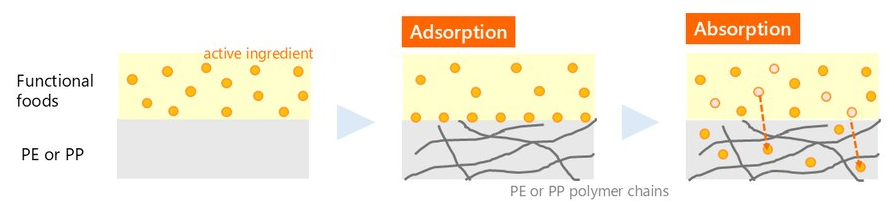
Figure 1. Schematic diagram of adsorption and absorption (sorption) of components onto packaging material.
The degree of sorption varies depending on the combination of ingredients in the food and the packaging material, the composition of the food contents, and the storage conditions. These influencing factors will be explained in detail in the next chapter.
How sorption leads to a decrease in content
When sorption occurs, some of the components present in the food are adsorbed onto the surface of the packaging material or absorbed into the resin. As a result, the amount of components remaining in the contents may decrease.
Typically, quantitative analysis of the active ingredient is performed on the contents. Therefore, ingredients that migrate to the packaging material are not evaluated as being present in the contents, which may result in a decrease in the analytical value.
In such cases, even if the analytical values decrease, it does not necessarily mean that all the components have been chemically broken down.
To determine the actual cause, it is necessary to combine the results of multiple evaluations, such as analysis of decomposition products and inspection of the packaging material.
Reasons why lipid-soluble functional components easily adhere to packaging materials
Why polyethylene and polypropylene are widely used in food packaging
Polyolefin resins such as polyethylene (PE) and polypropylene (PP) are widely used in food packaging. The following are some of the reasons for this:
- It offers excellent moldability and can accommodate a variety of packaging forms, including bottles, cups, tubes, and films.
- It has excellent water and chemical resistance and a proven track record of use in food packaging.
- It is lightweight, highly efficient to transport, and cost-effective.
On the other hand, PE and PP are low-polarity resins. This property is important when considering their interactions with lipid-soluble and hydrophobic components.
Interaction between lipid-soluble functional components and polyolefin resins
Generally, the affinity between the components and the packaging material is one of the factors that influence sorption. In non-polar resins such as PE and PP, depending on the combination with the packaging material, lipid-soluble and hydrophobic components may be incorporated into the resin.
For example, fat-soluble vitamins, fatty acids such as DHA and EPA, and hydrophobic components such as carotenoids may adhere to the packaging material.
In fact, in milk fortified with vitamin D₂, the amount of vitamin D₂ remaining decreases when stored in polyethylene pouches, and one of the factors cited is absorption by polyethylene. [4]
Thus, lipid-soluble functional components may adhere to packaging materials, but the degree of adhesion varies depending on the composition of the contents, the packaging material, and the storage conditions.
Factors affecting sorbation
So, what factors influence the actual sorption behavior? The main influencing factors are as follows:
Factors related to ingredients | Factors related to packaging materials | Factors related to product and storage conditions |
|---|---|---|
Polarityand hydrophobicity •Molecular weight and chemical structure | • Packaging material (PE, PP, PET, etc.) • Crystallinity and structure of the resin - Packaging specifications such as single-layer and multi-layer structures | • Composition of contents - Contact area between contents and packaging material Storage temperature and storage period |
Generally, the sorption of components into resins is related to the affinity between the component and the resin, as well as diffusion within the resin. Furthermore, the behavior changes depending on storage conditions such as temperature and contact time.
Therefore, instead of making a blanket judgment such as "it's easy to adsorb because it's a lipophilic functional component" or "it's easy to adsorb because it's PE or PP," it is important to evaluate based on actual product conditions, including the composition of the contents, packaging material, packaging form, and storage conditions.
Examples of lipid-soluble functional components whose sorption behavior to packaging materials we want to confirm.
The following are examples of lipid-soluble functional ingredients commonly used in foods with functional claims and foods for specified health uses, for which it may be worthwhile to consider checking their sorption behavior depending on the combination with the packaging material.
Ingredient Categories | Typical ingredients | Examples of main uses and dosage forms |
Fat-soluble vitamins | Vitamins A, D, E, K | Oils, soft capsules, emulsifiers |
Omega-3 fatty acids | DHA, EPA | Oils, emulsifiers, soft capsules |
Carotenoids | Lutein, zeaxanthin, beta-carotene, astaxanthin | Oils, emulsifiers, drinks, jellies |
Plant sterols | β-sitosterol, campesterol | Oils and greases, emulsifiers, foods for specified health uses |
Other lipid-soluble functional components | Coenzyme Q10, γ-oryzanol, sesamin | Oils, soft capsules, drinks |
*The above does not necessarily indicate components that will always sorb, but rather examples of components whose sorbation behavior should be considered in combination with packaging materials.
These ingredients are used in a variety of dosage forms, including oils, emulsifiers, soft capsules, jellies, and drinks. Since the composition of the contents and the contact with the packaging material differ depending on the dosage form, it is important to confirm the presence and degree of sorption using the actual combination of contents and packaging material. The next chapter will explain the evaluation methods.
Related: For more details on the decrease in the active ingredient content of quasi-drugs, please see "Causes of Decreased Active Ingredients in Quasi-Drugs | Adsorption to Containers and Packaging and Countermeasures".
Method for evaluating sorption to packaging materials: Confirmation through stability testing.
Identifying the cause of the decrease in content
If a decrease in the content of the active ingredient is confirmed in storage tests, we first check for instability of the ingredient itself, such as variations in raw material lots or manufacturing processes, analytical methods, oxidation, or hydrolysis.
If these factors cannot adequately explain the decrease in content, it is important to consider interaction with the packaging material as one of the possible causes.
In particular, if sorption to the packaging material is involved in the decrease in content, simply reviewing the composition of the contents may not be sufficient to achieve adequate improvement. Therefore, if an unexplained decrease in content persists, it is necessary to also examine the packaging material that comes into direct contact with the contents.
Compare the changes in content across multiple packaging materials.
If sorption to packaging material is suspected, the same contents are filled into multiple packaging materials with different materials and structures, and the changes in content after storage are compared. If necessary, comparison containers such as glass, containers or films made of PE, PP, or PET (polyethylene terephthalate), or multi-layered packaging materials are considered as candidates.
When evaluating the product, it is important to consider not only the material of the packaging but also other conditions such as the packaging form, the contact area with the contents, the filling rate, the storage temperature, and the storage period. If there are differences in the degree of content reduction depending on the packaging material, it can provide a clue to consider the possibility that interaction with the packaging material is involved.
On the other hand, changes in packaging materials can alter the barrier performance against oxygen and light. Therefore, it is important to consider not only the difference in content but also the effects of oxidation and photodegradation.
If necessary, also check for components that have adhered to the packaging material.
If comparative testing with the packaging material alone is insufficient to pinpoint the cause, examining the target component that has sorbed onto the packaging material is another method of root cause analysis.
For example, by extracting and analyzing the target component from the packaging material after storage, it is possible to confirm whether the component that decreased in the contents is present in the packaging material.
By combining data such as the changes in content within the contents, the presence or absence of decomposition products, and the detection results of the target component on the packaging material, we can investigate in more detail whether the decrease in content is due to chemical decomposition or whether sorption to the packaging material is involved.
However, the analysis results for the packaging material can vary depending on the target components, resins, and extraction conditions. Therefore, in actual evaluation, it is important to consider analytical methods that are appropriate for the product conditions.
Packaging design to maintain ingredient content
Packaging materials are part of the quality design.
Packaging materials are not simply for holding and protecting the contents.
From a quality design perspective, it is necessary not only to protect the contents from external factors such as oxygen, water vapor, and light, but also to consider the interaction between the contents and the materials that come into direct contact with them.
In particular, for products containing components that may adhere to packaging materials, such as lipid-soluble functional components, it is important to check not only oxidative stability and barrier performance, but also the adhesion behavior to packaging materials.
Thus, packaging materials, like the composition of the contents, are one of the design elements that affect the maintenance of product quality.
Characteristics required for packaging materials for lipid-soluble functional ingredients
When the goal is to maintain the content of lipid-soluble functional components, the packaging material must have the following characteristics:
- It should not have excessive affinity with the active ingredient.
- The diffusion and sorption of components are less likely to occur.
- The ability to maintain stable performance even during long-term storage.
- It must have oxygen and water vapor barrier performance appropriate to the contents.
- To exhibit stable performance at the contact surface with the contents.
However, it's not always possible to satisfy all performance requirements with a single material. In multilayer packaging, the design must take into account the role of each layer, such as the barrier layer, support layer, sealing layer, and the innermost layer that comes into contact with the contents.
Review the innermost layer and packaging structure.
If adhesion to the packaging material is a problem, you can consider not only changing the entire packaging, but also reviewing the innermost layer that comes into direct contact with the contents.
For example, in multi-layer packaging, one design approach is to minimize contact between the contents and other resin layers by using a material with low adsorption properties for the innermost layer that comes into contact with the contents.
Furthermore, reviewing the packaging form, material composition, contact area with the contents, and filling amount can also affect the sorption behavior of the components. These changes affect not only sorption but also oxygen, water vapor, and light barrier properties, moldability, sealing properties, and cost, so they must be considered in light of the overall performance requirements of the product.
Optimize the combination of contents composition and packaging materials.
In preventing sorption, the combination of packaging materials and the composition of the contents is just as important.
For example, the composition and state of the contents may affect the sorption behavior.
- Which phase do the components exist in, the oil phase or the aqueous phase?
- Emulsification/dispersion state and particle size
- Types and concentrations of emulsifiers and dispersants
- Types of oils and coexisting components
- pH and ionic strength
- Concentration and formulation of ingredients
Therefore, if a decrease in content is confirmed, it is important not to try to resolve the issue by changing either the composition of the contents or the packaging material alone, but rather to conduct a comparative evaluation of both the contents and the packaging material in combination.
An example of a low-adsorption packaging material: Zelas™ CP
One option for packaging design that suppresses the adsorption and sorption of ingredients is to reconsider the packaging material itself that comes into contact with the contents.
One example of a material that focuses on low sorbability is Mitsubishi Chemical's "Zelas™ CP".
Zelas™ CP is a resin compound based on amorphous polyolefin. Its material properties, which have been studied in fields such as medicine where minimizing interaction with contents is required, are being explored for use in various applications where reducing component sorption is a challenge.
In food packaging, when considering the maintenance of the content of lipid-soluble functional components, it is important to consider the sorption behavior to the packaging material. Therefore, using tocopherol acetate (a vitamin E derivative) as an example of a lipid-soluble component, we compared and evaluated the sorption amount of LLDPE (linear low-density polyethylene), which is commonly used as an inner layer material for containers, and Zelas™ CP extruded film. As a result, under specific test conditions, Zelas™ CP showed a higher component retention rate compared to LLDPE.
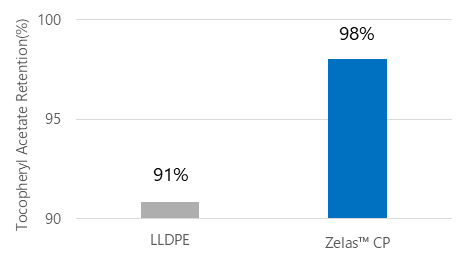
Figure 2. Comparison of tocopherol acetate residue rates in LLDPE and Zelas™ CP.
Test conditions: LLDPE and Zelas™ CP (CP208) extruded films; Target component: Tocopherol acetate (vitamin E derivative);
Storage conditions: 50°C for 2 weeks; Evaluation method: Quantitative analysis by HPLC (our company's evaluation).
Materials that exhibit such low sorption properties are also potential packaging materials in the food industry, where maintaining the content of functional ingredients is crucial. However, before actual adoption, it is necessary to confirm various performance characteristics, including sorption behavior, depending on the target food, ingredients, contents, storage conditions, and packaging specifications.
For detailed information on the material properties of Zelas™ CP and its applications in containers and packaging, please see below.
Frequently Asked Questions (FAQ)
Q1. What causes the nutrient content of functional foods to decrease during storage?
Various causes are possible, including oxidation of components, decomposition due to light and heat, hydrolysis, and variations due to raw materials and manufacturing processes.
In addition to these factors, the amount of components in the contents may decrease due to "adsorption," where components in the food are adsorbed onto the surface of the packaging material or absorbed into the resin. Furthermore, the analysis method and the uniformity of the sample may also affect the measurement results, so it is important to isolate the cause from multiple perspectives.
Q2. What is the difference between "adsorption" and "adsorption" of components onto packaging materials?
Adsorption is the phenomenon where a component adheres to the surface of the packaging material. On the other hand, absorption is the phenomenon where a component diffuses into the interior of the packaging material and is incorporated into the resin.
This combined phenomenon of adsorption and absorption is called "sorption." In actual food packaging, after the components reach the surface of the packaging material, some of them may diffuse into the resin, so it is important to consider both as part of the sorption process.
Q3. Do lipophilic functional components always sorb to PE/PP packaging materials?
No. Even if a functional component is lipophilic, it does not necessarily adsorb to PE or PP. The degree of adsorption varies depending on the physical properties of the component, the composition of the contents, the type and structure of the resin, the packaging shape, the contact area, the storage temperature, and the storage period. It is important to evaluate it with the actual combination of contents and packaging material.
Q4. How can we confirm whether sorption to the packaging material is the cause of the decrease in content?
The same contents are stored in multiple packaging materials such as glass, PE, and PP, and the changes in component content are compared. If there are differences in the degree of content decrease depending on the packaging material, interaction with the packaging material may be involved. If necessary, decomposition products and components sorbed onto the packaging material are also analyzed to isolate the cause.
Q5. How can we suppress the adsorption and sorption of ingredients onto packaging materials?
It is important to select packaging materials suitable for the target ingredients and the composition of the contents, and to compare and evaluate them under actual product conditions. In the case of multi-layer containers, methods include reviewing the innermost layer that comes into contact with the contents, or considering materials that focus on low sorption. Packaging specifications should be determined by considering not only sorption, but also barrier properties, moldability, and sealing properties.
Points to note when implementing
- Due to the nature of compound products, it may take some time to confirm the formulation and raw materials used. We appreciate your understanding and ask that you allow sufficient lead time in advance when inquiring about and responding to inquiries regarding compliance with regulations in various countries.
- This article is a general explanation based on publicly available information and market and regulatory information obtained by our company, and does not guarantee suitability for specific products or applications, nor does it guarantee compliance with laws and regulations. We assume no responsibility whatsoever for the results of decisions or actions taken by customers based on this article. When actually applying this information, please be sure to check the latest laws, standards, and public guidelines, and evaluate and make decisions at your own responsibility.
Are you concerned about the decrease in ingredient content during storage or the sorption of ingredients onto packaging materials?
Mitsubishi Chemical offers technical consultations regarding material selection based on the target ingredients, composition of contents, storage conditions, and packaging specifications, as well as evaluations to confirm the possibility of sorption to packaging materials.
Reference URL
[1] Guidelines on Notifications, etc., for Foods with Function Claims | Consumer Affairs Agency https://www.caa.go.jp/policies/policy/food_labeling/foods_with_function_claims/notice/assets/food_labeling_cms205_251001_41.pdf
[2] Guidelines for setting food expiration date labels | Consumer Affairs Agency https://www.caa.go.jp/policies/policy/food_labeling/food_labeling_act/assets/food_labeling_cms201_250328_1029.pdf
[3] Sorption of Flavors into Food Packaging Materials.
Foods & Food Ingredients Journal of Japan, Vol.216, No.1, 041 (2011)
[4] Vitamin D Incorporation in Foods: Formulation Strategies, Stability, and Bioaccessibility as Affected by the Food Matrix
Foods, Vol.10, No.9, 1989 (2021)