
Why do active ingredient levels decrease in quasi-drugs? Sorption to packaging materials and solutions
In the development of quasi-drugs, even if there are no problems during formulation review, a decrease in the active ingredient may be observed during storage stability evaluation or after filling the actual product containers and packaging. The primary cause is decomposition due to oxidation, light, heat, etc., but this is not the only cause. The content of the active ingredient may decrease due to "adsorption," where it adheres to the surface of the container or packaging material or is incorporated into the material.
This article explains the factors that reduce the amount of active ingredients, the mechanism of sorption to containers and packaging materials, points to check during evaluation, and considerations for material selection.
Table of Contents [hide]
- 1.Main causes of decrease in the active ingredients of quasi-drugs
- 1.1.Changes in active ingredients due to oxidation, light, heat, etc.
- 1.2.Interactions with other ingredients in the prescription
- 1.3.Interaction with containers and packaging materials
- 2.If a decrease in the active ingredient is found during the storage stability evaluation...
- 3.What is sorption onto containers and packaging materials?
- 3.1."Adsorption" including adsorption and absorption
- 3.2.Why is caution necessary regarding sorption of lipid-soluble components?
- 3.3.Examples of active ingredients that have been reported to adhere to containers and packaging materials
- 3.4.Method for confirming suspected sorption onto containers and packaging
- 4.How can we minimize the reduction of active ingredients? We'll consider this from both a formulation and container/packaging perspective.
- 5.Key points for selecting containers and packaging materials to protect the active ingredients
- 5.1.Confirm the characteristics of the active ingredients and contents.
- 5.2.Organize the functions required of containers and packaging.
- 5.3.Select materials based on the form and structure of the container/packaging.
- 5.4.Low-Adsorption Materials as an Option
- 5.5.Verify suitability under actual product conditions.
- 6.Summary | If the active ingredient decreases, the container and packaging materials should also be considered as a possible cause.
- 7.Frequently Asked Questions (FAQ)
- 8.Points to note when implementing
- 9.References
Main reasons for the decrease in active ingredients in quasi-drugs
In quasi-drugs, the active ingredient is a crucial element responsible for the product's efficacy and effects. The type, amount, and concentration of the active ingredient are all relevant to the approval application, so it is important to consider the stability of the active ingredient from the product design stage. [1]
Even if the active ingredients decrease during storage, there isn't always just one reason. The following are some of the main possible causes:
Changes in active ingredients due to oxidation, light, heat, etc.
The active ingredients may be affected by oxygen, light, heat, and moisture, and may undergo oxidation, photodegradation, or hydrolysis during storage. As a result, the amount of active ingredients in the contents may decrease.
When considering stability, it is necessary to check not only the effects of storage temperature, light, oxygen, and moisture, but also the light-shielding properties of the container and its barrier properties against oxygen and water vapor.
Interactions with other ingredients in the prescription
Even if an active ingredient is stable on its own, its stability may change during actual formulation due to interactions with other ingredients and formulation conditions.
For example, changes in the dissolution and dispersion state due to the inclusion of oily components or surfactants, as well as formulation conditions such as pH, can alter the state of existence and stability of the active ingredient.
Therefore, it is important to check not only the stability of the active ingredient itself, but also its condition in actual formulations and changes in its content over time.
Interaction with container and packaging materials
Another point to consider is the interaction between the contents and the container/packaging materials that come into direct contact with them.
For example, if the active ingredient adheres to the surface of the container material or is incorporated into the resin, the content in the contents may decrease.
Therefore, a decrease in the active ingredient does not necessarily mean that it has all broken down. Since various factors can contribute to the decrease in the active ingredient, it is important to isolate and examine each possibility.
This article focuses on "adsorption" to containers and packaging materials, explaining its mechanism and the considerations for material selection.
If a decrease in the active ingredient is found during storage stability evaluation...
The relationship between the active ingredient and the container/packaging materials may become clear at various stages of development.
For example, have you ever had an experience like this?
- Although no issues were found during the prescription review, further evaluation of storage stability revealed a decrease in the active ingredient over time.
- While laboratory evaluations using glass containers and other materials showed no problems, the retention rate of the active ingredient decreased when the product was filled into actual product containers and packaging.
- Despite being evaluated under the same formulation and storage conditions, differences in the retention rate of the active ingredient were observed depending on the container or packaging used.
- Although measures have been taken to address the effects of oxidation and light, a decrease in the active ingredient has been confirmed.
In such cases, it is important not to limit the cause of the decrease in the active ingredient to just one factor, but to consider multiple possibilities separately. Possible causes include changes in the ingredient itself, interactions during formulation, storage environment, and interactions with containers and packaging materials.
In particular, if no problems are found in laboratory evaluations, but a decrease in the active ingredient is observed after filling the actual product into containers, or if differences in the remaining amount are seen depending on the container, it can provide clues to consider the involvement of the container material.
In the next chapter, we will explain "adsorption to the container," which is one of the possible causes.
Adsorption to containers and packaging materials
"Adsorption" includes adsorption and absorption.
When considering the phenomenon of components in a product migrating to the container material, it's important to understand sorption.
- Adsorption: A phenomenon in which active ingredients are present on the surface or interface of containers and packaging materials.
- Absorption: The phenomenon in which active ingredients are absorbed into the container or packaging material.
This process of adsorption and absorption together is called sorbation.
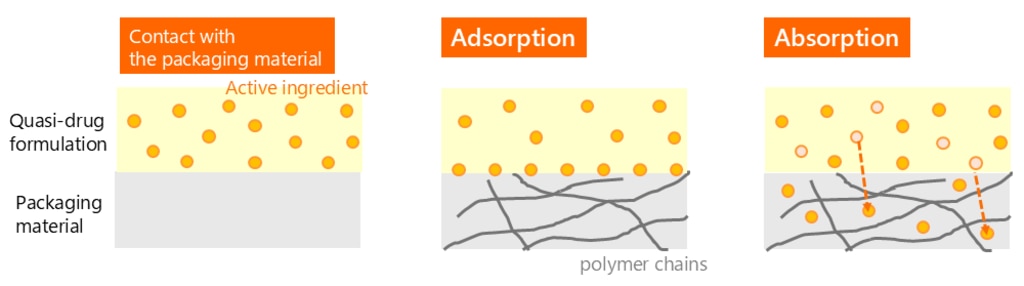
When sorption to a container occurs, the active ingredients in the contents migrate to the container material, which can reduce the concentration of the active ingredients in the contents even if they have not chemically decomposed. [2]
Furthermore, sorption does not necessarily occur only on the material surface. For example, there are reports that MALDI-IMS has visualized how vitamin E derivatives (tocopherol acetate) are incorporated into LDPE (low-density polyethylene) and EVA (ethylene-vinyl acetate copolymer) films. [5]
Why do lipid-soluble components require careful attention regarding sorption?
Polyolefin materials such as PE (polyethylene) and PP (polypropylene) are widely used for containers and packaging of quasi-drugs and cosmetics.
PE and PP are low-polarity materials. Therefore, low-polarity lipid-soluble components may have a high affinity for polyolefins and may migrate to the material. Generally, the closer the polarity of the component to that of the resin, the higher the affinity to the resin tends to be, and it has been reported that low-polarity components are more likely to adhere to low-polarity polyolefins. [3]
This sorption behavior primarily involves "distribution" and "diffusion." When the contents and container material come into contact, the components are distributed according to their affinity for the contents and the material, and components that migrate to the material may further diffuse into the resin. [2][3]
However, the degree of sorption is not determined solely by the degree of lipophilicity. Multiple factors, including the structure and concentration of the components, the polarity and crystallinity of the resin, temperature, and contact time, influence the sorption behavior. [3]
Therefore, it is important to evaluate the actual combination of formulation and container material, rather than making a blanket judgment such as "it will adhere because it is a lipid-soluble component" or "it will adhere because it is PE or PP."
Examples of active ingredients that have been reported to adhere to containers and packaging materials
Adsorption to containers and packaging materials is not only a theoretical possibility, but has also been reported for active ingredients used in pharmaceuticals and quasi-drugs.
- Vitamin E derivative (tocopherol acetate)
Adsorption to PE film has been studied, and there are reports that visualize the uptake into LDPE film. [4][5] - Vitamin A derivative (retinol acetate)
There have been previous reports of sorption onto plastic containers. [6] - Isopropylmethylphenol (IPMP)
There are studies that have investigated how to suppress adsorption to containers with PE as the innermost layer. [7] - Piroctone olamine
Adsorption to polyolefin resin containers has been reported as a problem affecting storage stability. [8]
Thus, sorption and adsorption to containers are not phenomena limited to a single specific component. On the other hand, even with the same active ingredient, the sorption behavior differs depending on the formulation, container material, and storage conditions. In fact, it has been reported that the sorption behavior of tocopherol acetate, a vitamin E derivative, to PE also changes depending on the solvent conditions and solubilization state.
Therefore, if an unexpected decrease in the active ingredient is observed during storage stability evaluation, it is important to consider sorption to the container/packaging material as one of the possible causes, in addition to the degradation of the ingredient and interactions during formulation.
Related: For more details on the decrease in the nutrient content of functional foods, please see "What causes the decrease in nutrient content of functional foods? Adsorption to packaging materials and countermeasures."
How to check for suspected sorption onto containers and packaging
If sorption to the container or packaging is suspected, it is important to evaluate not only the remaining percentage of the active ingredient in the contents, but also the decomposition products and the migration of ingredients to the material. The main items to check are listed below.
Check items | Contents to be confirmed | Things that can be confirmed |
|---|---|---|
Remaining rate of active ingredients | Measure the amount of active ingredients in the contents before and after storage. | Is the amount of active ingredient decreasing over time? |
Comparison by container and packaging materials | The same contents are stored using different materials, containers, and packaging, and the survival rate is compared. | Certain container and packaging materials may be contributing to the decrease in content. |
decomposition products | Check for the presence and amount of breakdown products of the active ingredient. | Chemical decomposition may be involved in the decrease in content. |
Component migration to the material side | Check for any components that have migrated to the container/packaging material after contact with the contents. | Adsorption to the material may be contributing to the decrease in content. |
Comparison based on storage conditions | We will compare the changes in content by varying the storage temperature and storage period. | The effect of temperature and contact time on content reduction |
By combining these evaluation results, we can investigate whether the decrease in content is due to chemical decomposition or whether sorption to the container/packaging material is involved. However, the analytical methods and evaluation conditions must be set according to the target component, formulation, materials, storage conditions, etc.
Furthermore, when conducting evaluations, it is important to standardize conditions such as formulation, contact area, and storage temperature and duration as much as possible.
How can we minimize the reduction of active ingredients? We need to consider this from both a formulation and container/packaging perspective.
If a decrease in the active ingredient is confirmed, we will investigate the cause and then consider countermeasures from both the formulation and the container/packaging materials perspectives.
A prescription-based approach
For example, this could involve stabilization to suppress chemical changes such as oxidation, or reviewing formulation conditions such as pH and the dissolution and dispersion state of the active ingredient. It is also important to check the effect of oily components and surfactants on the dissolution and dispersion state of the active ingredient.
However, changing the formula may affect other quality characteristics such as usability, manufacturability, and appearance.
Therefore, it is important to identify the factors that cause a decrease in the active ingredient and then consider whether the countermeasures taken on the formulation side or on the container/packaging material side are appropriate.
An approach from containers and packaging.
On the container/packaging side, the necessary functions are organized according to the cause of the reduction in ingredients.
For components susceptible to light, light-shielding properties are important; for components susceptible to oxygen, oxygen barrier properties and airtightness are crucial; and for components susceptible to moisture, water vapor barrier properties are important. Containers and packaging must be selected not only to protect the contents from the external environment, but also to ensure compatibility with the contents.
On the other hand, if sorption to containers and packaging materials is contributing to the decrease in content, one possible solution is to review the materials and components that come into direct contact with the contents. In addition to materials that come into contact with the contents, such as bottles, tubes, and pouches, components that come into direct contact with the contents, such as caps, gaskets, pumps, and sealing materials, should also be checked.
Furthermore, changing the container or packaging can alter not only the material but also other conditions such as the contact area and shape with the contents. Therefore, when comparing sorption behavior using different materials, it is important to evaluate them while keeping other conditions as consistent as possible.
Instead of simply assuming a change in the prescription, considering both the prescription and the container/packaging, depending on the cause, can broaden the options for minimizing the reduction of the active ingredient.
Main factors | Things to consider on the prescribing side. | Things to consider on the container/packaging side. |
|---|---|---|
oxidation | Stabilization against oxidation, review of formulation conditions | Oxygen barrier properties, sealing properties |
Decomposition by light | Stabilization against light | Light blocking property |
The effect of moisture | Review of prescription conditions | Water vapor barrier properties, airtightness |
Prescription interactions | Review of ingredients, pH, and dissolution/dispersion state. | - |
Adsorption to containers and packaging materials | Confirmation of the dissolution and dispersion state of the components. | Review of materials and components that come into contact with the contents. |
*Since multiple factors may be involved simultaneously, the above is just one example to consider when thinking about countermeasures.
Key points for selecting containers and packaging materials to protect active ingredients
When selecting container and packaging materials, it's not simply a matter of choosing materials that are "less prone to sorption."
It is important to select materials that are suitable for the actual product conditions after organizing the characteristics of the active ingredients and contents, storage conditions, the functions required of the container and packaging, and their form and structure.
Check the properties of the active ingredients and contents.
First, let's summarize the characteristics of the active ingredients and their contents.
- Chemical stability of the active ingredient
- Lipid solubility, polarity, and concentration
- Oily components, surfactants, emulsifiers, dispersants, and other blended ingredients
- Prescription conditions such as pH and water content
- Expected storage temperature and storage period
In particular, from the perspective of sorption, it is necessary to consider not only the lipid solubility and polarity of the active ingredient, but also its dissolution and dispersion state in the formulation, as well as its combination with other ingredients. Since the sorption behavior may differ depending on the formulation even for the same active ingredient, it is important to evaluate the material based on the actual formulation rather than selecting the material based solely on the properties of the active ingredient alone.
Let's organize the functions required of containers and packaging.
Based on the factors contributing to the decline identified in the previous chapter, we will now organize the necessary functions for containers and packaging.
- low sorption
- Barrier properties that suppress the permeation of oxygen and water vapor
- Light-blocking properties that minimize the effects of light.
- Transparency for checking the contents
- Airtight seal that retains contents
- Required moldability and mechanical strength
- Compatibility with contents and other components
The key is not to improve all functions uniformly, but to determine which functions to prioritize based on the cause of the decrease in active ingredients and the performance required for the product.
Select materials based on the form and structure of the container/packaging.
In actual product development, the container cannot be determined solely by the stability of the active ingredient. The appropriate form, such as a bottle, tube, pouch, or pump dispenser, must be considered based on the properties of the contents and the intended use.
Furthermore, instead of using a single material, another approach is to employ a multilayer structure combining multiple materials. For example, one could design a structure where a material that suppresses interaction is placed in the inner layer that comes into contact with the contents, while the outer layer is given other functions such as barrier properties or mechanical strength.
However, changing the container structure introduces new verification items, such as adhesion, delamination, moldability, sealing, and compatibility between components. It is important to discuss these with container manufacturers and material manufacturers, sharing information about the characteristics of the contents and the required container functions.
Low-adsorption materials as an option
If sorption of the active ingredient to the container material is a contributing factor to its reduction, selecting a material with low sorption properties is one effective countermeasure.
Therefore, Mitsubishi Chemical is proposing "Zelas™ CP," a low-adsorption resin, as an option to suppress the sorption of components to container materials. Zelas™ CP is a resin compound based on amorphous polyolefin and has been studied in fields such as medicine where it is necessary to suppress interaction with the contents. Taking advantage of its material properties, its application to other applications where reducing component sorption is required is also being considered.
To confirm the differences in sorption behavior depending on the material, we used tocopherol acetate (a vitamin E derivative) as an example of a lipid-soluble component and compared the remaining percentage of tocopherol acetate calculated from the amount absorbed into LLDPE (linear low-density polyethylene), which is commonly used as an inner layer material for containers, and Zelas™ CP.
As a result, Zelas™ CP showed a higher retention rate compared to LLDPE, confirming that it suppressed the absorption of tocopherol acetate.
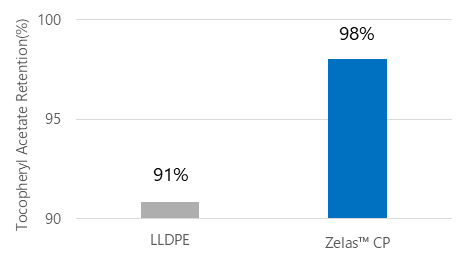
Figure 2. Comparison of tocopherol acetate residue rates in LLDPE and Zelas™ CP.
Test conditions: LLDPE and Zelas™ CP (CP208) extruded films; Target component: Tocopherol acetate (a derivative of vitamin E);
Storage conditions: 50°C for 2 weeks; Evaluation method: Quantitative analysis by HPLC (our company's evaluation).
For detailed information on the material properties of Zelas™ CP and its applications in containers and packaging, please see below.
Verify suitability under actual product conditions.
Even materials with low sorption properties may not exhibit the same level of low sorption for all active ingredients, formulations, and containers/packaging. When selecting materials, it is important to evaluate the compatibility between the contents and the container/packaging material, taking the following conditions into consideration.
- The active ingredients and their concentrations
- Actual prescription
- Storage temperature/storage period
- Container and packaging form and structure
- Materials and components that come into contact with the contents
The general performance of materials and test results using model components provide useful information when considering candidate materials. However, for the final decision on whether to adopt a material, it is important to fill it with actual contents into actual containers and packaging and confirm its suitability under expected storage conditions.
Summary | If the active ingredient decreases, the container and packaging materials should also be considered as a possible cause.
When a decrease in the active ingredient is detected during a storage stability evaluation of a quasi-drug, the decomposition of the active ingredient itself is not the only possible cause.
- The decrease in active ingredients can be attributed to several factors, including changes in the ingredients themselves, interactions during the prescription process, and interactions with containers and packaging materials.
- Adsorption to containers and packaging materials can sometimes reduce the concentration of active ingredients in the contents.
- Depending on the cause, it is important to consider countermeasures not only from the perspective of prescription but also from the perspective of selecting container materials.
In particular, if no problems were found during formulation review, but a decrease in the active ingredient was confirmed in storage tests with actual containers and packaging, or if there were differences in the remaining rate of the active ingredient depending on the type of container, it is important to also check the interaction between the contents and the container material.
Frequently Asked Questions (FAQ)
Q1. If the amount of active ingredient has decreased, can we assume that this is due to sorption to the container?
No. There are various possible causes for the decrease in active ingredients, including oxidation, decomposition due to light and heat, interaction with other ingredients in the formulation, and analytical factors. Adsorption to the container should also be considered as a possible cause, and it is important to evaluate it separately from other factors.
Q2. Are all lipid-soluble active ingredients easily adsorbed onto container materials?
High lipophilicity alone does not guarantee sorption. Adsorption behavior varies depending on the properties and concentration of the components, the formulation, the type and structure of the container material, temperature, and contact time. The incorporation of components into polyolefins involves distribution between the components and the material, as well as diffusion into the resin.
Q3. If sorption to a container is suspected, how can it be confirmed?
For example, one method is to store the same contents in different container materials and compare the retention rate of the active ingredients. In addition, to distinguish whether the ingredients have decomposed or migrated to the container material, the evaluation should include decomposition products and migration to the material as needed.
Q4. Can Zelas™ CP prevent the sorption of the active ingredient?
Zelas™ CP is a low-adsorption resin that we propose as an option to suppress the adsorption of components to container materials. In our evaluation using tocopherol acetate (vitamin E derivative), it shows a higher retention rate of active ingredients compared to PE.
However, this does not guarantee the same effect for all active ingredients and formulations. It is important to evaluate suitability with the actual contents and container, taking into account the target ingredients, formulation, storage conditions, and container specifications.
Points to note when implementing
When applying low-adsorption materials such as Zelas™ CP to containers and packaging, it is important to confirm their suitability with the actual contents and container, taking into account the active ingredients, formulation, storage conditions, and the form and structure of the container and packaging.
Please note that it may take time to confirm the compounding composition, raw materials used, and compliance with regulations in various countries for your compound products. When considering the adoption or evaluation of materials, please share the necessary specifications, applications, and regulatory information in advance.
This article is intended to provide general technical information and does not guarantee suitability for specific products or applications, nor does it guarantee compliance with laws and regulations. When actually applying this information, please check the latest laws, standards, and public guidelines, and evaluate and judge its suitability at your own responsibility.
A decrease in the content of the active ingredient was confirmed in the storage stability evaluation.
If you are considering interactions with containers and packaging materials, please contact us.
Based on the target ingredients, formulation, storage conditions, and container/packaging structure, we can advise you on how to assess the possibility of sorption, select materials, and evaluate suitability. We also accept inquiries regarding the material properties of the low-sorbability resin "Zelas™ CP" and its application to containers and packaging.
References
[1] Ministry of Health, Labour and Welfare
"Questions and Answers (Q&A) Regarding the Handling of Approval Standards for Quasi-Drugs, etc." June 28, 2021
https://www.mhlw.go.jp/content/000797742.pdf
[2] “Sorption of Flavors into Food Packaging Materials.” Foods & Food Ingredients Journal of Japan, 216(1), 41-45 (2011).
[3] “Flavor Scalping in Packaged Foods: A Review.” Molecules, 31(8), 1358 (2026).
[4] “Effects of Added Lower Alcohols on Solubilized Tocopherol Acetate Sorption to Polyethylene Film in Aqueous Solution.” Chemical and Pharmaceutical Bulletin, 44(1), 196-200 (1996).
[5] “Visualization of Tocopherol Acetate Absorbed Inside Laminated Films by a Matrix-assisted Laser Desorption/Ionization-imaging Mass Spectrometry.” Food Science and Technology Research, 21(6), 821-826 (2015).
[6] "Interaction between bromhexine hydrochloride and polyethylene film in solid dosage forms (Part 1): Effect of water content in solid dosage forms on drug sorption," Journal of Pharmaceutical Sciences, 109(12), 943-948 (1989).
[7] "Toothpaste composition and method for suppressing the adsorption of isopropylmethylphenol to a container in a toothpaste composition" JP2020196767A
[8] "Articles containing cosmetics" JP5948153B2